
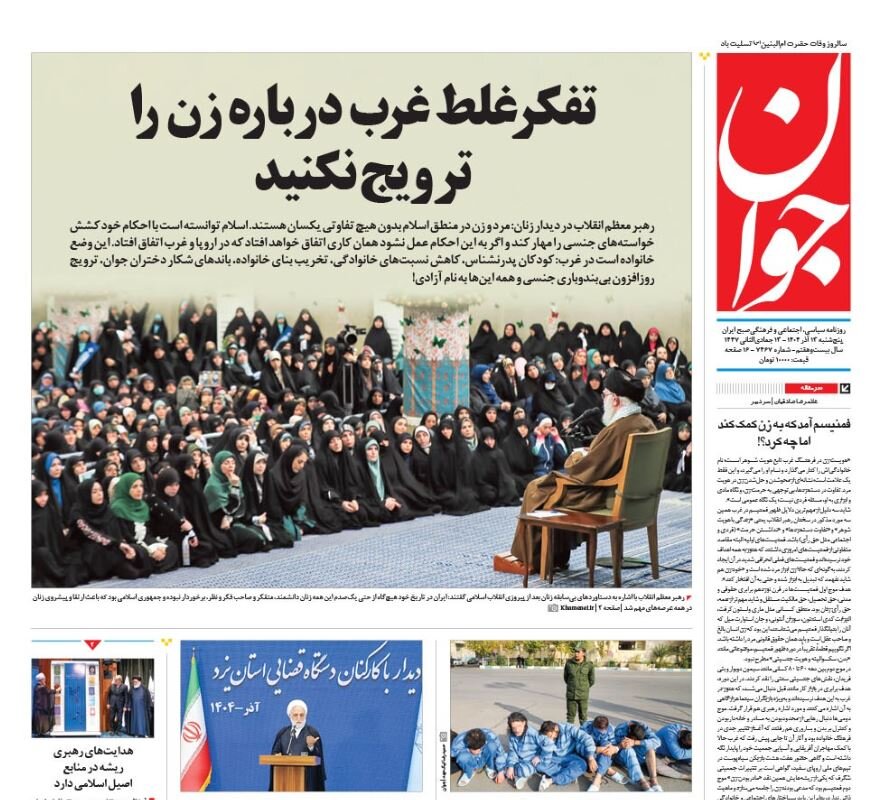
TEHRAN – In his commentary, Mr. Jawan emphasized the importance of a strong and innovative Sahand 2025 exercise.
The newspaper argued that the exercise, hosted by the Islamic Revolutionary Guards Corps and involving member states of the Shanghai Cooperation Organization, has strategic importance and shows that Iran is actively shaping both regional and transregional power relations. The Shanghai Organization’s participation reflects a shared understanding of the dangers and the need for collective action at a time when regional terrorism led by the Zionist regime is expanding and threatening the entire region. Additionally, the exercise will strengthen mutual understanding of interests and threats between SCO member states, paving the way for deeper political and economic ties as well as cooperation and investment in energy projects and transmission routes, including the North-South Corridor. The exercise, with the slogan “a comprehensive effort to fight terrorism”, shows that Western attempts to isolate the Revolutionary Guards have failed. This shows that countries around the world, especially those with anti-Western orientations, will not be swayed by US policy and will cooperate with the Revolutionary Guards within the framework of collective security.
Siasate Ruth: America’s threat is limitless
In his analysis, Siasat-e-Roos referred to America’s renewed insistence on destroying Iran’s nuclear facilities. The paper wrote: Despite evidence that Washington is trying to overcome Tehran’s resilience in the face of nuclear ambiguity and force it to reveal the status of its bombed nuclear facilities, the US has recently again raised the issue of destroying Iran’s nuclear infrastructure. After suffering a crushing defeat in the 12-day war with Iran, the United States is now working to construct a narrative to project unilateral power while concealing the costs incurred by itself and the Zionist regime. At the same time, the U.S. government is forcing IAEA inspectors into Iran’s nuclear facilities through sanctions and threats, paving the way for new military attacks. Through humiliation, it aims to force Iran to “zero enrichment” and dismantle its missile capabilities. Therefore, justifying new military attacks on other countries under the guise of “peace through war” is also part of this plan. In this regard, the Trump administration’s Secretary of State in June once again mentioned the US invasion of Iran and reiterated its insistence on destroying Iran’s nuclear facilities.
Etemad: Why did Turkish and Saudi diplomats visit Tehran at the same time?
Etemad commented on the simultaneous presence in Tehran of the Turkish Foreign Minister and the Saudi Deputy Foreign Minister. “The visit comes at a time when the region has re-entered a phase of geopolitical realignment, following a period of relative calm following the Gaza ceasefire and temporary easing of tensions,” the report said. The coincidence of Saudi Arabia and Turkey’s visit should not be interpreted as a sign of lasting convergence between the three countries, but rather as a reflection of the important needs of all three countries to prevent the outbreak of new conflicts. Each stakeholder faces a situation where a lack of dialogue could result in security and economic losses. Turkey is concerned that the conflict between Iran and Israel could upset the fragile balance in northern Syria. Saudi Arabia is concerned about the outcome of a possible war in Lebanon and the impact on energy security and investment. And Iran, under pressure from the United States and Israel, must maintain some level of engagement with regional countries to defuse external tensions. Seen from this perspective, the “tactical synergy” between the three countries is less about building a long-term cooperation mechanism and more about creating a breathing space for crisis management. Still, this level of synergy is important because it marks a return to the logic of regional diplomacy, one aimed at preventing unwanted wars.
Jam-e-Jam: Gulf emirates on a path of conflict
Jam-e-Jam investigated hostile statements by Arab countries against Iran on the southern coast of the Persian Gulf Cooperation Agreement. The paper pointed out that “(P)GCC has issued a harsh statement targeting our country.” Issuing such a statement under the current regional situation reveals that Persian Gulf sheikhs misunderstand Tehran’s neighborhood policy. The statement not only reiterates Abu Dhabi’s false sovereignty claims over Iranian territory, but also brazenly condemns Iranian military exercises and visits by senior commanders. In recent years, Iran has approached its relations with the Persian Gulf Arab states with restraint, especially in light of its efforts to mend relations with Saudi Arabia, despite the accusations and positions of (P)GCC member states. Nevertheless, the (P)GCC appears to be interpreting Tehran’s political reservations differently and moving toward confrontation with Iran. Meanwhile, the United States and the Zionist regime, seeking to recover from two years of war, are inciting the adventurous leaders of the Persian Gulf emirates against Iran, gradually pushing them into direct conflict with the Islamic Republic.