
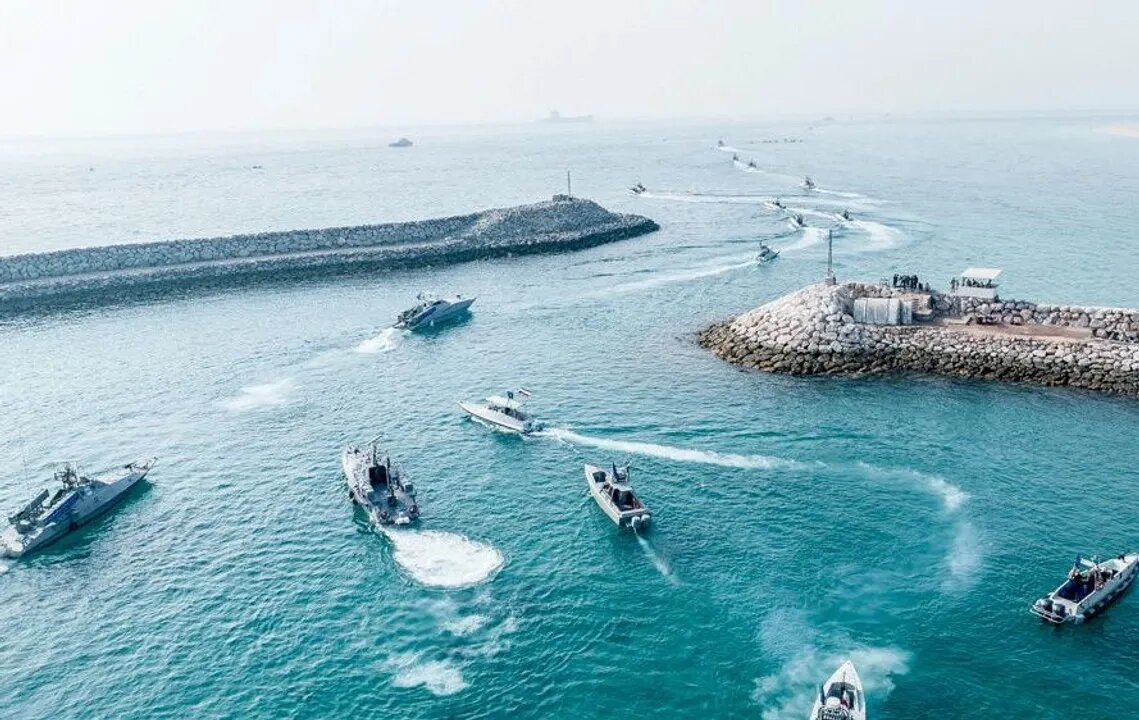
TEHRAN – The Islamic Revolutionary Guards Corps (IRGC) Navy has launched a major military exercise in the Persian Gulf, unveiling advanced AI-enhanced defense and attack systems in the country’s second major naval exercise since its war with the United States and Israel in June.
The exercise began on Thursday, with the Revolutionary Guards emphasizing enhanced intelligence readiness and the Navy’s determination and readiness to confront all threats. During the exercise, Revolutionary Guard naval units issued warnings to U.S. ships operating in the area, sending a clear message of deterrence.
Advanced air defense systems including Nawab, Majid and Misag platforms were deployed under electronic warfare conditions. Iranian military officials said the system used artificial intelligence to identify air and sea targets within seconds and attack them with high precision.
The exercise, codenamed “Shahid Mohammad Nazeri,” will span a wide area of the Persian Gulf, including the islands of Bu Musa, Greater Tunbu, Lesser Tunbu, and Siri, as well as the Strait of Hormuz and the Sea of Oman.
Nazeri, for whom the exercise is named, previously commanded the Revolutionary Guard’s Naval Special Forces and is best known domestically for his role in capturing 10 U.S. Navy sailors who entered Iranian waters on January 12, 2016.
During the exercise, advanced air defense systems including Nawab, Majid and Misag were also deployed in electronic warfare conditions.
In August, Iran’s navy demonstrated its formidable and expanding military capabilities during the Sustainable Power 1404 missile exercise in the strategic northern Indian Ocean and the Sea of Oman.
Rear Admiral Alireza Tansiri, commander of the Revolutionary Guards Navy, said his force maintains “continuous information dominance” across the Persian Gulf and systematically uses this surveillance during exercises.
“This exercise will involve underground, surface and aerial surveillance,” he said. “We have a persistent intelligence advantage, and we use it deliberately in exercises to set its path and direction and determine how operations should unfold.”
At the same time, Iran is seeking to strengthen its defense capabilities in all areas. Commander-in-Chief of the Iranian Armed Forces (Artesh) Major General Amir Khatami told members of parliament’s Planning, Budget and Accounts Committee on Thursday that Iran is “not wasting a moment” in building up its military capabilities.
Khatami said that protecting the Islamic Republic is inseparable from maintaining Iran’s independence and territorial integrity, adding: “The least harm to the Islamic system is harm to the independence and territorial integrity of our beloved country Iran.”
Referring to long-standing tensions with the United States and Israel, Khatami said hostility due to global arrogance has been going on since the 1979 Islamic Revolution and has intensified over time.
Referring to the recent 12-day war in June, he said Iran was negotiating with the United States when Israel suddenly launched attacks with American support. The June 13 Israeli attack killed senior Iranian commanders, nuclear scientists and civilians, Khatami said. More than a week later, the United States entered the conflict by bombing three Iranian nuclear facilities, he said.
Iranian forces retaliated by attacking strategic targets throughout the occupied territories and the largest US military base in West Asia, Al Udeid Air Base in Qatar.
Khatami said the attack on Iran was aimed at paralyzing Iran’s nuclear, missile and defense programs and eliminating key commanders as part of a broader effort to overthrow the Islamic Republic. He claimed that Iran “won the war” because its adversaries failed to achieve their objectives.
He went on to say that Israel views Iran as an existential threat. “After the war, we have not wasted a single moment in strengthening our defense capabilities and increasing our military preparedness. Getting stronger was our top priority.”
Iranian officials say the country’s military response has established a balance of deterrence, but analysts warn that any new confrontation could spread into the maritime domain, particularly into the Strait of Hormuz.
The narrow waterway at the entrance to the Persian Gulf is the world’s most important energy chokepoint. Approximately 20 percent of the world’s oil supplies (approximately 17-18 million barrels per day) pass through the strait, as well as large exports of liquefied natural gas, particularly from Qatar.
Experts have warned that any disruption could cause energy prices to soar and destabilize global markets. Some forecasts suggest that industries around the world are facing shutdowns within days due to fuel shortages, and that oil prices could rise by up to 80% within the first week of the shutdown.
Military officials in Tehran said Iran was closely monitoring US and Israeli military movements in the region. Officials have hinted that if fighting escalates, Tehran may consider restricting navigation through the Strait of Hormuz as part of its defense strategy.