
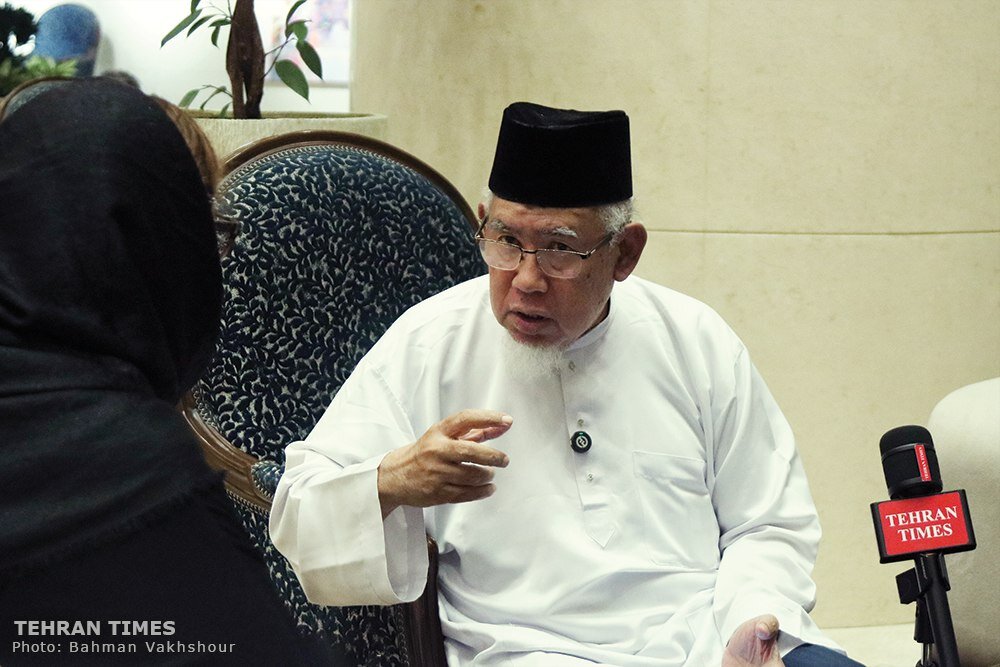
TEHRAN – On the sidelines of the conference on “People’s Rights and Just Freedoms in the Thought of Khamenei,” Tehran Times spoke with Mohd Azmi Abdul Hamid, Chairman of the Malaysian Consultative Council of Islamic Organizations (MAPIM), to discuss the evolving state of global justice, advocacy for Palestine, and the role of the Islamic world in confronting oppressive power structures.
Known for his outspoken positions on humanitarian crises and neo-colonial policies, Azmi offers candid assessments of Malaysia’s responsibilities, the shortcomings of Western human rights frameworks, and the growing moral awakening in the Global South and beyond. In this interview, he outlines a strategic path for stronger solidarity, principled foreign policy, and human-centered resistance to global injustice.
The text of the interview is below.
How can Malaysia step up its diplomatic and humanitarian support to Palestine and other oppressed areas?
Malaysia already has a strong moral and diplomatic record with respect to Palestine, but today’s climate requires upgrading that foundation to a more strategic and structured role.
Diplomatically, Malaysia can step up its support in various ways by building a coordinated Global South front for Palestine, along with Iran, Turkiye, Indonesia, South Africa, Brazil, and others. Resolutions at the United Nations and other multilateral forums will then become part of a bloc that rejects the normalization of genocide and occupation, rather than an isolated voice.
More aggressively pursuing legal measures, including support for litigation at the ICJ and ICC, would result in sanctions against companies complicit in war crimes and concrete diplomatic consequences for states that use Israel as arms and shields.
By institutionalizing Palestine as a permanent pillar of foreign policy, rather than an issue dependent on the personal inclinations of particular governments.
On the humanitarian side, Malaysia should develop a permanent humanitarian recovery mechanism for Gaza and all occupied territories, with government facilitation and NGO implementation, moving from ad hoc relief to long-term resilience.
We will use our credibility in the Islamic world and ASEAN to convene a regional humanitarian coalition that can negotiate more effective aid convoy access and protection.
Expand people-to-people programs such as scholarships, medical care, rehabilitation, and specialized training for Palestinians to ensure that humanitarian work not only helps them survive in emergencies, but also rebuilds their human capital.
The same approach should be extended to other areas of oppression, such as Kashmir, Yemen, Rohingya camps, and occupied or marginalized communities in South and West Asia. Malaysia has the advantage of being seen as less threatening and more independent. That position should be used more boldly.
What are the main challenges you face in mobilizing support for the Palestinian cause within Malaysia and internationally, and how do you overcome political, social and diplomatic constraints?
The main challenge within Malaysia is not sympathy. Malaysians are overwhelmingly pro-Palestinian. The challenge is to maintain that commitment beyond moments of anger. People can become fatigued and local economic issues can narrow their focus. We must constantly educate that Palestine is not just a foreign issue. It is a moral mirror of the world order and a test of our own integrity.
Internationally, there are three major constraints:
-Securitization of Palestinian activities. In some countries, clearly siding with the Palestinians is quickly equated with extremism and terrorism, even if that position is clearly humanitarian and legal.
– Western media coverage that criminalizes Palestinian resistance and frames Israeli actions as self-defense is dominant, making our claims appear to go against the so-called mainstream.
-The diplomatic caution of many governments that are privately sympathetic to Palestine but fear the economic or political repercussions of taking a firm stand publicly.
We deal with these pressures in several ways.
First, we anchor our story in international law, human rights treaties, and fundamental humanitarian principles so that even those who do not share our religious framework can understand the legitimacy of our position.
Second, we build coalitions across ideological lines. We work with Christian organizations, secular human rights organizations, trade unions, student organizations and movements in the Global South. Palestine is not just a concern for Muslims. It is the front line of the global fight against apartheid and impunity.
Third, we use people power as leverage. Mass mobilizations, boycott movements, and ongoing campaigns in universities and professional circles are creating new political costs for governments that continue to defend Israel. In this sense, the streets and civil society become unofficial diplomatic forces.
From your perspective, what are the most pressing challenges to “people’s rights and legitimate freedoms” in South Asia and the Middle East, and how does the framework proposed at this conference (rooted in Islamic principles) offer a better response than the Western human rights model?
The most pressing challenge is the separation of state power from moral responsibility in many countries. The same pattern is found in occupied territories, authoritarian states, and majoritarian democracies. Security language is used to quash dissent. Laws are weaponized to silence minorities. Media is controlled or manipulated. South Asia and the Middle East are witnessing a dangerous fusion of ethno-nationalism, sectarian manipulation, and geopolitical interests. This results in the systematic denial of the rights of women, especially Muslims, minorities, refugees, and vulnerable groups.
Although the Western human rights model has provided some important tools, especially after World War II, it actually has three significant weaknesses.
Applied selectively. Powerful states and their allies are often exempt. Palestine is the most obvious example.
It is highly individualistic and often ignores structural injustice, economic exploitation, and historical oppression.
Because it is disconnected from any grounded metaphysical and moral anchors, it is easily bent to political fashion.
The Islamic framework proposed at this conference does not negate the text of the rights. Instead, deepen it and fix it.
Islamic principles begin with the idea that human dignity is conferred by Allah, not by nation, race, or ideology. Rights arise from this divine dignity and are balanced by duties. Maqasid al-Sharia provides a consistent structure for the protection of life, faith, intelligence, family, property, and honor. Justice is not a slogan. It is a sacred duty that applies to rulers and ruled, friends and enemies alike.
This framework insists on consistency and rejects hypocrisy, so you can respond better. You cannot condemn one profession and justify another.
It integrates social and economic justice with civil and political rights. Poverty, usury, exploitation and environmental destruction are all human rights issues.
It recognizes communities and nations, not just isolated individuals, as moral beings. Collective rights such as self-determination, protection from genocide, and cultural survival are central.
In short, Islamic principles do not abolish human rights. They rescue human rights from double standards and moral emptiness.
What do you make of the world’s reaction to the ongoing Israeli war in Gaza, especially the widening gap between Western public opinion and Western governments?
What we are witnessing is historic. For the first time on such a scale, Western public opinion, particularly among young people, minority communities, and many ordinary citizens, is openly defying their government regarding Palestine. Millions marched in cities such as London, Paris, New York and Madrid. Academic societies, professional associations, artists, and even some churches are speaking out loud and clear.
At the same time, Western governments continue to provide Israel with political asylum, weapons, and diplomatic protection while talking about largely empty humanitarian concerns. This gap highlights the crisis in Western democracy itself. When a majority of the population no longer trusts its leaders on the most basic moral questions of life and death, the legitimacy of the system is undermined.
Several factors explain this change at the public level.
Social media has broken the monopoly of mainstream media. People are seeing children killed, hospitals destroyed, and dehumanizing language in real time.
Many Westerners are already disillusioned with Iraq, Afghanistan, Libya, and the blatant hypocrisy in the administration of international law. Gaza is the point where patience has reached its limit.
New alliances are emerging at the intersection of Palestine and other struggles such as Black Lives Matter, anti-colonial movements, and economic justice.
For those of us in the Global South, this moment is important. This shows that the West is not one block. There are ruling systems that protect imperial interests, and some societies are beginning to ask deeper questions. Part of our task is to build bridges with the conscience of the West and turn moral outrage into long-term political pressure.
How do you assess Iran’s role as a strategic actor in West Asia today, especially in forming alliances with non-Arab regional players?
Whether you agree with all their policies or not, it is undeniable that Iran has emerged as one of the few states openly challenging Zionist and American hegemony in the West Asian region. It has paid a very high price for its stance through sanctions, isolation, and constant threats, but it has not abandoned its fundamental position on Palestine and the resistance.
Iran’s importance lies in several aspects.
First, it has brought strategic depth to the axes of resistance in Palestine, Lebanon, and elsewhere, changing the calculus of those who once believed that military rule would be easy and without consequences.
Second, Iran is fostering relationships with non-Arab actors such as Russia, China, and various movements in Latin America and Africa, contributing to the formation of a more multipolar order. This is painful for Western planners who prefer regions with weak and docile regimes.
Third, Iran’s insistence on a path to independence, including in science and technology, shatters the myth that the only possible path for an Islamic state is complete submission to Western security and economic frameworks.
At the same time, I believe that countries such as Iran, Malaysia, Turkiye, Indonesia, Pakistan, and Qatar need to move beyond parallel efforts to more coordinated political and economic strategies. The future of West Asia and the wider Islamic world depends on whether these countries can work together despite their differences and present a credible alternative to the current ruling structures.
What role should Southeast Asian leaders play in resisting neocolonialism and promoting regional cohesion?
Southeast Asia is often viewed as economically dynamic but politically cautious. Historically, however, the region has strong memories of anti-colonialism, from struggles against the Dutch in Indonesia and the British in Malaya to the American war in Vietnam. Neocolonialism today is more subtle. It works through debt, unfair trade, military coordination, digital dependence, and narrative control.
Southeast Asia’s leaders must play several important roles.
They should refuse to be used as proxies or bases for conflicts between great powers that have nothing to do with the well-being of their peoples. The region cannot tolerate a new Cold War that turns ASEAN into a chessboard for other countries.
The economic weight of ASEAN and Muslim-majority countries such as Indonesia, Malaysia, and Brunei should be used to promote fairer trade, fairer financial arrangements, and stronger South-South cooperation with West Asia, Africa, and Latin America.
Rather than hide behind neutrality when basic justice is at stake, we should articulate clear moral positions on global issues, especially Islamophobia in Palestine, the Rohingya, Kashmir, India and elsewhere.
We should also invest in building people-centered regionalism, where civil society, youth, academics, trade unions, and NGOs in Southeast Asia and West Asia can come together, strategize, and act together.
In other words, Southeast Asian leaders need to understand that neutrality toward injustice is not stable. It is a slow surrender of moral authority. True stability comes when a region becomes self-reliant, protects its dignity and builds solidarity with other oppressed peoples.