
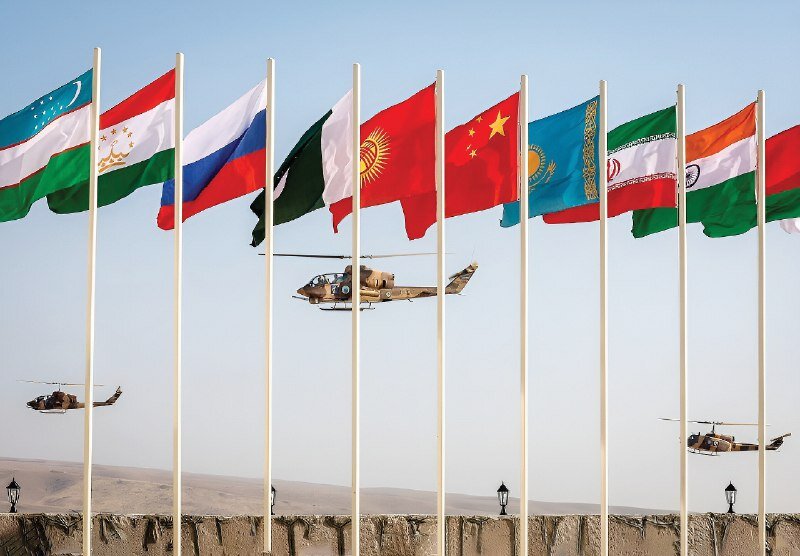
TEHRAN – Islamic Revolutionary Guards Corps (IRGC) ground forces have ended hosting a five-day multinational military exercise on Iranian territory. The exercise served as an exercise in sending a political message not only to terrorist groups in the region, but also to Western powers seeking to isolate and stigmatize the troops.
The exercise, codenamed Sahand 2025, brought together troops from across the Shanghai Cooperation Organization (SCO) from December 1st to December 5th. All 10 countries of the Shanghai Cooperation Organization (China, Russia, Kazakhstan, Kyrgyzstan, Tajikistan, Uzbekistan, India, Pakistan, Iran, and Belarus) sent troops or representatives, and Saudi Arabia, the Republic of Azerbaijan, Oman, and Iraq sent observers.
The exercise was mainly conducted at the Imam Zaman Mechanized Brigade base in Shavester County, located in East Azerbaijan province in northwestern Iran.
Tactical commanders interviewed by the Tehran Times said the training included complex multi-step operations designed to simulate real-world threats.
The exercise consisted of four main stages. Intelligence units conducted precise surveillance to identify simulated enemy movements. Drone units carried out targeted attacks against identified locations. Helicopter units conducted air strikes to neutralize the threat in depth. Special forces carried out a rapid heliborne insertion to free hostages captured by mock “white elements”. And finally, the team conducted a final area clearance operation to establish lasting security. During the exercise, weapons and military equipment from participating countries were displayed.
Maj. Gen. Mohammad Pakpour, the commander-in-chief of the Revolutionary Guards, said Iran’s vast presence is a “source of pride” and a symbol of “deep strategic cooperation.” He stressed that Iran is ready to share its hard-earned counterterrorism experience with partner countries “without restriction.”
Analysts and field commanders hailed the operation as a military success. However, another important aspect of the training was the rhetoric surrounding it, emphasizing common purpose, mutual respect, and a collective position against unilateral Western dictates.
“Independent countries are determined to protect themselves from an unjust world order,” Iranian Parliament Speaker Mohammad Baqer Qalibaf said on the first day of the exercise.
Regarding Iran and the role of the Revolutionary Guards, analysts noted that the Sahand exercise showed that Western attempts to discredit the Revolutionary Guards have had little success.
The United States designated the entire Revolutionary Guards as a foreign terrorist organization (FTO) in 2019, the first time an official part of another government has received such a designation. Canada followed suit, and Australia last month became the latest Western country to blacklist the Revolutionary Guards. A similar designation is being advanced in the United Kingdom and the European Union, primarily by pro-Israel Zionist groups. Western countries say Iran should stop supporting resistance groups fighting Israeli occupation and aggression across West Asia.
The blacklisting has not affected the development of Iran’s armament and defense capabilities, as it has been building its domestic military industry over the past four decades. But it appears to have pushed the country deeper into alliances with non-Western countries, which are increasingly at odds with the West over unilateral measures. For example, Russia is currently at war with the West in Ukraine, and China is locked in a dispute with the West over the sovereignty of the breakaway state of Taiwan. There is a risk that a military conflict will eventually occur in Taiwan as well. India, too, finds itself increasingly estranged from the West over economic and trade issues that may eventually spill over into the military sphere.
In comments to the Tehran Times, Iran’s Deputy Foreign Minister for Justice and International Affairs Kazem Gharibabadi said that Iran’s hosting of the Sahand exercise was an action for “coordination and coalition building in line with a new architecture for regional security.”
“The Islamic Republic of Iran is one of the main victims of terrorism and has been at the forefront of the fight against terrorism, gaining valuable experience in confronting it in all its forms and sizes. In this regard, we have provided a platform for the transfer of experience and synergistic exchange among the SCO member states,” he explained.