
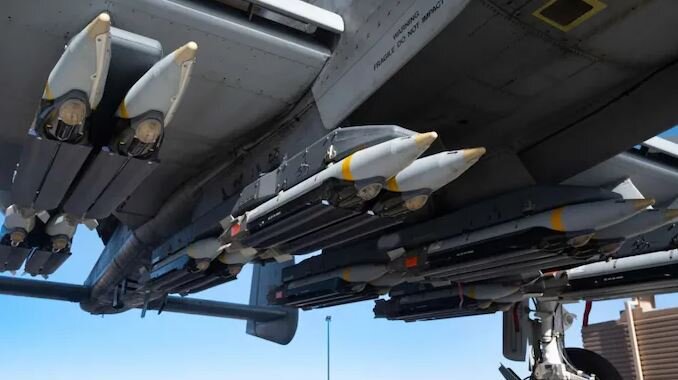
TEHRAN – Lebanese media reported that the Lebanese resistance movement Hezbollah has provided its ally Iran with images and parts for the latest U.S.-made GBU-39B bomb.
Following the Israeli regime’s assassination of senior Hezbollah commander Haysam Ali Tabatabai last month, a GBU-39 smart small-diameter bomb reportedly failed to detonate. Hezbollah’s security forces reportedly sprang into action, photographing the bomb, defusing it, and sending the necessary electronic components to Iran for reverse engineering. This development has reportedly concerned Washington, which has since demanded that the Lebanese government return the remains of the bomb to the United States.
The report also revealed that US fighter jets used a gigantic GBU-57 bunker buster bomb weighing 13 tons during an attack on Iran’s nuclear facilities in June 2025. One such bomb reportedly failed to detonate and then fell into the hands of Iranian Ministry of Defense experts. Later, Iranian intelligence sources confirmed that the Iranian government had successfully reverse engineered the giant weapon.
Iran has reportedly cloned the giant GBU-57 bomb, but its 13-ton weight limits its widespread use. Iranian Ministry of Defense sources suggest that access to the lightweight GBU-39B bombs (weighing about 100 tons) provided by Hezbollah is more important to Iran’s missile doctrine. Iran reportedly intends to incorporate the bomb’s penetration and guidance technology into ballistic missile warheads.
Iranian military engineers have reportedly successfully designed a warhead similar to the GBU-57 intended for installation on the “Fattah” hypersonic/ballistic missile (1,400 km range). In addition, a more modern version of the Khorramshahr-4 missile (2,000 km range) is under development. Field tests have shown that Iranian warheads can penetrate reinforced concrete and underground fortifications to depths of up to 20 meters, while the American version reportedly achieves penetration depths of up to 60 meters.
Most of Iran’s military equipment is produced domestically. Some of its designs are now being copied by other countries, and the Shahed-136 drone is one of the most copied weapons by several major arms manufacturers, including those in the United States. However, the Iranian government has also reverse-engineered captured U.S. weapons, such as a Lockheed Martin RQ-170 drone that it shot down safely over Iranian territory through cyber warfare in 2021.
Since the United States and Israel attacked Iran in June, the country has focused on closing the military gap and further evolving its most important defense tool: missiles. These missiles wreaked havoc in the occupied territories for 12 days before forcing Israel and the United States to call for a ceasefire. Despite strict Israeli censorship, a large amount of footage has been released showing parts of Israeli neighborhoods completely in ruins. Israel maintains much of its military and intelligence infrastructure within crowded areas.
Neither Iranian nor Hezbollah officials have mentioned the rumored bomb shipment. But the US government’s demands for the government to return the weapons sparked outrage in Lebanon, with citizens pointing out on social media that they wanted the US to “shamelessly” return the unexploded ordnance to the Lebanese so it could be used to kill more people.
According to Hebrew-language media, Pentagon officials viewed the situation as “sensitive” and noted that even partial access to the bomb’s internal components could expose the design methods the United States relies on to support modern offensive weapons.
An American military blog describes the GBU-39 as a lightweight air-launched weapon that has been converted into a precision-guided bomb. Utilizes GPS-assisted inertial navigation to enable precise attacks from long range.