
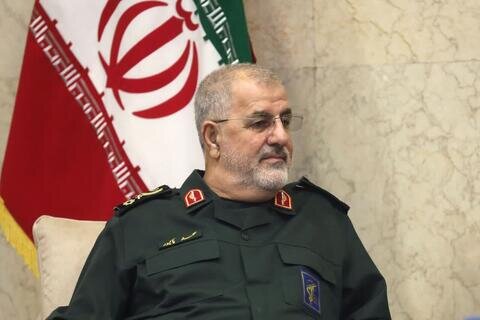
TEHRAN – The commander of Iran’s Islamic Revolutionary Guards Corps (IRGC) has declared that strengthening the country’s stealth missile technology is a key priority. He also warned that any new invasion by Israel would be met with an even harsher response.
Speaking at Tehran’s Imam Hussein (AS) University on Sunday, Major General Mohammad Pakpour said that Iran has thoroughly analyzed the recent 12-day war that Israel and the United States imposed against Iran in June. He described the conflict as a battle of technology, saying, “It is not only the Zionist regime that is confronting Iran, but rather the Americans, Europeans and many other countries are participating in this conflict, which means that Iran has effectively fought against the world’s technology.”
The commander emphasized that artificial intelligence was a “fundamental element” for both sides during hostilities. He insisted that the enemy understood the consequences of the provocation and said: “The enemy has made an assessment that it will not take such action.” Nevertheless, Pakpour stressed that Iran needs to strengthen its military preparedness and scientific development to counter the enemy’s own efforts to address and improve weaknesses.
He cited the Revolutionary Guard’s scientific centers, specifically Imam Hussein University, in his call for support in weapon advancement. He noted that the main focus must be on the missile’s stealth capabilities. Foreign Minister Pakpour emphasized, “If Iran can equip its missiles with stealth capabilities, it will be able to further increase the penetration rate of its missiles through the Zionist regime’s defense shield.”
Israel launched an unprovoked war against Iran on June 13, and more than a week later the United States attacked Iran’s nuclear facilities in a grave violation of international law. Iranian forces responded by attacking positions in the occupied territories and a major US military base in Qatar, eventually forcing a halt to their illegal attacks.
Senior Iranian commanders continue to warn that any new hostilities could trigger even stronger retaliation from the Islamic Republic.