
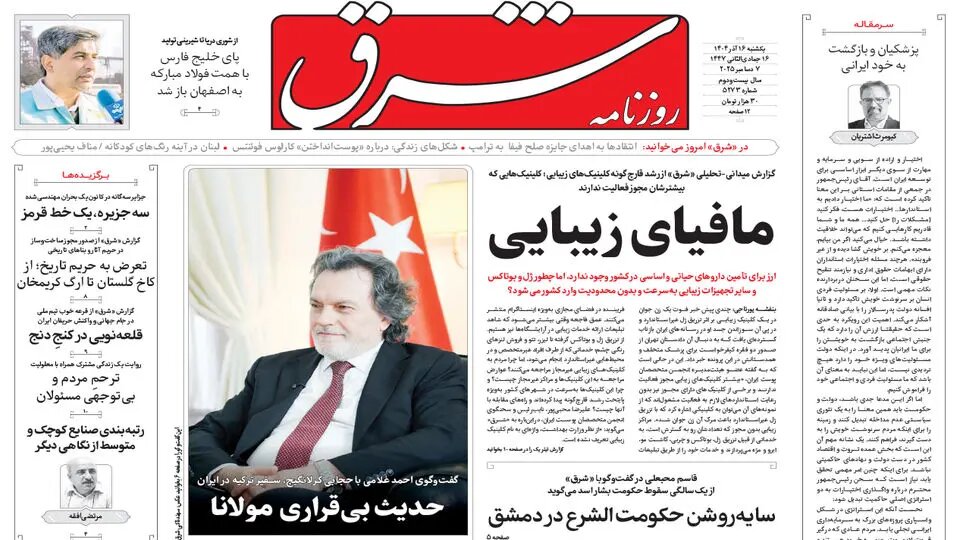
TEHRAN – In his analysis, Foreign Minister Shagh referred to Abu Dhabi’s threat to file a lawsuit against the Islamic Republic in The Hague over three Iranian islands in the Persian Gulf.
The paper argues that European support and “yellow flags” from China and Russia have escalated this long-standing conflict to unprecedented levels of tension. Experts stress that Iran must pursue two parallel paths. The first is “legal neutralization,” which prevents interpretations that suggest consent or willingness to negotiate over territorial integrity. Second, to dispel doubts about Iran’s de facto ownership, it seeks to “strengthen sovereignty on land” through an active presence on the islands, infrastructure development, and integration of political and economic functions. Current developments indicate that the issue of the islands is not simply a bilateral dispute with the UAE, but is part of a broader structure in the Persian Gulf security order. The new tensions highlight the reality that managing the conflict is impossible without actively redefining Iran’s role in the Persian Gulf.
Khorasan: Sending Iranian security message from Mashhad
In his commentary, Khorasan highlighted that Iran hosted the largest international gathering since the 12-day attack on the Islamic Republic by the Zionist regime (later the United States). According to the newspaper, 15 parliamentary delegations from some of Asia’s most influential countries attended the “Permanent Meeting of the Asian Parliamentary Political Committee” in Mashhad. The presence of so many delegations from East Asia to West Asia, from the Persian Gulf region to Central Asia and the northern tip of the continent demonstrates the Islamic Republic’s ability to maintain security and stability and points to the failure of Western policies aimed at isolating Iran. A notable outcome of the conference was that most delegates acknowledged that their perceptions of Iran had changed after their visit to Mashhad. The global media, largely controlled by the United States and large Zionist corporations, seeks to project Iran as a war-torn and unstable country. But regardless of the conference’s resolutions and agreements, the presence of parliamentarians, government officials, and influential figures from around the world will by itself have the greatest effect on neutralizing Western propaganda against Iran.
Jam Jam: Two exercises with strategic messages of power and deterrence.
Jam-e-Jam wrote about two recent drills by Iran. Recently, the Islamic Revolutionary Guard Corps began large-scale naval exercises in Iran’s southern waters, while Iran also hosted joint land-based counterterrorism exercises with Shanghai Cooperation Organization (SCO) member states. Together, these two operations conveyed strategic messages about strength, deterrence, and Tehran’s central role in the emerging regional order. In coordination with international partners, Iran has demonstrated military capabilities not only on the high seas but also on its own territory. This combination of “sea and land” will strengthen Iran’s deterrent capabilities. The exercise showed that Iran is part of a broader security and political bloc. It is an alignment with global importance that can increase Tehran’s importance in the international equation. Iran’s focus on the Strait of Hormuz and its strategic southern islands underscored its readiness to influence key oil and energy routes, one of the pillars of power that could serve as a lever for pressure. Finally, with long-range missile launches and a show of regional security solidarity, Tehran warned the United States, Israel, and any forces seeking to blackmail Iran that any new aggression or pressure would be accompanied by a “determined, multipronged response.”
Mr. Etelert: “Not negotiating” is part of negotiation.
International affairs analyst Amir Ali Abolfas reflected on the ambiguous diplomatic situation between Iran and Western countries in an interview with Etelat. He claimed that Iran and the United States are currently in a negotiating position. The issue is not whether negotiations are taking place, but rather that no agreement has been reached. Officials insist the two sides are not negotiating, but five rounds of indirect talks were held earlier this year, with a sixth round scheduled for two days before Israel’s military attack on Iran. Still, diplomacy continues through the exchange of messages. He stressed that Iran’s “we will not negotiate” statement itself is part of the negotiation process. The challenges and crisis imposed on Iran by sanctions are so severe that the country must find ways to adjust its diplomatic and economic relations to the new reality, even as it is cut off from the West. What is clear and undeniable is that Iran is facing multiple economic crises that could spill over into a social crisis and intensify internal divisions. Therefore, the governance system needs to take seriously a total policy review so that the problem starts to diminish.