
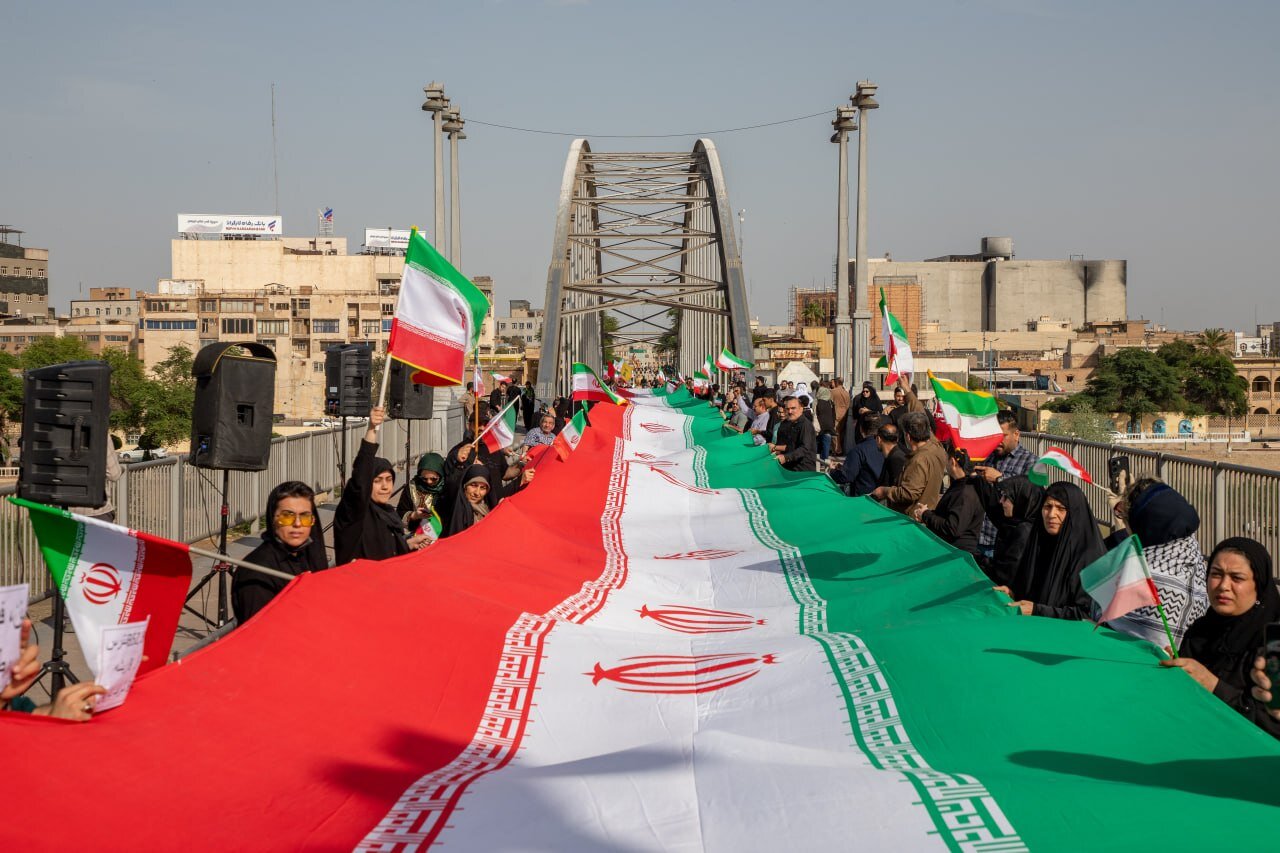
TEHRAN – U.S. President Donald Trump has repeatedly and unflinchingly threatened to commit massive war crimes against the Iranian people, an act that not only harms the Iranian people but also seriously undermines the interests of America’s Arab allies in the Persian Gulf and will prompt the Iranian government to take further actions to restrict the flow of oil out of West Asia.
At a press conference held to explain what the United States called a “historic rescue mission” for two expelled airmen on Iranian territory – but which Iranian media described as a failure of a larger operation – President Trump said he would destroy Iranian bridges, power plants and other civilian infrastructure if Iran did not accept defeat in the unpopular war by midnight Washington time by midnight Tuesday.
“The plan is that by military force, by 12 o’clock tomorrow night, every bridge in Iran will be destroyed, every power plant in Iran will be set ablaze, exploded, and never be used again,” he said at a press conference on Monday, which was also attended by the army chief and the chairman of the Joint Chiefs of Staff. Trump added: “That means we’re going to completely destroy it by 12 o’clock. It’s going to take four hours.”
“Do I want to destroy their infrastructure? No,” he said. “Now it will take them 100 years to rebuild. If we leave today, it will take 20 years to rebuild their country, and it will never be as good as it was before. And the only way they can rebuild the country is by harnessing the genius of the United States of America.”
Over the past five weeks, the United States and Israel have primarily attacked Iranian civilian infrastructure, hospitals, universities, schools, and residential buildings. Early Tuesday morning, they attacked multiple parts of Iran’s vast railway network, several major highways connecting major cities, and a synagogue in central Tehran.
Reporters at Monday’s briefing did not press the president on the outright illegality of his threat to take Iran “back to the Stone Age.” Only one or two people mentioned President Trump’s claim that the bombing campaign was aimed at “liberating” the Iranian people and asked how that could be accomplished by stripping Iranians of electricity. However, they fell silent when President Trump responded that he wanted the US to continue attacking Iran, saying that the Iranian people were “willing to suffer for the sake of freedom.”
Reporters also didn’t seem alarmed by the president’s comments about wanting to get his hands on Iranian oil, referring to Iranian resources as potential “spoils” of war.
Most of the questions concerned soaring U.S. gasoline prices due to Iran’s restrictions on navigation in the Strait of Hormuz. There were also questions about whether the United States intends to expand its invasion by sending ground forces to Iran.
President Trump’s war against Iran appears to have been launched on the assumption that Iran’s political system would collapse within days of the February 28 assassination of Iranian leader Seyyed Ali Khamenei. Instead, the Islamic Republic has proven its resilience, imposing staggering costs on the United States, Israel, and its Arab allies who made the invasion possible. Iran has been attacking U.S. military bases across West Asia, rendering about 70% of military facilities inoperable. They bash Israel every day. and prevent ships belonging to or affiliated with the United States and Israel from sailing through the strait.
Both the United States and Israel have censored the damage and casualties of their wars through harsh repression of the media and their citizens. But the economic damage caused by the Hormuz situation, through which more than 20% of the world’s energy and a third of the world’s fertilizers passed, could not be hidden, despite massive US market manipulation. In the United States, gas prices rose 35% and food prices rose 6%. Energy prices are also rising in Europe and East Asia, and food prices are likely to rise significantly in the coming months as planting season approaches.
Iran’s restrictions on the Strait of Hormuz (which President Trump reportedly dismissed as impossible before the war) and the U.S. government’s inability to forcefully open the Strait of Hormuz are the main obstacles preventing President Trump from halting the failed attack and declaring victory. Iran is likely to maintain control of the strait even after the war ends.
President Trump’s recent expletive-filled threats, calling on Iran to open the Strait or “disappear” as a nation, reflect this frustration. According to sources who spoke to Al-Mayadeen, President Trump has been in contact with Iran through various intermediaries while simultaneously threatening the country. But his call for a ceasefire was called “illogical” and “clumsy” by Iranian authorities, who instead submitted their own 10-point peace plan to mediators. According to the IRNA report, the plan calls on the United States and Israel to cease all aggression against Iran and its allies in the region, lift economic sanctions against Iran, respect its right to enrich uranium for civilian purposes, pay reparations and recognize Iran’s new undisputed control of the Strait of Hormuz. Even if the United States and Israel increase their crimes, Iran is unlikely to withdraw these demands.
If President Trump escalates his attacks on Iranian infrastructure, it will cause widespread damage not only to Israel but also to Washington’s Arab allies in the Persian Gulf as well. Iran has responded to similar threats in the past by saying it would “plunge the region into darkness.”
The Iranian government has previously attacked gas and petrochemical infrastructure in the region in retaliation for attacks by the United States and Israel on its companies and gas fields. Both Israel and countries in the Arab region rely on a limited number of power plants and desalination plants to meet the needs of their populations. By contrast, Iran has more than 200 power plants scattered across the country and relies on desalination for just 5% of its water for civilian use.
In response to President Trump’s latest war crimes threat, the Islamic Revolutionary Guards Corps (IRGC) said it would expand the war “beyond the region.” Analysts believe this is probably a warning that Iran will rely on its Yemeni allies to restrict the flow of oil through the Bab el-Mandeb Strait, which will further exacerbate the global energy supply crisis. The Revolutionary Guards said in a statement that it would strip the United States and its allies of rights “for many years” in the coming years.
In a separate statement, the Revolutionary Guards warned Arab states in the region that allow the use of their airspace and land for attacks against Iran that Iran has so far exercised considerable “restraint” in its attacks on Persian Gulf Arab states and has only carried out attacks in kind. He added that he would “abandon all restraint if necessary.”
In a related development, Handara Cyber Group, which is close to resistance forces, announced on Tuesday night that it had gained full access to and handed over to Iran all data related to Israel’s sensitive election infrastructure, which it said was now held by a standby missile force.
*************** Caption: US President Donald Trump said at a press conference on April 6, 2026 that he would “blow up” the entire country if Iran did not accept defeat. American reporters seemed unconcerned by his threats.