
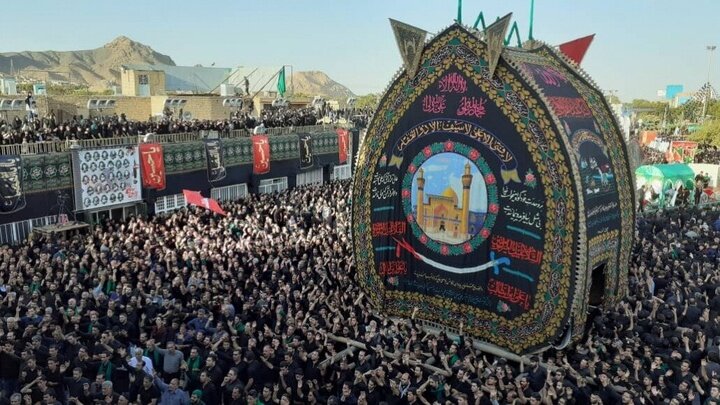
Tehran – When Muharam arrives, the Iranian cultural calendar takes on a different colour. Rituals are born, traditions are revived, and nations discuss each other in a common language called ashura, which stretches beyond geographical boundaries.
Muharam is not only a religious ritual, but also a medium in which Iran presents the world with a humanitarian, spiritual, ethical and justice-oriented face in the form of art, ritual, ritual and popular participation, Milas Alia (CHTN) writes.
Every year, Muharram guides the true manifestation of Shia culture. It resonates with Iran through similar rituals, including Iraq, Lebanon, Pakistan, India, Azerbaijan, Turkey, and even Shia communities in Europe and North America. This cultural harmony has shaped the direct diplomacy that has become one of the most important tools of Iran’s soft power.
Muharam is a mirror that reflects Iranian culture, art, history, literature and customs. This mirror also influenced other countries with different languages and traditions. They gather around a general message named “Hossein (AS).”
Transnational cultural connections
From the pilgrimage of Albain in Iraq to the lamenting rituals of Karachi and Kashmir, to the performances of Sajie and Berlin’s Tajie (Passion) to the Nakurgardani (Passion Carrie) in Yazd and Tabas (Passion Carrie), Ashura is a cultural ties that has evolved into a historical network that traverses the historical network of Israo.
Iran plays a prominent role as a centre for the production and transfer of these habits. The Iranian structure for mourning uses the language of art.
In recent decades, an important part of the world society, especially in the countries of the region, has come to know Iran during Muharam through religious and cultural rituals.
Muharam has become a tool for cultural cooperation and civilized dialogue.
Tajie
One of the brightest cultural symbols of Iranian Muharam is the performance of Tajiye. It is an art rooted in oral tradition, but combined with theatrical, musical, dramatic, literary elements. Today, Taziers are performed in cities such as Paris, Rome, London, Istanbul and Beirut in a variety of languages adapted from Iranian models. Tajie’s performance is a tool to showcase Shia culture and the grand spirit of Asura, presented in an art form that is understandable to other countries.
Mookebs
Mookeb is a service center with a religious nature that brings together Shiite Muslims and performs religious rituals during Arba’een. Iranian mook is another ability of cultural diplomacy. Mookebs shows the Iranian and Islamic lifestyle. This shows a style that is at the highest level of hospitality, simplicity, kindness, politeness, hospitality and respect for pilgrims.
These actions also had a positive impact among non-Iranian pilgrims. In the public conversation, many pilgrims from Arab and European countries mention the “Iranian processions” as the most memorable part of their trip. A place where they were familiar with Iranian culture, food, customs and manners.
In recent years, coverage of Iranian Muharam rituals in international media has increased dramatically. Networks such as Al Jazeera, France 24, RT, and BBC Arabic specifically cover mourning matrices, Nakhl Gardani (Palm-Carrying) rituals, Tazieh, and matrices. In these media reports, Iran is presented as a country with a deep-rooted religious, spiritual and popular culture. These stories are in complete conflict with the negative portrayal of Iran by several Western media.
KD