
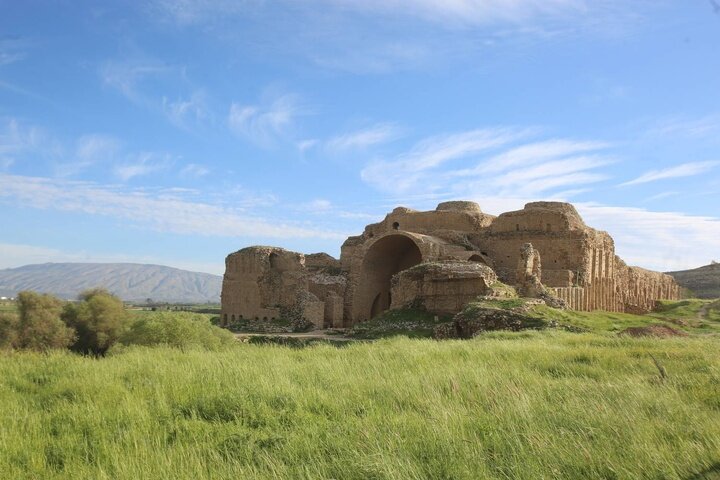
TEHRAN – Archaeological excavation work at the historic Ardesir Babakan Palace has officially resumed after being suspended, according to the state’s cultural heritage authorities.
During a recent visit to Firzabad, Behzad Moridi, director of the Fars Province Cultural Heritage Department, announced that the suspension of excavation work has ended and that work will soon continue, IRNA reported on Saturday.
The site is part of the UNESCO-recognized Sasanian Heritage Complex, and promising discoveries have been made since excavations began earlier this year.
Moridi explained that the suspension, which began after the first discovery in February, was due to specific local conditions. “The necessary planning has already been completed and archaeological work is expected to resume in the near future,” he said.
In addition to excavation activities, authorities are prioritizing restoration work on the palace. Mr Moridi stressed that the preservation of the structure is being seriously pursued as part of a broader cultural and social responsibility. Restoration projects are currently underway on parts of the palace, including the iconic iwan, an arched hall characteristic of Sasanian architecture.
The Ardeshir Babacan Palace was built by Ardeshir Babacan in the 3rd century AD and is one of the most notable examples of Sasanian design in existence. Unlike much early Iranian architecture, which featured a circular layout, the palace was built on a square platform, a characteristic of the evolving architectural trends of the Sassanid period. Approximately 116 meters long and 55 meters wide, the complex includes several corridors, a large hall, and three distinctive domes.
The palace once served as the administrative center of the early Sassanid Empire, with separate areas designated for official and residential use. A large audience hall adjacent to the main building was used for meetings between the king and government officials.
Enhancing tourist access to ancient Ghoul
Authorities are also focusing on improving access to the nearby ancient city of Ghur, historically known as Ghur and once the main political and cultural capital of the Sasanian Empire (224-651 AD).
Mr. Moridi said efforts are now focused on making the historic site more accessible to visitors. Of the four main entrances to the city, the ‘Ardesir Entrance’ is undergoing renovations, including grading and gravel paving, to ease traffic and improve the overall experience for visitors.
Located south of Shiraz, Firzabad covers an area of approximately 3,579 square kilometers and is visited by thousands of tourists each year. The area is famous for its rich collection of Sasanian-era landmarks, including Qala Dokhtar, a mountaintop fortress, and the Minaret of Ghur, a unique tower-like structure that is thought to have served both symbolic and practical purposes.
Another highlight is the relief of the Triumph Rock at Ardeshir. This is a monumental sculpture depicting the victory of Ardeshir Babacan over Ardavan V. This relief is notable for its intricate detail and unusual focus on a secular historical event.
cultural significance
Firzabad occupies an important place in Iranian history. Initially important during the Achaemenid period, it became more famous during the time of Ardeshir Babacan and was established as the capital of the Sasanian dynasty. Today, the area continues to be a major destination for lovers of ancient art and architecture.
With the resumption of excavation activities and ongoing restoration work, authorities hope to uncover further insights into the Sasanian period, as well as enhance the site’s accessibility and preservation for future generations.
The Sasanian period is very important in Iranian history. Under the Sassanids, Persian art and architecture experienced a total renaissance. The buildings are often of a grand scale, such as the several palaces at Ctesiphon, Firzabad, and Sarvestan, which are among the highlights of the ensemble.
Crafts such as metalworking and jewelry carving became highly sophisticated, while learning was encouraged by the state. At that time, both Eastern and Western works were translated into Pahlavi, the language of the Sassanids.
The Sasanian archaeological landscape represents a highly efficient land-use system and strategic use of natural landforms in the creation of early cultural centers of the Sasanian civilization.
In 2018, UNESCO added a group of historic Sasanian cities in southern Iran to its World Heritage List, entitled “Sassanid Archaeological Landscape of Fars Region”. The ensemble consists of eight archaeological sites located in three geographical regions: Firzabad, Bishapur and Sarvestan. It reflects the optimal use of the natural topography and attests to the influence of Achaemenid and Parthian cultural traditions and Roman art, which later had a major influence on the architecture and art styles of the Islamic period.
morning