
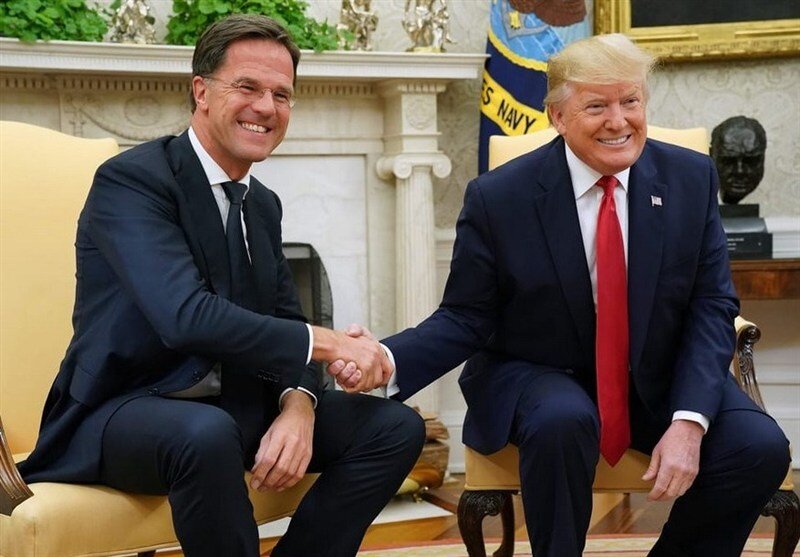
Tehran – The NATO decision to explicitly support a unilateral US military strike against Iran represents one of the critical betrayals of its founding spirit.
NATO Executive Director Mark Latte went ahead to congratulate Donald Trump on what he called a “really extraordinary” attack on Iran’s nuclear facilities. Latte supported the attack despite lack of UN support and never justified under the assumption of an imminent threat.
The US attacked nuclear facilities in Fordow, Natanz and Isfahan 10 days after Israel launched a surprising attack on Iran.
This dangerous trajectory of an alliance to promote a breach treaty that violates Article 5 of an offensive war treaty provides for its members’ defense agreements. By justifying this offensive act, NATO has compromised its own moral status, opened the door to awful double standards in Middle East policy, and upset global copycats who can eliminate the alliance as a collective security authority.
Contradiction with the mission of establishing NATO
The main reason for NATO is the collective security of its members as set out in the Washington Convention. It is justified on the principle that attacks should be repeated on members and forces may be imposed accordingly. Power should not be used as a punishment for non-members or as a punishment for non-members. Various US strikes in Iran, including people from the three nuclear sites mentioned above, took place without clear attacks on NATO members or permission from the Security Council under the UN Charter.
In celebrating these strikes, NATO leadership appears to have abandoned the very reason it was created. Open a question. Has NATO become a tool for the one-sided ambitions of the US and its close allies, not collective security guardians?
Silence and co-convict in the face of international law
The UN Security Council never allowed the US strike over Iran’s nuclear facilities. Secretary-General Latte argued that the actions did not violate international law, but UN Secretary-General Antonio Guterres and other international figures denounce the strike as a dangerous escalation and oppose the ban on using forces that are obsessed with the UN Charter.
The failure of NATO to condemn the attacks not only justifies violations of international norms, but also undermines its unique credibility as a force of peace.
Double Standards: Israel, Iran, and Security Issues
NATO has strict policies against Iran. NATO has repeatedly argued that “Iran should never develop nuclear weapons.” Contrary to this claim, the US intelligence community and Trump’s spy chief
Tarsi Gabbard concluded that Iran is not trying to build nuclear weapons. Furthermore, as a signatory to the NPT, Iran’s nuclear activities will be subject to inspection by the International Atomic Energy Agency.
This is while NATO engages in close ties with Israel through intelligence, technology and military exercise cooperation. However, Israel has openly refused to recognize nuclear weapons or participate in the Non-Proliferation Treaty (NPT).
This selective application of security concerns promotes double standard indictment. Critics also point out that NATO’s unwavering support for Israel’s “right of self-defense” has not been extended to Iran, and that the alliance is prominently silent on Israeli nuclear ambiguity and record of violating international law.
Israel is widely believed to have around 100 nuclear warheads and refuses to accept the Middle East without nuclear weapons. The heritage minister also proposed to use nuclear weapons against Gazan following the October 7 attack.
NATO equipment for US domestic politics
The timing and tone of Latte’s celebration notes convey the impression that NATO leadership is far more interested in Washington’s prominent courtship than in favour of NATO principles.
This politicization undermines NATO’s independence and overcomes the alliance into the means for ambitions in which the US administration has in power.
Ignore global public opinion
NATO officially approved the US attack, but there is considerable public opposition to the strike, not to mention non-Natal countries, especially in Europe. In The Hague, thousands of people protested in The Hague against both the US attacks and the military stance of NATO, calling for de-escalation and diplomacy in place of war. Polls show that NATO is still supported among older Europeans, but skepticism is rising – especially with young people who question the importance of NATO, and whether they will align themselves with American foreign policy. By ignoring these voices, we argue that NATO not only risks alienating the public very much, but also complicates the bay between the Western government and its citizens.
European costs
Military escalation in the Middle East has significant potential costs for Europe. Regardless of the ongoing western brink, an open military conflict with Iran could disrupt the energy supply, cause new waves of refugees, and create new radicalisations and terrorism in Europe.
German diplomat Wolfgang has already contemplated the impact of the Middle Eastern war on Europe, citing many European countries as being between a sluggish system of exile, general political bias and “very profound rage” in the past Middle East wars that created a tensioned system of exile, general political bias, and security concerns.
Furthermore, as Europe is working on the consequences of the Middle Eastern conflicts past and present, they rely on the US for military support, but this does not just help with the defense. By enabling NATO to support US military operations, they may be leading a new era of instability that is most common in their respective capitals.