
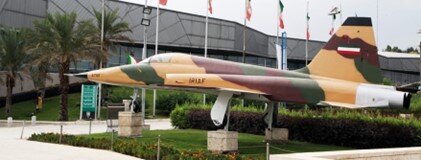
Tehran – Tehran’s Museum of Islamic Revolution and Sacred Defense offers one of the most comprehensive war tourism experiences in West Asia, witnessing an astonishing outdoor display of heavy military equipment (1980–88) used in the Iran-Iraq War (1980–88), known to visitors as “sacred defense.”
The museum’s vast outdoor space spans over 22 hectares of landscaping and features over 60 major war machinery, including gardens, artillery, helicopters and other military vehicles.
As recently reported by the International Museum Commission and IComam Magazine, the official publication of weapons collections and military history, this curated exhibit of military hardware provides insights into not only the tools of war, but also the cultural memory and national narrative surrounding one of the longest-running conflicts of the 20th century.

Highlights of outdoor spaces
Visitors to the outdoor exhibition can explore a wide range of historically important military equipment that represents various aspects of Iran’s defensive capabilities during the Eight Years War.
Tanks and armored vehicles
Chieftain Tank (UK): Operated by Iranian military, this horrifying tank features 120 mm guns ranging from over 22 km, advanced night vision and a nuclear biochemistry (NBC) protection system.

T62, T55, and T64 tanks (generated by the Soviet Union): Captured from the Iraqi army, these tanks introduce Soviet military engineering and include stabilizers, nighttime, and anti-NBC systems.
BMP-1 and MT-LB personnel (Soviet-made): These amphibious vehicles carried troops across rough terrain and water with onboard weapons that could employ infantry and armored targets.
Aircraft and helicopters
F-4 Phantom II & F-5 Tiger (USA): A high-speed fighter jet with multi-purpose weapons for bombing, intercepting, and reconnaissance.

MIG-21 (Soviet, captured from Iraq): A classic Cold War jet fighter that is remarkable for its speed and maneuverability in air combat.
Bell 206, 205 & Cobra Helicopters (USA): deployed for reconnaissance, military transport and precision attacks. With a 20 mm cannon and rocket pod, the Cobra was particularly effective against the armored threat.

Cannon and rocket system
203mm Propulsion Cannon (US): Although still in operation, this huge gun can fire a 93kg shell over 16km.
107 mm rocket launcher (made in Iran): A multi-selling system produced domestically. It can fire 12 rockets in less than 10 seconds.
Naze’at Rocket (Iranian): Iran’s first indigenous surface-to-surface missile with a 150 km range and mobile launch capability.

Air defense systems
14.5 mm Quad Anti-Aircraft (North Korea) and 37 mm Anti-Aircraft (Soviet/China): Captured from the Iraqi army, these systems were used for low-altitude defense against enemy aircraft.

Recovery vehicles and support equipment
There are also many armored recovery vehicles, including American-made vehicles equipped with cranes and winches, demonstrating the essential support role of military logistics.

A considerable experience
Beyond the outdoor collection, the museum features immersive indoor displays in seven halls. Visitors will be introduced to war timelines with audiovisual aids, archival footage and interactive predictions. A notable highlight is the Panorama Museum, which essentially recreates pivotal moments such as the liberation of Khorramshahr. Meanwhile, the butterfly hall serves as a memorial to the hearts of fallen soldiers, showing personal belongings recovered from the battlefield.
A replica of the museum’s Khorramshahr mosque, decorated with turquoise and cream tiles, further embedding the spiritual and cultural symbolism of resistance into the visitor experience.
Iran’s war tourism
As the Iranian-Iraq war war is the second-longest conflict in the 20th century, Iran’s war heritage has emerged as an important destination for war tourism, dark tourism and cultural education. Once the realm of conflict photojournalists is, such destinations are recommended in major travel guides for historical and emotional depth.
Museums of Islamic Revolution and Sacred Defence are at the forefront of this trend, with historical documents and national storytelling, all within Tehran’s accessible urban environment. Sleek presentations, interactive exhibits and impressive outdoor arsenals provide both national and international visitors with unique opportunities that reflect the human, technological and cultural aspects of modern warfare.
The museum is open all year round and is easily accessible from Central Tehran. The vast lot also includes recreational areas, water features and play zones for children, making it suitable for both history lovers and families.
morning