
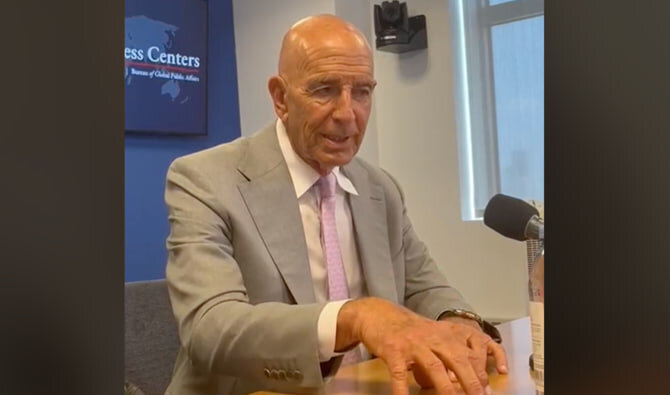
Beirut – In a post from X, the US Special Envoy to Syrian Thomas Barracks argues that his statement to the nation was intended to praise the “impressive progress” of the Syrian regime rather than threaten Lebanon.
US envoys had warned that if the government didn’t deal with Hezbollah’s weapons stockpile, Lebanon would once again become part of the Levant (is it romanticized like Bill?
“You have Israel on one side and Iran on the other, and now Syria is re-emerging strongly and quickly. If Lebanon doesn’t act, it will return to “part of Bill? d al-sh? m’.”
Barrack continued. “Syrians say Lebanon is a seaside resort, so we have to act. We fully understand the frustration of Lebanese people.
He argued that Syria is accelerating its efforts at an unprecedented speed to exploit the historical opportunity arose from the US president’s decision to lift sanctions in light of a clear and ambitious vision for the future.
The US envoy also argued that the HTS-led Syrian regime was “committed” to support Washington, and that it only wanted to coexist with Lebanon and share prosperity.
Barrack will return to Beirut on July 23 to comment on Lebanon’s official response to the US proposal to disarm the Resistance Front.
European diplomats reportedly told Lebanese officials that Washington was dissatisfied with Barrack’s mild approach during his recent visit, particularly when he told him, “The Hezbollah issue is a Lebanese incident and the Lebanese must deal with it.”
Analysts said the US envoy appears to be returning to the position of his predecessor, Morgan Ortags, especially as he distinguished between Hezbollah’s political and military wings.
This led U.S. State Department spokeswoman Tammy Bruce to say, “Our position has not changed. Hezbollah is a designated terrorist organization and does not distinguish between its political or armed wings.”
“Ambassador Barracks is very pleased with the initial response by the Lebanese government, but he points out that he is now working on this in detail.”
“I don’t want to see Hezbollah and other terrorist groups in Lebanon reinstate their ability to commit violence and threaten Lebanon and Israel’s security,” a spokesperson added.
Regarding Ortagus, the source warned that the Lebanese believed they had removed what they described as “arrageous” women without paying attention to what they were preparing.
Ortagus is currently Senior Political Advisor to Dorothy Shea, the permanent US representative at the United Nations (former US ambassador), who is doing everything necessary to modify Unifil’s duties and authority ahead of the August update next year.
It should be noted that Israel’s enemy is pushing through a large lobby within the United Nations to prevent updates, under the pretext that Unifil is not performing the tasks assigned to it.
Observers seriously warn that ending the Unifil mission means an explosion at the border between Lebanon and occupied Palestinians.
Paris has insisted on unrelenting efforts to maintain the Unifil in southern Lebanon, but Washington has leaned towards using its veto to block expansion.
This not only reduces its strength, especially if funds are not available, but also effectively ends UNIFIL’s mission (according to Trump’s decision to cut the budgets of SO-COLLED peacekeeping forces around the world).
The Lebanese government had formally requested an extension of UNIFIL for additional years, insisting that it would not change its mission, either by staff or by mandate.
Meanwhile, the state and the Justice Department officially held a meeting with Europol, the European Union law enforcement cooperative body, on the fight against Hezbollah’s activities.
The person who attended the meeting was a Ministry of Finance official. Member of the Law Enforcement Coordination Group (LECG). Representative of law enforcement. Prosecutor; financial experts from around 30 countries.
Representatives from the so-called US National Center for Counterterrorism (established in 2014 by the US administration and Europole) also attended, claiming to strengthen international coordination between the world governments to combat Hezbollah’s activities.
A State Department statement acknowledged that Hezbollah is a serious threat, maintaining its presence overseas and possessing the ability to “perform attacks without warning against targets around the world.”
The statement also states Hezbollah’s “unstable” financial situation, which states that “we may seek to increase funding and equipment procurement activities, particularly in the Western Hemisphere, Africa and other regions.”