
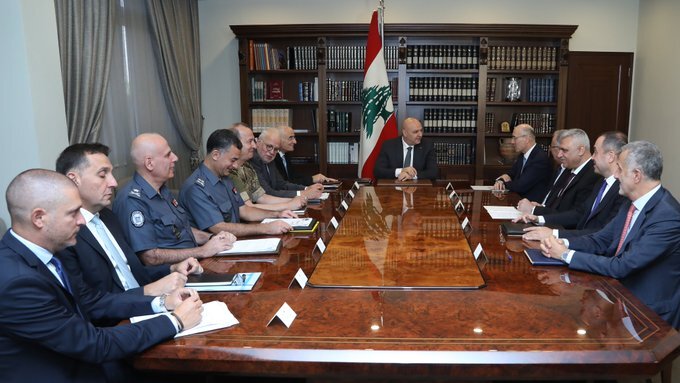
BEIRUT – Amid intensifying pressure from the HTS regime to hand over Syrian prisoners from Lebanon, President Joseph Own has held his second security meeting to address the issue.
The meeting reportedly asked Syrian Foreign Minister Asaad al-Sheibani to receive concrete positive signals from the Lebanese side to visit Beirut.
The meeting was attended by the head of the security department and judicial organisations and Justice Judge Raja Abhi Nadar, the supervisor of the prisons of the Ministry of Justice.
It is worth noting that the conference is not dealing with Syrians linked to terrorist groups and is not involved in killing around 350 Lebanese soldiers and civilians.
Syrian prisoners make up about 30% of the total prison population under the jurisdiction of the Lebanon Ministry of Justice.
The number of prisoners in Lebanon is around 2,600.
So far, 380 cases have been sentenced to final sentences, 370 sub-sentences or cases pending, with the rest still in trial.
The advisors stressed that it is illegal to hand over these detainees unless final judgment is issued against them. They proposed to study a judicial cooperation agreement that requires Lebanon (specifically, those not convicted of terrorists or security-related crimes) to complete their sentence in Syria.
In this connection, it has been found that Lebanese security services have begun preparing a detailed list of names of Syrian prisoners during their detention (classified according to the charges against them).
The relevant ministers and many advisors were present, but despite the importance of the meeting, Prime Minister Nawafsalam was particularly absent.
Justice Minister Adel Nassar, prison supervisor Judge Raja Abi Nadar, and prosecutor Jamal Hajar stressed the need to strictly enforce Section 108 of the Code of Criminal Procedure, as it is impossible to hand over detainees before trial.
Amid rising tensions in Syria and the crimes committed by Ahmed al-Shara’s civilians, Lebanon witnessed security tensions (e.g., major roads and violent demonstrations) and speeches of hatred. These events prompted the Army Chief to shun the conflict and call on the Lebanese people to prioritize the highest national interest over everything else. Rodolph Heichal has promised that the Army will not allow “secure violations or violations of civil peace.”
The Lebanese military emphasized that overcoming the current problems experienced by Lebanon requires “uniformity and solidarity of the Lebanese people and their recognition of the severity of the situation.”
“Lebanon is currently facing a series of exceptional circumstances, most notably the continued attacks and violations of national sovereignty by Israeli enemies, as well as the challenges of maintaining internal security and border control, as well as the complex development of the region.”
While warning against “assuming actions that could have unintended effects on Lebanese security,” the Lebanese military emphasized the need to “execute responsibility” when confronting this sensitive situation.