
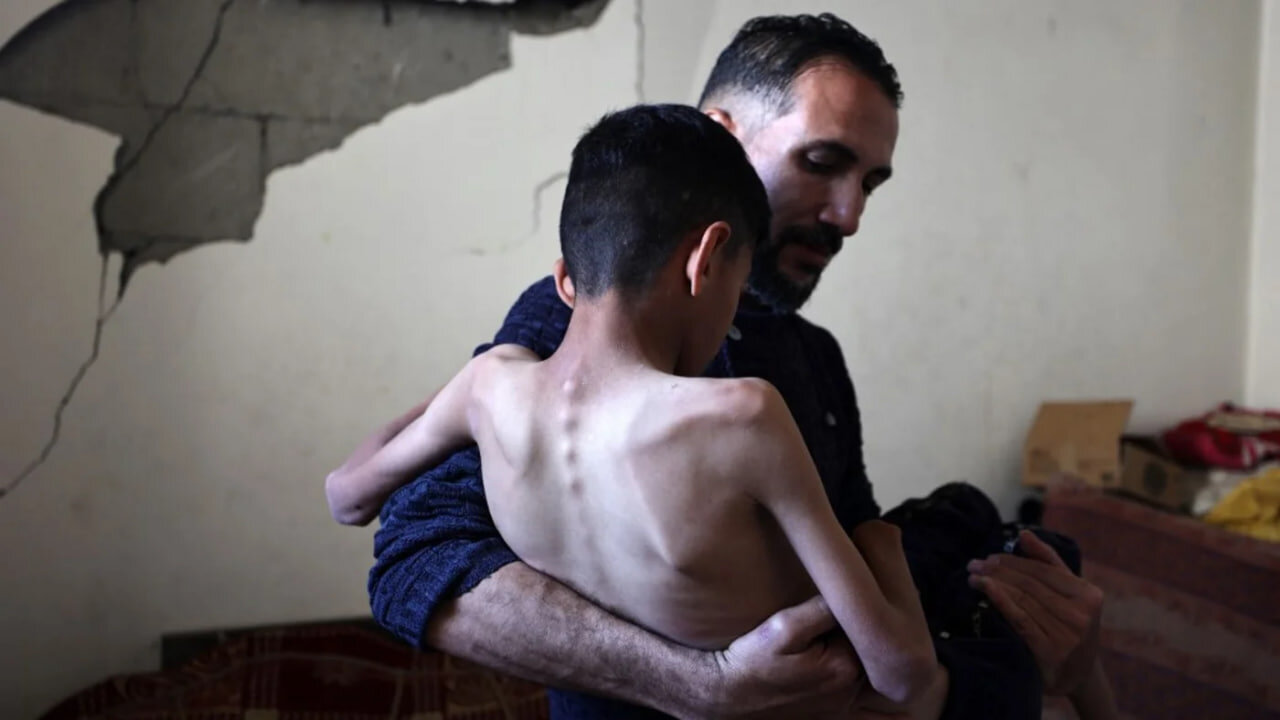
On Sunday alone, at least 18 Palestinians died of starvation in Gaza as Israel continues to implement a systematic hunger policy on the territories’ 2 million residents.
I’ve been troubled by that idea. What passes through someone’s mind when you take your final breath for starvation?
Every time I’m distracted, I get a notification on my screen with another name, another death by starvation, returning to this relentless loop. What did they think in the end?
I have ideas about what runs through a person’s mind as they are about to be killed on an air strike. Most people in Gaza do that. We had those ideas often, so they are embedded in our nervous system. Decades after this genocide ended, they will never leave forever.
They also understand the type of idea that consumes people who are dying due to lack of medical care. I lived that moment with someone close to me. I looked into their eyes as they took their final breaths. I could almost hear what they thought.
But starving is different. I imagine someone lying on a bed and die in complete silence – the silence is very powerful and can kill bones, muscles, flesh, and blood. Stronger silence than the 125,000 tonnes of explosives dropped in Gaza in the past 21 months. A silence that seals the boundaries and food blocks the entrance.
What do they feel when they learn that they have survived thousands of air strikes, shells, outdoor executions, epidemics, and the collapse of their health system?
Do they feel betrayed by humanity?
It reminds me of my last meal
Or are they just thinking about food and craving it? Do they imagine themselves around a large table surrounded by families, steam rising from the pot, laughing in the air, clinking a glass plate spoon and fork?
Does their failed mind try to remember the last meal they had? Do you start smelling your favorite dishes?
Perhaps the food is the last thing they think of at the moment. Maybe for the first time in a few months, they feel full – not in their stomachs, but in their souls. It probably has a sense of completion. They can no longer lose some of their dignity as they line up for a hot meal or run through the bullet hi in the hungry crowd near the aid distribution site.
Maybe they ultimately realize that it is never worth it. That the world was not worthy of a desperate attempt to stay alive and be a part of it. For the first time in their lives, they were freed from occupation as the countries of the world remained occupied.
I have always believed that taxis reflect what is happening in society. You come in and quickly immerse yourself in conversations about price rises, unbearable heat, and inevitable political analysis from drivers and passengers who always last long on the journey.
Before the fuel crisis, when I was still in the car, I had missed those raw, unfiltered connections. Sometimes I would leave my car parked, get in a taxi and experience it again.
Last week, on my way to work, I arrived at a taxi where a young woman was holding a newborn baby. In the burnt sun and the suffocating heat, I saw the infant sleeping on my mother’s lap and said, “Poor baby, he looks hot.”
“He’s just sleepy,” she replied. “He hasn’t slept all night.”
I asked why. “He’s not getting enough from breastfeeding,” she said. “I’ll take him to the doctor.”
Hungry sleep
She went on to explain that the one-month-old baby was suffering from severe malnutrition. He had previously weighed about 3.8 kilograms, but instead of gaining weight he had now fallen to 3.3 kg. Her breast milk told me she was malnourished herself and she couldn’t find a baby formula anywhere, so she no longer carried enough nutrients.
A few weeks ago I shared a taxi with a woman and her daughter. The curious and playful girl touched my bag and continued to look up at me for a response. I smiled for a moment and played, then turned to my mother and said, “God blesses her. How old is she?”
“5,” the woman replied. I smiled again and then turned around to look out the window, and it wasn’t a five-year-old hand. Her hands were too small and thin, even at 3 years old.
I really lost the number of mothers I met on my way to work.
These are the stories of taxis in Gaza now, with snapshots of the entire population quietly being wasted.
But it’s not just a taxi. It’s a pharmacy with empty shelves, a hospital with no supplies, a food-free market, and a home where children sleep hungry every night.
What happens in a taxi in Gaza is just one of the windows into a hungry society in all aspects of life.
(Source: Middle Eastern Eye)