
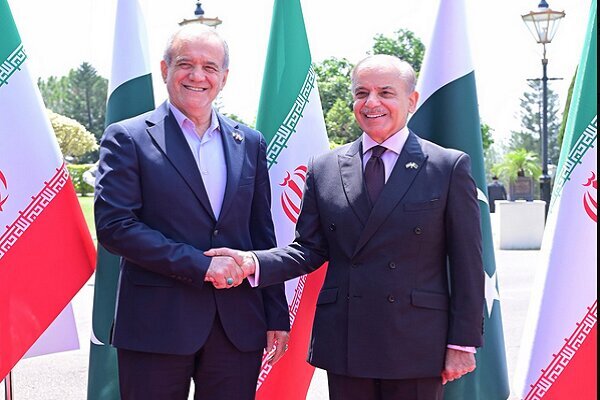
Karachi, Pakistan – The new involvement between Iran and Pakistan, marked by President Masuud Pezeshkian’s recent visit to Islamabad, reflecting a turning point in how both countries are rethinking the role of the region.
This is not just an exchange of diplomatic pleasures. It demonstrates a broader readjustment rooted in economic pragmatism, evolving geopolitical calculations, and recognition of common challenges and opportunities, particularly along the 900-kilometer border. Balochistan is at the heart of this evolving dynamic. Balochistan is a region that is often discussed in terms of its difficulties, but is now increasingly seen through the lens of potential and connectivity.
Balochistan holds a vital geographical and strategic position on both Pakistan and Iranian side. In Pakistan, the province has the deep sea port of Gwadar, an important node of the China-Pakistan Economic Corridor (CPEC). On the Iranian side, Sistan Balchestan is hosting the port of Chabahar, which was developed with the support of India. Far from being merely rivals, the ports of Gwadar and Chabahar act as double gateways to Central Asia, the Middle East and South Asia when they are based on trust and strategic vision.
Both countries are increasingly aware of this opportunity. Rather than allowing outside actors to frame Gwadar and Chabahar as conflicting projects, Tehran and Islamabad began to suggest synergistic effects. This change in thinking is important. It acknowledges that economic integration of the region cannot be successful unless border states like Balochistan are considered bridges rather than barriers.
Balochistan’s economic potential is quite substantial. The area is rich in natural resources, strategically located and is home to a young population. However, it remains underdeveloped in terms of infrastructure, education and access to mainstream markets. To address this gap, you need investment, not charities. Both Iran and Pakistan are beginning to realize that comprehensive development in Balochistan is essential for long-term regional stability. There is growing awareness that empowering the region through legitimate trade, education and connectivity, rather than looking at Balochistan alone, is a great deal of recognition that greater returns will be generated.
The broader context of Iran-Pakistan relations contains a common understanding of global pressure. Iran remains under sanctions, but Pakistan continues to wrestle with the Persian Gulf, China, the US and now India. In this context, strengthening relations with the majority of neighboring Muslim countries provides strategic depth for both countries. Importantly, the two countries have reiterated their strong positions on global issues, particularly solidarity with Palestine and Kashmir.
During President Pezeschkian’s visit, both sides signed 12 agreements and memorandum covering sectors such as agriculture, technology, media, maritime cooperation and border control. These contracts define not only the intention but also the scope of operation of the moving relationship. The goal of increasing trade from $3 billion to $10 billion may be ambitious, but it reflects the severity of the purpose on both sides.
One important issue that continues to require thoughtful management is cross-border transactions. Balochistan has traditionally been at the heart of formal and informal trade flows. Smuggling, especially fuels and goods, was an unintended consequence of poorly regulated borders and economic disparities. But instead of treating this as a criminal matter alone, both countries are now investigating normalized legal trade mechanisms to provide transparency and benefit local communities. In fact, recent steps by Pakistani authorities have significantly increased the formal imports from Iran by more than 300% through legal channels. The current challenge is to maintain and expand this, ensuring that border communities are economically integrated into the national framework.
What stands out most in this evolving relationship is the change in tone. Iran and Pakistan will no longer speak simply from the perspective of security cooperation or religious Brotherhood. They now frame their relationships as rooted in shared economic interests, regional peace and comprehensive development. Balochistan is no longer treated as a periphery. This is becoming central to this vision.
If both countries maintain this momentum and align the words with policies, Balochistan could emerge as a corridor of opportunity. The ports of Gwadar and Chabahar, once symbolized geopolitical competition, could become symbols of regional pragmatism and cooperation. And in doing so, Iran and Pakistan will not only strengthen their bilateral relations, but will also help to lock down more stable, connected and economically resilient regions.
In a world increasingly polarized by rivalry and economic fragmentation of the great powers, regional cooperation between neighbors like Iran and Pakistan based on mutual respect and shared prosperity provides a realistic and much-needed alternative. The presence of Balochistan at the heart of this vision is not a responsibility. It is a test of leadership and foresight. And perhaps it is also where the future of regional integration really begins.
⇒HaseebUr Rehman is a journalist and regional affairs analyst based in Karachi, Pakistan. He writes about South Asian geopolitics, cross-border trade and the socioeconomic dynamics of Balochistan. He is currently associated with Daily Balochistan Express, Quetta, and Huashang News.
⇒The views expressed in this article are those of the author and do not necessarily reflect the official position of the Tehran Times.