
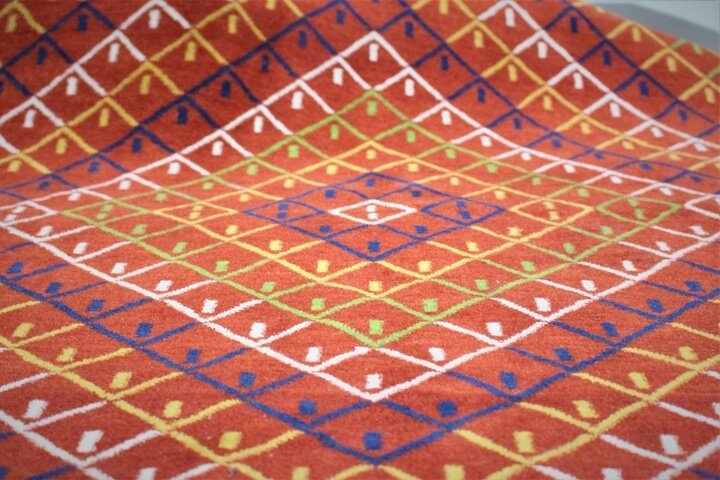
Tehran – The first in Mazandaran to be the authentic carpet with “Jerigy” designs, inspired by ancient motifs from the Sassanid period, the authentic carpet was created entirely by hand. A gorgeous piece that revives the relationship between the fabrics of carpets of the north and the aesthetics of new forms of historic architecture.
According to Irib, Kobra and Zahra Baqeri, the two artist sisters of Sari’s Dodangeh designed and woven the first Mazandara hand-woven carpet in a real Gelij pattern.
A pattern inspired by the “bird’s feet” motif of the Sassanido era, featuring a continuous and thoughtful effort of over 40 days, showing off a unique combination of traditional symbols, the visual heritage of ancient pottery, and native carpet weaving.
Zahra Baqeri highlights the innovative nature of this design in the area of carpet weaving, saying:
Cobra Bakeli, who was responsible for the composition and arrangement of the patterns in the work, said:
With an emphasis on Gelij Art and the possibilities of other traditional Mazandaran motifs, these artists sought targeted support, facilitated the process of registering their works, provided facilities equipped with workshops, and provided a platform suitable for their presence in both national and international markets.
In addition to this artistic aspect, this 1.5 x 1 meter Gelij carpet, woven using plant-based thread, brings a story of the connections of generations and the revival of forgotten heritage. This work is one of the noble pieces of Mazandaran handicrafts and goes through a preliminary stage of local registration.
More than artworks, Jeriji’s carpet is a symbol of Mazandaran’s cultural ecosystem. A story of women’s creativity, dependence on native memory, and efforts to maintain the legacy of development paths. This work is the initiator of new trends in the art of carpet weaving in the country’s northern part of the country.
Carpet weaving is prevalent in Iranian cities and provinces, with some cities such as Tabriz, Isfahan and Kashan being particularly well known.
According to Zahra Kamani, head of the Iranian National Carpet Centre, Iran’s hand-made carpet exports have increased by around 4% in past Iranian calendar years (ends March 20) after a decline in the past decades (ends March 20).
She said the Iranian carpet has been exported to 65 countries around the world, bringing the value of the exported handmade carpet to $39.7 million over the past year.
Germany, the United Arab Emirates, Japan and China are one of the top four export destinations of the previous year, collectively making up more than $22 million in exports, she added.
The growth stems from the removal or revision of restrictions and the support measures by the National Carpet Centre, Kamani said, “The new initiative launched by the Ministry of Industry, Mining and Trade, together with the National Carpet Centre, aims to strengthen the global position of hand-made carpets.
The synergy of the currency and banking system and support measures from related organizations are expected to lead to further growth in exports. ”
KD