
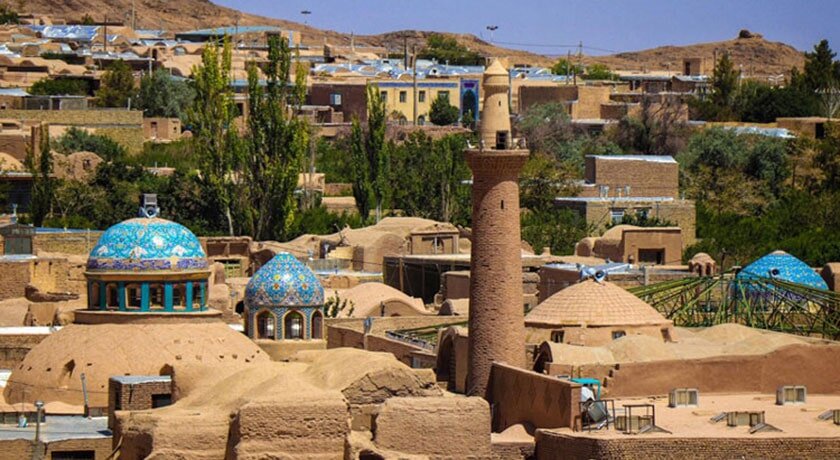
TEHRAN – Cultural Heritage Manister Seyyed Reza Salehi-Amiri visited the 50 hectares of historic texture in the Nodoushan district in Meybod county, Yazd province on Saturday.
He also visited White Castle in Noduhan, which is linked to Afsharid and Zand-era in central Iran, Isna reported.
During this visit it was proposed to review the state’s national registration file to deploy a team representing the Council for Registration of the Ministry of Cultural Heritage to this historic city.
The structure of Nodoohan city dates back to the Ilhonid era, and is the shape of a castle surrounded by brick towers and walls. It flourished in the 5th and 6th centuries, according to existing evidence, such as the pulpit of Nodoushan Jame’ Mosque.
Based on historical texts, Nodoushan’s current structure dates back to the time of the existence of the Al-E Mozaffar family in Meybod, and the aforementioned changes to the structure were also made by this family.
The Minister also visited the Nodusan Gem Mosque, which is related to the 8th century ah. The mosque features a 20-meter-high minaret, which was added during the safavid period.
Featuring a brick facade and a glazed brick spire with a swaying minaret similar to the swaying minaret of Isfahan, this 60-step minaret is a masterpiece.
Salehi Amiri also visited the historic home of Iranian literary critic, translator, poet and one of the most well-known contemporary writers of Iranian culture and literature.
Nodoushan’s academic journey began at Yazd, where he graduated from high school before completing his bachelor’s degree in law from Tehran University. He then moves to Paris to pursue MA and Ph.D. Back in Iran, he began teaching literature and law at the University of Tehran, and soon became one of his famous professors and one of the famous authors of Iran.
His fame extends beyond Iran and reaches thinkers, writers and scholars around the world. Nodoushan’s grand works contribute significantly to the promotion of Persian language and literature.
Noduhan’s tireless efforts to accustom Iranian literature from around the world and his deep sense of patriotism to the world are truly praiseworthy and will continue to inspire future generations.
He spent his life studying the scientific and literary works of Iranian writers and translating books by world’s great writers. All of these have been published in over 50 books.
“Iranian Conscience: Feldwi, Rumi, Sadi, Hafez” is one of his great books. The book covers a series of lectures he gave at Tehran’s Municipal Institute in the late 1990s.
His research on the Persian poet Hafez is one of the most useful sources for Persian literature scholars. Among them are “The Infinite Story of Hafez” and “The Contemplation of Hafez.”
Some of his extensive research into Shahnameh (The Book of Kings) are included in the books of The Tale of Story: Rustam and Esfandiar of Shahnameh and Heroes ‘Death and the Shahnameh’, the epic masterpieces of Persian poet abolqasem ferdowsi.
The streets in Tehran’s sixth district were named after Muhammad Ali Esrami Noduhan in November 2020, and busts of Iranian scholars were installed at the intersection of Besar Siraj St. and the streets.
The main streets of the central city of Yazd were also named after him at the same time. The city council of his hometown, Nodusian, had previously named the square after him.
Nodoushan has a population of 4,500 and is located in northwestern Yazd Province.
KD