
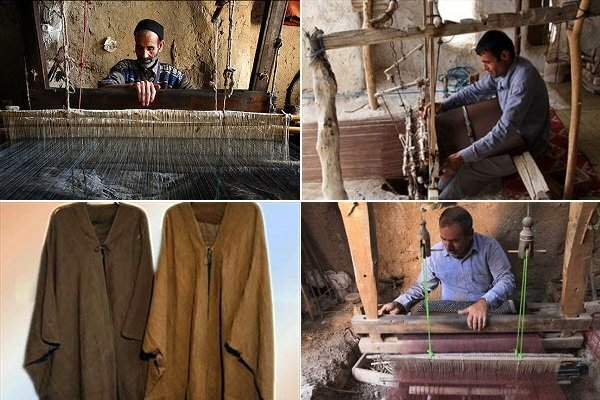
Tehran – Traditional type of cloak produced in the Nine of Isfahan province is undergoing a process of global registration potential at the initiatives of the Nine Cultural Heritage Division, the Nine City and the Isfahan Chamber of Commerce.
By registering this intangible cultural heritage, it is expected that Nine’s famous handicrafts will be introduced to the world.
According to Mehr News Agency, Na’in Cloak’s history dates back 200 years. The Na’in people exported about 5,000 cloaks from the city each year in the 1970s to cold-climate countries in the Persian Gulf Arab countries and regions, but today the weaving of the cloaks has diminished and, if woven, are exported to Lebanon and Syria among other destinations.
The art of textiles is also part of the intangible heritage of the Nine people of Isfahan, this handicraft is completely woven in one piece, and its fabric is made of camel or sheep wool, absorbing the cold in winter.
Spinning threads must be done by both older women and older women, but unfortunately the number of people involved in this task is very small, and the number of nine cloak weavers is not economically viable, which has resulted in a significant drop. Because of this, due to the lack of economic viability, Na’in faces a lack of public acceptance for cape weaving, especially among young people.
Mahmoud Madanian, head of the Nine Cultural Heritage, Tourism and Handicrafts Bureau, said unfortunately the Na’in Cloak market has declined for a variety of reasons over the past 40 years.
Many of the nine cape weaving workshops have been restored through the efforts of the cultural heritage department and restoration companies. centuries old arts provide for the identification of artists in this field, issuing ID cards, issuing production licenses for workshops, production of workshops, marketing, cloak production, cloak production, marketing, and granting low-joint and long-term facilities to expand the offering of products tailored to the needs of society, purchasing from cloak fabrics, offering carding machines to expand the offering of carding machines to provide purchasing machines, and providing carding machines to eliminate the needs of wool to maintain the needs of wool to promote the work of cloak weaving.
“Mohamadie’s cape weaving is a tourist facility and a field of employment generation,” Ezatra Zargami, a former minister of cultural heritage, tourism and crafts, said during a visit to the Nine two years ago.
The nine cloak has been awarded the Seal of Excellence along with 26 handicrafts from Isfahan. The plan to change the use of cloak fabric to vests, shawls, belts and other usable items was implemented with the cooperation of artisans, but it was a temporary solution, with the 2,000 people employed in the field diminishing at one of Mohammadiy’s workshops.
Now, cloak weaving at the nines faces serious problems, but the danians have given new news and spoke about plans for the possibility of a global registration of nines cloaks. Recently, the second planning session for the possibility of global registration of the Nine Mantes was held in the NA’IN Municipality by the Nine Cultural Heritage, Tourism and Handicrafts Bureau, as there are members of the Isfahan Chamber of Commerce, Governor, Mayor and Chairman of the Nine Islamic City Council.
The conference determined that the procedure for the global registration of nine cloaks should follow up with the special urgency and sensitivity of the Isfahan Chamber of Commerce and Industry, and that the municipality and the cultural heritage sector should provide the necessary support and cooperation.
The global registration of this ancient handicraft produced in Mohammadie, Nine, allows the Nine city to be featured as a more prominent tourist city than ever before at the international level.
The Nine dates back to nearly 2000 years and is one of the oldest and continuous settlements in the Iranian Heights.
The nine is 170 km north of Yazd and 140 km east of Isfahan. Like many Iranian plateaus, there is a desert climate, with a maximum temperature of 41°C in summer and a minimum of -9°C in winter.
In ancient times, the city was at the intersection of the desert roads connecting Tabas and Mashhad, and was a key confluence of trade routes that had converged since the Sassanid era. The nines were known for their pottery and fabrics. Today it is best known for its hand-woven carpets and hand-woven camel wool cloakrooms made in the surrounding villages.
KD