
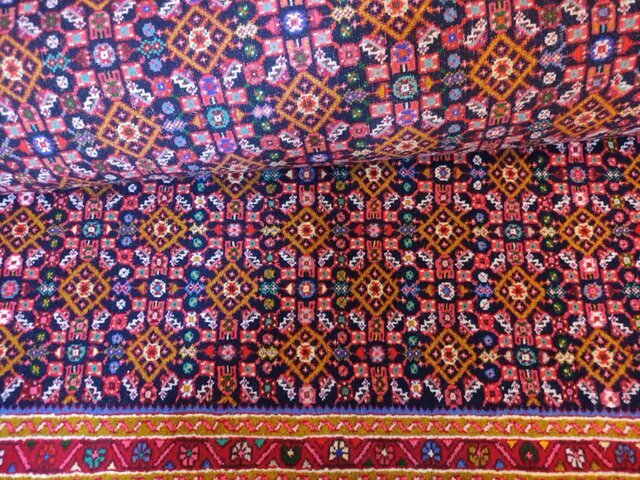
Tehran – The Malayayaya in Hamedan has been a cradle of carpet-woven Iranian art and creativity.
It is not only one of the largest hand-woven carpet production hubs, but also has a special position in the history of Iranian carpet industry, with its unique diversity of patterns, colors and weaving styles.
Carpet weaving is not merely a profession or industry, but also part of the cultural and social identity of the people in this land. Surviving in small country workshops and old homes, the legacy passed from generation to generation reports.
Every region of Malayer has its own identity, from the elegance of Shahribaab and Jozan to the originality of Mishan’s geometric nomads and the enduring patterns of Musa Khan and Hosseinabad. This unique diversity transformed Malaea into a living museum of Iranian carpets. A place where foreign customers can line up on a single trip and observe a variety of authentic Iranian designs and patterns.
From lacquer and turquoise to olive and cream, the Malayan color palette, combined with the durability of the Turkish knots and the use of cotton distortion and wefts, created a carpet that is beautiful, artistically elegant, strong and durable.
Many ancient patterns, such as Mishan Rugs, are now kept in trusted museums and palaces around the world. Malayari Weavers’ art fame spreads all over the world.
However, the importance of Malayer Carpets is not limited to the artistic side. This arts industry plays a critical role in the local economy and the country’s non-oil exports.
The markets in Europe, West Asia, East Asia and even the US have been customers of Malaea Carpet for many years, but they have struggled with obstacles such as the lack of a single brand, sanctions and the lack of standard raw materials.
Hamidreza Forousanathan, head of the Hamadan Hand-woven Carpet Producer and Exporters Association, said Malaea is not just a carpet weave centre, but also a cluster of independent centres with diverse design identities. Malayer is Iran’s first city, with the largest number of weavers and a wide variety of colours and patterns, he added.
He said each of the local carpet weaving centres operates in the form of home and rural workshops. Overall, the number of weavers has been declining compared to the past, with about hundreds of active weavers in the villages and in the city of Malaya, which he noted is much lower than in the 1980s and 1990s.
The Mishan pattern is one of the oldest carpet patterns in Malayan with a variety of designs, including geometry, flowers, special fish, and slime betta combinations. Many of the old samples of Mishan’s rugs are stored in museums and palaces around the world.
Said that the number of threads in Mishan carpet ranges from medium to very high (by period and order), he added that Mishan carpet is woven in both single and double piles, depending on the style and time of the weaving.
Forouzanahsan said the UAE is the buyer of Malayer Carpets, primarily as an export centre. Germany, China, Italy and the US are also seeking Malayan carpets, he added.
According to him, the unique variety of designs and colors of Malayer rugs could create a global collection of Malayer rugs.
He said that Malaea could attend a large exhibition titled “Malaea Pavilion”, where designs such as Jozan, Maishan, Musa Khan and others will have booths and all covered under the “Malaya Rug” brand.
He has included geographical signs of Malaea carpets that include all these villages and districts, compiling digital booklets or catalogues, compiling catalogues that showcase each style and its historical stories, establishing a direct exhibition and sales centre that demonstrates this diversity in one place, and special purchases that measure Malaea’s position using this diversity that attracts art tourists in their use of this diversity.
Forouzanahsan listed the issue of currency exchange, the lack of a single brand introducing all these styles under one umbrella, and the embargo as obstacles to export.
He said light livestock wool is available, but added that its collection, processing and dyeing is not standardized, not of high quality, weavers are old and the younger generations do not tend to turn to carpet weave as the domestic and export markets are unstable.
Mohammad Amini, one of the carpet activists in Malayan County, also considered high-quality raw materials to be the main foundation for hand-woven carpets. “Carpet buyers are looking for high quality carpets woven from sheep wool and natural dyes.”
He said that around 6,000 wool spinning mills operated in Malaea, primarily in the province of Lorestan, especially Borgeld, and while most of the raw materials for Malaea carpets were sourced from these spinning factories, unfortunately the wool spinning has been closed for about eight years, and most weavers use mechanical span wool.
He considers the revival of Spanwool as a viable task that requires more support and supervision from the relevant organizations, and requires prevention of spinning machine factory activities.
KD