
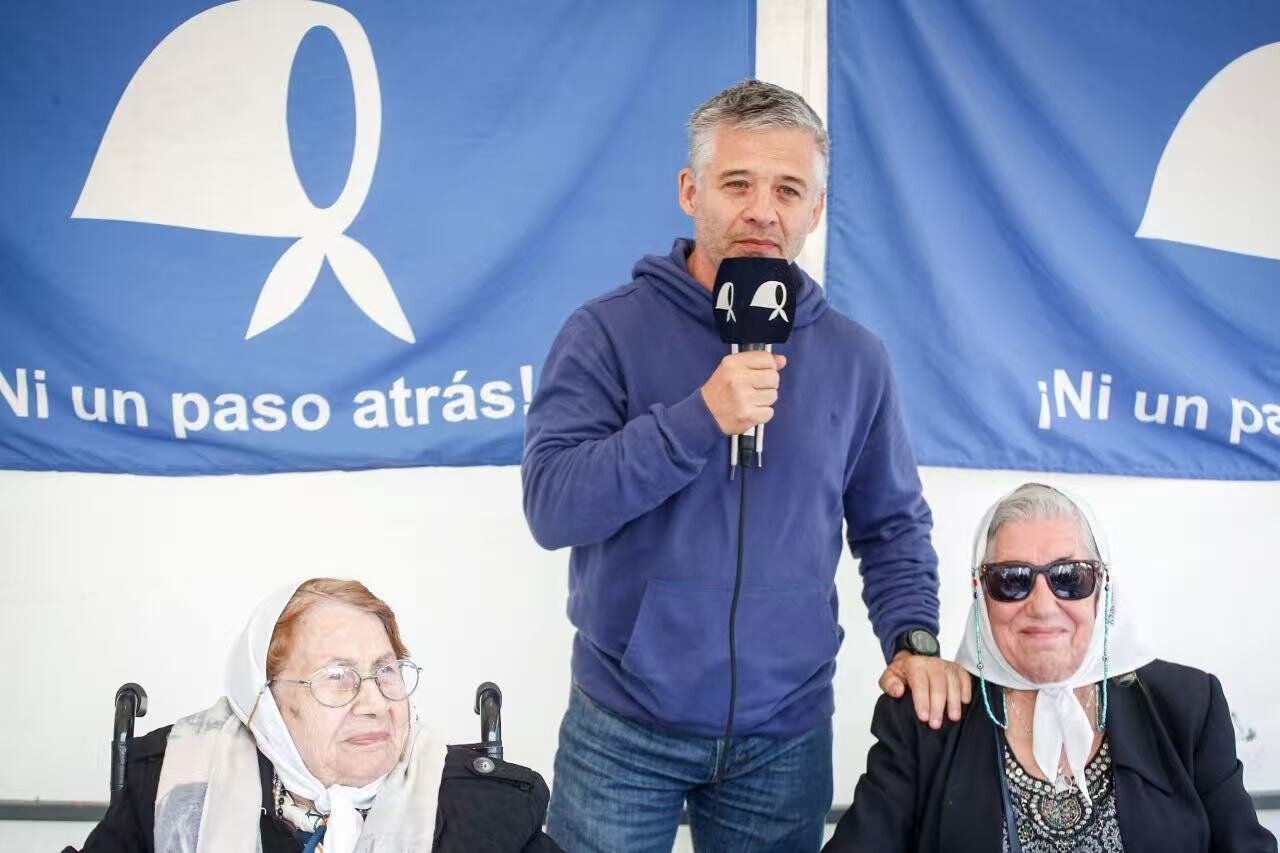
Buenos Aires – Jorge Norbert Elbaum is one of the most outspoken and insightful voices in the Argentine Jewish community. A sociologist, journalist and researcher, he was the first president of the Argentine Jewish Call (Ramamiento Argentina Judio) and was ambassador to the Ministry of Foreign Affairs of the International Holocaust Memorial Union.
From these positions, Elbaum challenged the debate monopoly of the Argentinas, a subsidiary organisation representing the Argentina Jewish community. He accused Dia of working with local political rights and not representing community diversity.
Far from an institutional TI disease, Elbaum publicly condemns crimes against humanity committed against civilians in Gaza, highlighting the Israeli government’s responsibility for the devastation, hunger and death that torment the stripes. Argentine journalist Silvina Pachelo interviewed Elbaum amid widespread rage in Argentina about the upcoming visit of Israeli Prime Minister Benjamin Netanyahu, who has been appointed by the International Criminal Court for Gaza’s war crimes.
Here is an excerpt from the interview:
What is the Jewish community’s stance regarding the possibility that Benjamin Netanyahu will visit Argentina?
Jorge Norbert Elbaum: Netanyahu’s protection violates the Argentina constitution and defends the rule of law. On the one hand, Dia defends his right to land in Argentina. Meanwhile, the Argentine Jewish call will condemn his presence and demand an arrest if he arrives in Buenos Aires. Our position is based on Roman law and the International Criminal Court’s demand for Netanyahu’s detention for crimes against humanity and war crimes. We defend the rule of law. Protecting him from executive branch would constitute a direct violation of the constitution by President Javier Miley and his government.
A few days ago, the Argentine Jewish appeal filed a complaint with a court requesting Netanyahu’s arrest if he stepped into Argentinean soil. What is the motivation for this behavior and what do you want to achieve?
We have submitted this request to the judiciary as we believe that the ethnic cleansing process is ongoing in the West Bank, along with the siege of Gaza and the massacre of civilians. The International Criminal Court has called for the detention of his former defense minister and Hamas leader Netanyahu for the events of October 7, 2023. If they come to Argentina, they will demand their arrest. This is not a personal attack. This is a lawsuit mandated by an international court investigating war crimes and crimes against humanity against civilians. Among the victims are more than 60,000, including 16,000 children.
We now request that Netanyahu, as we requested the detention of Hamas leaders. Political and symbolically, we want Argentinian society to understand that this is not a matter of identity, religion, or ethnic cultural affiliation. It’s a humanitarian issue. Whether Muslims, Jews, Armenians, Arabs, Afro-born or part of Indigenous people, crimes are committed here. The key is to demand an end to the murder of innocent people in Gaza, as established by the United Nations in the 1947 divisional programme, and contribute to the two states’ solutions.
What impact has Netanyahu’s statement that it controlled the entire Gaza Strip within Argentina and the Jewish community had?
The impact was clear. Some marched to condemn the occupying state of the rog. Others, especially the sector alongside the Argentine government, are silent. There is no open defense of the ethnic cleansing programme announced by Netanyahu.
It opposes British occupation of the Falklands and Israeli occupation of the West Bank and Gaza. We have called for Netanyahu’s arrest and defended our position for over a decade. The appeals of Argentine Jews were consistent. Israel must leave its occupied territory and allow the existence of a Palestinian state established by the United Nations in 1947.
How do you assess the responsibility of national and international organizations regarding the humanitarian situation in Gaza?
Countries react differently to crimes against humanity in Gaza. Some countries spoke firmly, some remained hypocritical, others, and others, like Chile and Colombia, are even demanding that diplomatic relations be broken with Israel. The main responsible party is the United States, which protects the Security Council’s Israel through veto. If the condemnation of the West Bank and Gaza occupation since 1967 has not been blocked, then there may already be peace in two states and regions. Today, that peace is much more difficult to achieve due to the genocide that Gazan is experiencing.
How can Israeli defense balance the defense of Palestinian human rights?
There is no balance of rights. While Israeli citizens enjoy full political and civil rights, Palestinians live under occupation without comparable rights. In the West Bank, Palestinians are subject to military justice, while Israelis (including Arab Muslims) realize their full rights. This extreme inequality promotes administrative detention, hunger, crime against humanity, and the genocide currently occurring in Gaza.
More generally, how do you analyze the relationship between Argentine political leaders and the Jewish community?
Argentine president Mairay is an unreliable person, showing a statement of clear emotional instability and confusion. He maintains good relations with the right wing with Jews, Arabs, or Armenians, and poor relations with popular nationalist groups like the Argentine Jewish appeal. We legally accuse him and hope he will answer the judiciary for fraud, lies and attacks. In short, Mairay harms society and harms society while avoiding responsibility for his crimes.
How are the calling of the Jews in Argentine? What kind of activities are carried out? In addition to legal complaints, what other actions are the organization taking to protect human rights and promote historical memory?
The appeal of Argentine Jews is a civil society organization recognized by the IGJ (general test of justice). It is a democratic institution where registered members vote in multiple elections. We have completed five terms each, lasting three years. Unlike the flagship agency of non-democratic community rights, rather than voting for individuals, they vote for the assumed facility, hide the vote and limit it to less than 60 people, but the election involves thousands.
“The pursuit of Netanyahu’s detention is an action for humanity based on crimes against Palestinians in Gaza.” We are a democratic institution located on the other side of our community. We work with other organizations, such as the Choice Priest for the Poor People. In the first week of September, for the second year in a row, these priests were invited to the annual seminar held in Cordoba. We are deeply connected with the general traditions of all communities and ethnic backgrounds, in stark contrast to those who defend strong sectors and maintain a submissive attitude towards the United States.
We are far from the conservative and fascist traditions that marked Argentinean history. We honor the 1,800 Jewish comrades who disappeared during the dictatorship, descendants of Colonel Manuel Drego, the long Sephardic Jewish tradition, and figures like Juan Germain and Milstein.
Calls operate through commissions. In addition to democratically elected boards, there are law committees, political committees, cultural committees, arts committees, and human rights committees. These five committees carry out daily activities. The Human Rights Commission participates in most civil society events and movements. The political committee will conduct an analysis and prepare an internal discussion document, some of which are publicly available. The Legal Committee is working on that position and we are involved in many lawsuits. The Arts Committee develops initiatives in theaters, film discussions and other joint projects with various groups.
The call has national and federal presence, with board members representing various states. Furthermore, the political committee is in international contact with similar organisations such as Chilean Aron and opposes Chilean rights. We held virtual meetings with various delegations and drafted anti-fascist statuses in line with the time we live in.
What do you think is the biggest challenge facing the Jewish community in Argentina today?
Three major challenges are seen as outlined in the legislation available at llamamiento.net. The first is the battle against fascism at the international level. That’s why we’ve participated in initiatives around the world, including the anti-fascist parliament in Venezuela and anti-fascist conferences in Russia related to war and denazisation in Ukraine.
Locally, there are two main actions: The first is to ensure that society understands the situation of conflict in the Middle East, question Israel’s position and promotes the need for two states of two people. The second is to combat all forms of discrimination, including anti-Semitism, Islamophobia, discrimination against Indigenous people, African people, the general sector, the poor, and diverse communities. All of these causes, aimed at ensuring equality before the law, are non-negotiable banners of the Argentine Jewish appeal.