
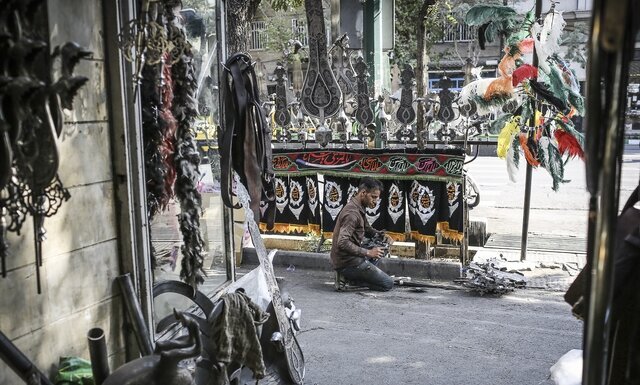
Tehran – Isfahan is the origin of Alam Making, one of Iran’s ritual crafts. The Crisis Standard (ALAMS) is used by Shiite communities in many parts of the Islamic world in the work of marking the martialism of Imam Hussain (AS), the grandson of the prophet Muhammad (Pbuh), who died in the Battle of Karbara in 680.
Rooted in the Safavid era, Aram’s art combines metalworking, lattice, calligraphy and plating techniques to create works that are not only symbols of Muharam’s mourning, but also embody the faith, art and collective identity of the people of Isfahan.
Not only is Isfahan known for its minaret and turquoise tiles, it is also the fabric and foundation of the art of alam making.
Alam is carried to the shoulders of mourners during the months of Muharam and Safa, but is in fact a product of dozens of arts fields and craft techniques used in religious and ritual forms.
Alam Making is a complicated process. In Isfahan’s old workshops, artisans create the Procession Standard (ALAM), a small exhibition of traditional Iranian art, using art such as metalworking, lattice works, sculpture, calligraphy, casting, plating, and even cloth flags.
One of the veteran artisans of this art, Majid Nesarari said: “To make an alam, you have to learn some crafts, such as metalwork, cutting, lattice work, plating, calligraphy, and more, which are not enough for yourself.
The history of Iranian “Alam Gardani” (standard transport) is not clear, especially among the Tehranian people. What is certain is that the ritual dates back to the pre-Vid era. It was a sign of the existence of tribes and families during the war, but the Safavid era, like other rituals of this era, made Alam the tradition, and the artists of Isfahan brought it to its peak.
The “Alam Gardani” custom took a new form during the Qajar era, with the flags becoming heavier and more flags added each day thanks to the efforts of Iranian artists. During the Naser Al-Din Shah Qajar era there were several famous alams associated with the capital of Tehran.
The oldest Iranian Aram is kept at the Top Kapi Museum in Istanbul, Turkey.
Perhaps these alams are examples of symbols and emblems of various Iranian tribes, which existed during the reigns of AQ Qoyunlu and Qara Qoyunlu Turkmens and were used by political and religious groups. These alams were war booty, and after the Ottoman capture of the Tabriz, Shah Selim moved to Istanbul.
There is also an alam at the Central Museum of Astan Kudos Razabi in Mashhad, Korasan Razabi province, which dates back to the 13th century and is built in Isfahan city.
In the 17th century AD, travelers such as Pietro della Valle mentioned the “metal matrix criteria” of Isfahan’s mourning groups during their travels. From that time, Alam became known as a symbol of Imam Hussein (AS) soldiers and loyalty, finding special places in the district and Tekkie (Tekkie) (confronting religious gatherings, then taking part in the streets in a group known as the Parade Dramatic Doahn’s Parade Dramatic Doahn’s Dramatic Doahn.
Aram in Isfahan is an old workshop like the “Kamran” that has been active since 1995 and has thrived in the months leading up to Muharam. The orders will be made from various cities in Iran and Iraq to create or repair Arams in Isfahan. After being prepared, each Aram is placed on the shoulder of the mourner while mourning, becoming the focus of a procession and group of people pounding the chest.
The art of alam making is not independently listed on the National Heritage List, but the rituals of Alam Making and Alam Gardani are listed on the National Intangible Heritage List that helps maintain the art of alam making. However, the decline in the number of traditional artisans, the disgust of the younger generation to learn this profession, and the high cost of metallic raw materials are threatening the future of this art.
KD