
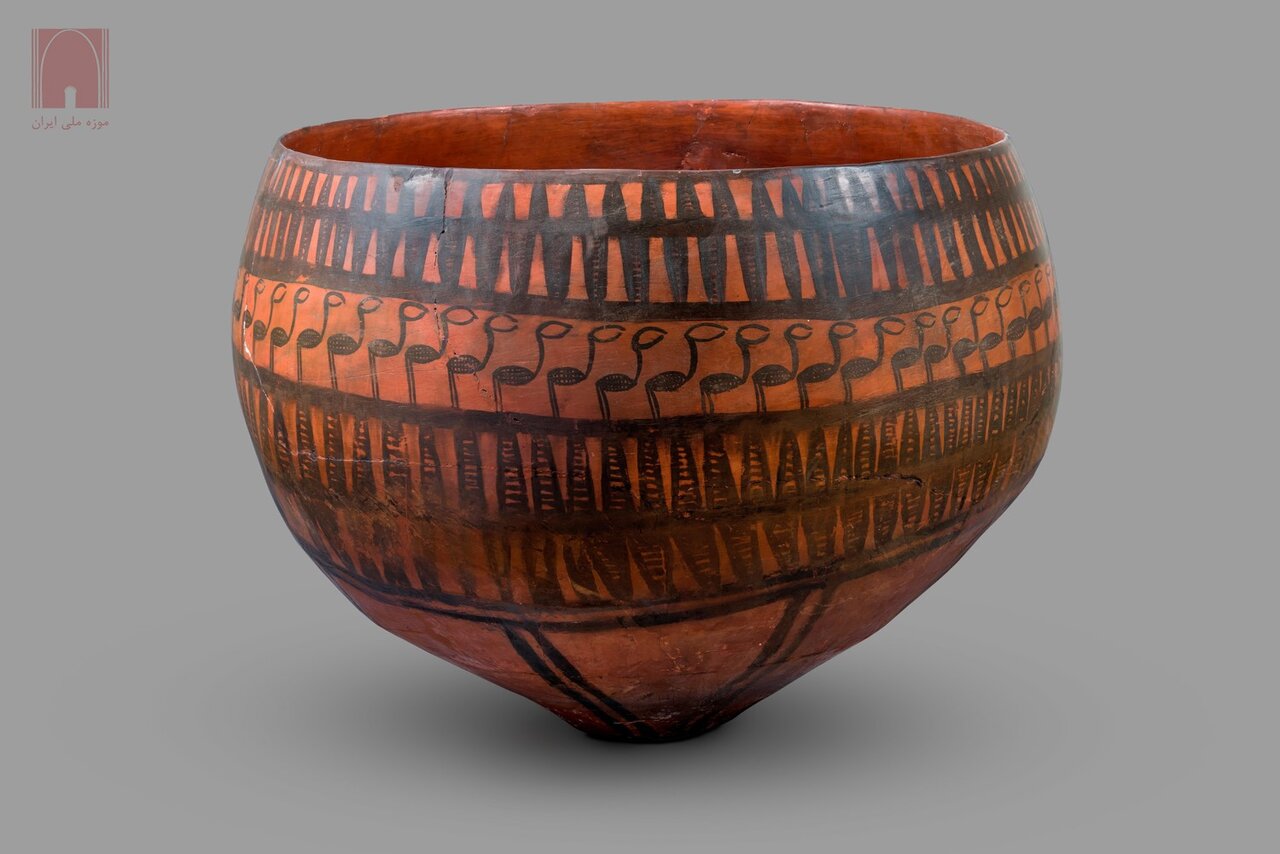
The container in the photo is a stunning example of the famous Cheshmee aliwear tradition dating back to the transitional Calcolithic period, approximately 5200-4800 BC.
Its surface exhibits a rich orange red colour, meticulously smooth and polishes to a soft sheen. The elegant decorations are performed with deep black pigments, and all motifs are rendered with fine, confident lines.
The shape and decorative scheme of the ship demonstrate the deep influence of the old traditions in basket measurements and woodworking. This is evident in the band of accurate hatched lines that assemble the central scene. This is a pattern that is very similar to the work of a basket weaver. The majority of Cheshmeh Ali Pottery is decorated with geometric designs such as stripes, chevrons and dots, but this piece is far less common and features more narrative motifs. The central register presents an impressive procession of long, long-necked birds, perhaps herons and storks, parading in horizontal bands. This portrayal is a great example of Potter’s skill, capturing the essence of local fauna with minimal yet extremely naturalistic strokes. Images of such animals, including goats, ibex and gazelles, are part of the ceramic tradition, which has very little human representation, but rare, is important.
Famous for its unique handmade construction, Cheshmeh Ali Ware decorative schemes are usually painted with black pigments on still wet surfaces, allowing for slightly blurry edges. In contrast to the common geometric or floral patterns, the presence of such complex animal figures in this large bowl makes it a prominent, unusual and important specimen in tradition.
Ismailabad or Mushelan Tappeh is located south of Tehran Kazbin Road and was first excavated by archaeologist Ali Hakemi between 1958 and 1961.
morning