
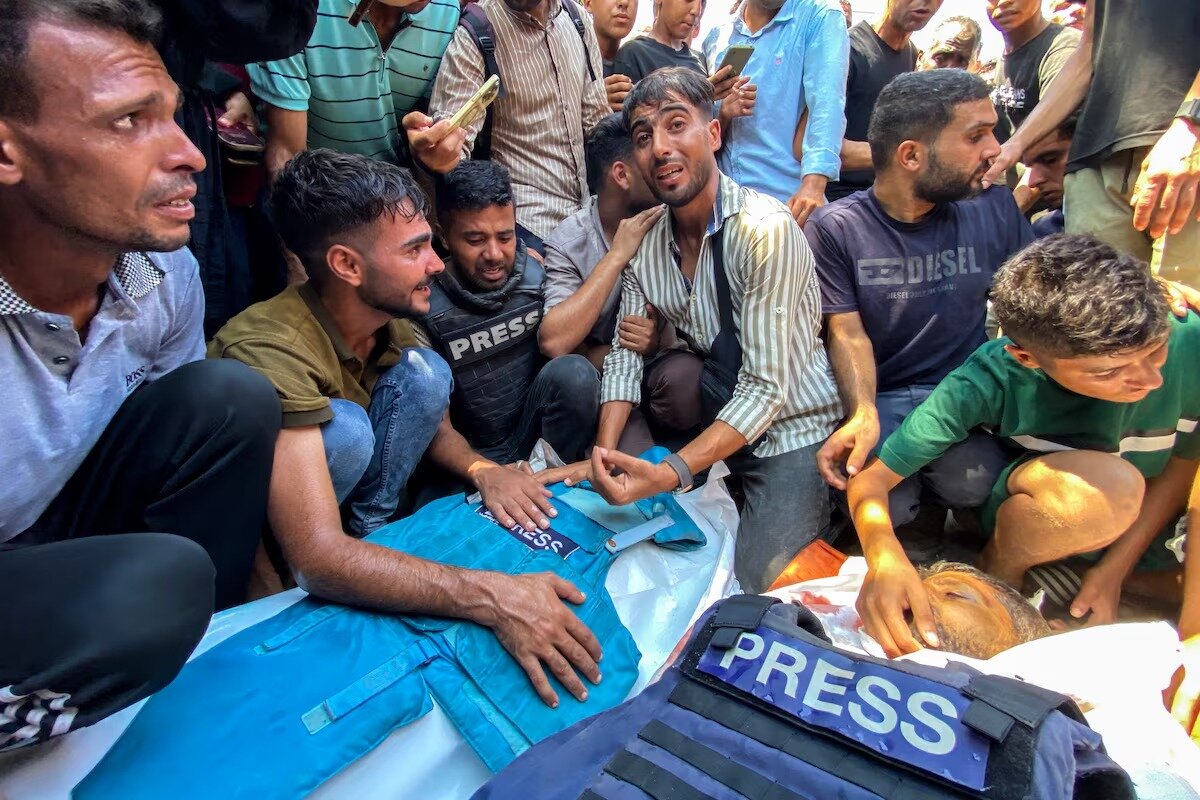
ISLAMABAD – Khan Yunis wakes up under an obscure dawn, and the silence echoing through the streets and roofs, Palestinian journalists have adjusted the cameras in preparation for a livestream on another day from an endless night in Gaza. Smoke wafted over the broken street. Sunlight caught some shards of glass. These exhausted journalists continued to fulfill their final obligation to record, witness, and keep their memories alive when others chose not to witness.
As Mohamed Salama of Al Jazeera prepared to set up a camera on the roof of Nasser Hospital, a loud metallic scream came out as the first missile hit. When medical professionals and fellow journalists rushed to pull the injured from the fragments, the second missile hit the same spot. It was a “double tap” strike designed to kill rescuers, silence witnesses and fill the story.
Mohammed Salama (Al Jazeera), Husam Al Masri (Reuters), Mariam Abu Dhaka (Applications), Morez Abu Taha, Ahmed Abu Aziz and Hassan Duhan were killed within seconds of six journalists, Hassan Duhan, an academic of Al Hayat Al Jadida. Their cameras were bloody on the rooftop and broken. At least 20 people have died, including stretcher patients, nurses transporting supplies between wards and paramedics carrying supplies.
This attack is not a result of chaos. That’s intentional. When a missile first targets someone holding a camera, it is by no means a coincidence. That’s an intention. Since October 7, 2023, more than 270 journalists have been killed in Gaza, as recorded by the committee to protect journalists (CPJs), making it the bloodiest period for the media in modern history. Nasser’s attack on the rooftop was not an isolated incident. It was part of a systematic campaign that stripped Gaza from its memory and buried eyewitnesses under the tiled rub.
The pattern began long before the missile. An investigation by the digital units of Bellingcat, The Intercept and Al Jazeera revealed a coordinated disinformation campaign that brands Palestinian journalists as “Hamas operatives.” Their livestream was removed, accounts overshadowed, and reliability was dismantled online. The assassination of this digital character was intended to make it easier to justify their ultimate death. When their voices were silent with the algorithm, their bodies actually made the target easier.
The nation amplified this erasure. Israeli military spokesman Daniel Hagali publicly labeled Palestinian journalists as Hamas infrastructure. Under policies such as meta’s dangerous organizations and individual control, social media platforms have deleted archives, suppressed live footage, and quarantined reporters in the last few hours, while deleting accounts that they mistakenly linked to banned groups.
Hospitals like Nasser, once a sanctuary, have now become theaters of destruction. Bombing where patients are injured, hitting where cameras flow through the truth, or crumbling the last shelter where memories are stored is not merely an attack on infrastructure. It is an attack on the testimony itself. Without journalists, the massacre will blend into conflicted numbers on the podium. Without images, the grave is rumored. Without witnesses, Gaza’s suffering risks being completely erased from history.
Justice relaxes when the camera silences. Each live stream, each photograph, and each recording is evidence and is possible display in front of the International Criminal Court or the International Court of Justice. By erasing the witnesses of Gaza, Israel not only rewrites the story, but also dismantles the possibility of accountability. Professor Jeffrey Sachs of Columbia University describes the campaign as an attack on the truth itself. Francesca Albanese, the United Nations Special Rapporteur, warns that there may be “rational grounds” to suspect these killings are part of genocide’s organized attempt to erase both the victims and their history.
The United Nations condemned these killings and called for accountability as soon as possible. Stephen Dujaric, a spokesman for UN Secretary-General Antonio Guterres, emphasized the urgency to investigate incidents such as the Nasser attack. Dujarric said Guterres does not have the authority to initiate international inquiries without being granted one by one by UNSC Resolution 2222, but Israel must adhere to existing mechanisms that ensure journalist protection as a civil infrastructure. He warned of “potential fears” when Israel continued its military attacks on Gaza city and said there was “no safe place within Gaza.”
The sadness reached even further, and until August 10, 2025, a simple white media tent stood outside the Alsifa Hospital in Gaza city. Among them was Anas Al Sharif, 28, of Al Jazeera, who had written another update for viewers. When an Israeli missile struck, it quickly killed everyone. In the tent, nothing survived except for cameras, equipment and stories they dedicated their lives to sharing.
Before the strike, Anas had recorded what would become his final message for us all to hear: “If these words reached you, I know they killed me and my voice.” Sadly, his voice remains heard across the roofs and newsrooms of Gaza by those who do not want to allow silence to engulf the truth.
From the rooftop of the Nasser Medical Complex to the media tents of the Al Shifa, the patterns are unbroken. The journalist hasn’t died by chance. They are excluded as their cameras stand between cruelty and accountability. It destroys witnesses and makes history itself negotiable. Bomb Archives and Justice are optional.
Today, six more names have been added to the list. Their cameras will never rise again. Their notebooks remained semi-written. Their broadcast will not arrive tomorrow. But their absence tells a more loud story than any live feed ever. Somewhere, under the ruins of Al-Sifa, perhaps the wind still carries the last words of Anas Al-Sharif. When the last witness is killed, it’s not just journalism that dies. It is the truth itself, buried with them, waiting for the day the world will decide that memory is worth defending.