
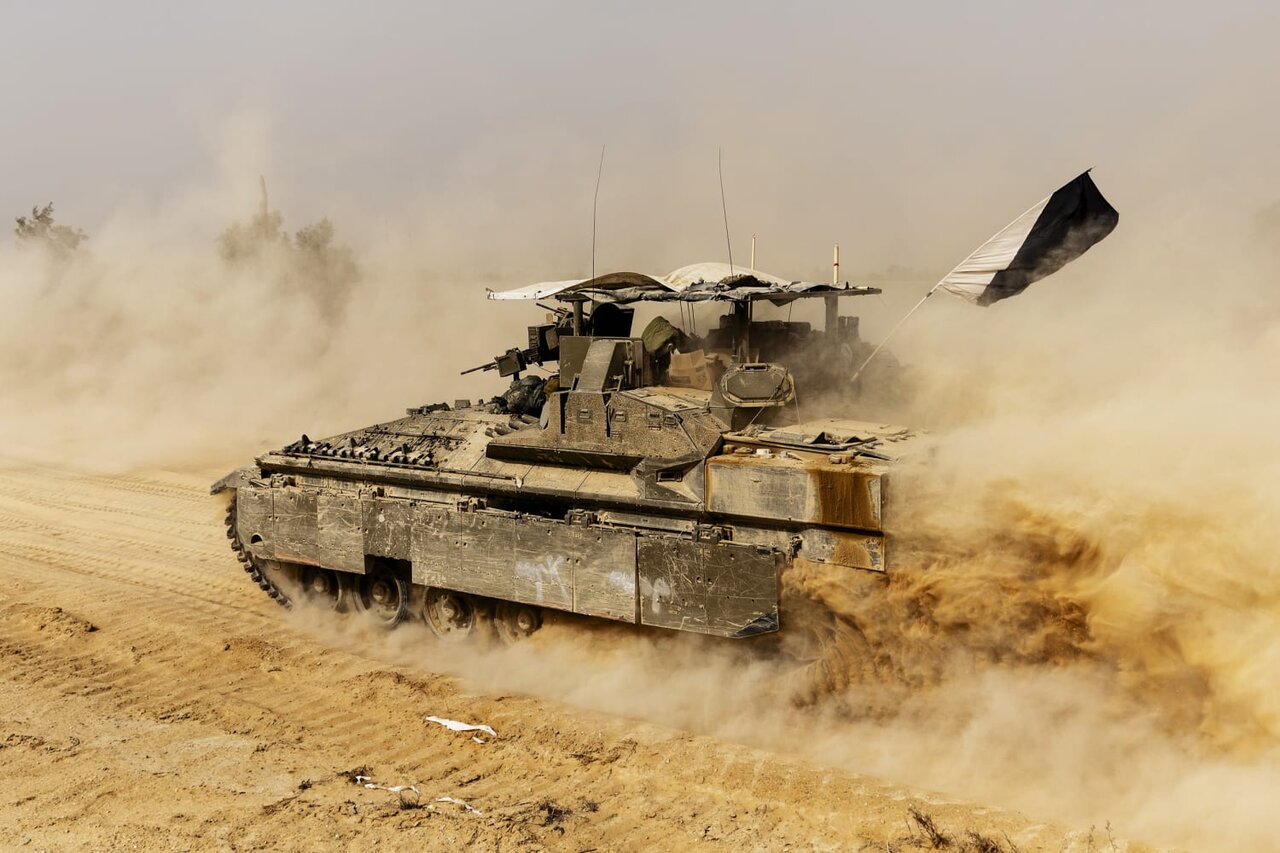
Tehran – Palestinian resistance is continuing operations against infantry in Israel’s occupation, seeking to invade Gaza city through the Zeitoun district.
The Al-Kassam Brigade announced that its fighter planes had attacked Israeli occupied Merkaba tanks and D9 armored bulldozers, using Yasin-105 missiles and Shawaz explosive devices.
The attack took place at Street 8 in the southwest of the Zeitoun district of southern Gaza city.
In a statement, Hamas’ armed wing confirmed the strike and said the attack took place during an attempted invasion by the Israeli Occupation Forces (IOF) near Zeitoun.
In another statement, Alcasam said their resistance fighters fired a gathering of IOF soldiers and vehicles with multiple mortar rounds south of the Zeitoun region.
Israeli media reported that a Palestinian resistance fighter fired an anti-tank missile at an IOF tank in Jabaria, northern Gaza, and crashed into the vehicle, before a soldier was injured. According to Al-Kassam, “A Zionist carrier with a very explosive mine was destroyed near Al Nazra, west of Jabaria, and monitored attempts to evacuate helicopters.”
Meanwhile, the Al-Quds brigade said it had destroyed a Zionist military vehicle near the Arsabla Clinic in the Arsabla district of South Gaza. The armed wings of Palestinian Islamic Jihad also said that its resistance fighter captured control of an IOF drone that conducts intelligence in the airspace of Khan Eunice.
Al-Nasser Salah Al-Din Brigades said it launched a barrage of 60mm mortars at IOF near Hassan Al-Banna Mosque in Deir Al-Balah city in central Gaza.
Seven IOF soldiers were injured a few days ago when an explosive device exploded under Zeitoun’s Namah Armored Personnel Carrier.
The regime’s failure to capture the Zeitoun neighborhood without retaining the casualties caused a wave of fierce and deadly airstrikes throughout Gaza City. These strikes target private and residential areas, leading to massacres against Palestinian civilians, killing dozens of people in the past 24 hours and increasing scores. Most of the victims are women and children.
Officials from the Israeli government said Netanyahu security ministers convened to discuss the next phase of the attack planned to seize Gaza city, known as Hamas’s last fortress.
The same argument was used to justify the February 2024 invasion of Rafa. Netanyahu told Western media that the “last Hamas Battalion” was located in the southernmost city of Palestinian territory.
According to Yedioth Ahronoth, IOF Chief of Staff Eyal Zamir tried to convince the administration’s security ministers to cancel their decision to re-occupy Gaza city.
However, Prime Minister Benjamin Netanyahu and the key ministers have insisted on moving forward with the plan. Zamir reportedly believes the current terms are ripe for partial deals to ensure the release of Israeli prisoners of war.
Journalist Yev Zitun also wrote for Yedios Afronos and raised concerns about Israel’s delay in response to potential deals. He questioned whether the long-term deployment of Gaza soldiers was truly intended to restore prisoners of war, or whether it was a political manipulation for Netanyahu and Minister Bezalel Sumotrich to maintain advance access for resettlement in Gaza.
Zitun also noted that the Israeli (occupying) Army is currently planning new routes for Gaza’s next military operation. Officially, the target is tactical and segregated the neighboring Hamas brigades, but given the ongoing political stagnation, some suspect that these routes will later be used as negotiation tips or even to lay the basis for a settlement expansion.
Hebrew newspaper Maariv reported that 60,000 IOF reserves will begin rolling out and join the 70,000 others already mobilized. The original call-up order was extended for an additional 40 days.
The IOF is about to re-enter Gaza City for the 10th time since the war of massacre began. In previous surgery, the occupying regime’s army suffered major losses as 100 dead soldiers and many other soldiers were injured.
Military estimates show that fighting in Gaza city will be extremely complicated. It is a dense urban area with an extensive underground network. Hamas has been preparing for months by planting explosives, strengthening buildings and tunnels, setting up ambush, and deploying snipers and tank anti-tank units.