
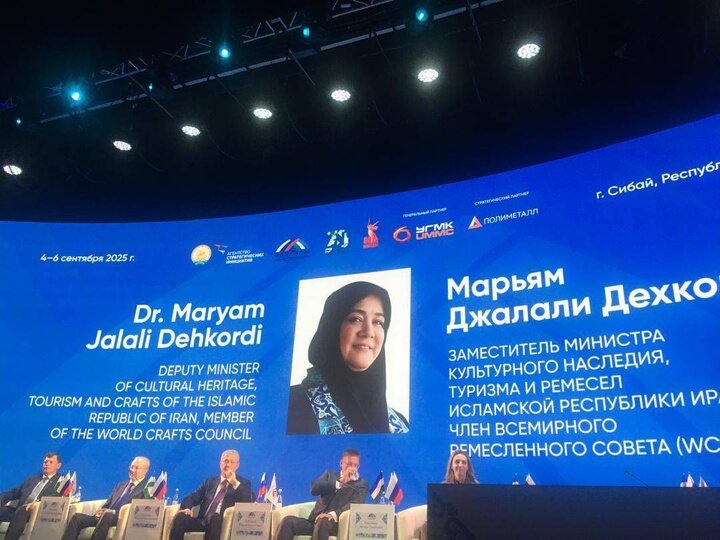
TEHRAN – Iran’s Deputy Minister of Handicrafts and Traditional Arts said on Saturday that Handicrafts proposed a joint initiative with Russia’s Republic of Bashkortostan, serving as a tool to develop creative economy and cultural diplomacy.
According to Miras Aria, the state-run news agency, Mariam Jalali Dékordi, deputy minister of the Iranian cultural heritage, tourism and handicrafts ministry, made a statement during the Sibei Investment Conference and the UNESCO expert meeting in Bashkortostan.
The meeting attended by the head of Bashkortostan Republic provided an opportunity to expand economic and cultural cooperation between Iran and the region, the report said.
Jalali- Dekhordi took part in the World Craft Council (WCC) Assessor session held in Bashkortostan, highlighting what is called the key role of crafts in economic development and cultural diplomacy.
“Handicrafts are not only narrators of the past, but by combining tradition and innovation, they can help us build a sustainable future,” she was quoted as saying by CHTN on Saturday. “They generate income at the local and international levels, generate decent jobs and attract tourists.”
She further highlights the historical link between Iran and Bashkortostan along the Volga-Rural Trade Route and the Silk Road, describing handicrafts as a bridge for stronger cultural and economic cooperation.
Elsewhere in her remarks, Jalali-Dehkordi proposed to hold joint workshops, mutual exhibitions in the historic city, and documentary of handicraft knowledge to deepen collaboration between the two sides.
She also highlighted the importance of UNESCO’s Living Silk Road Network, saying that international exhibitions and artisan interactions can enhance the creative economy and showcase shared experiences.
According to Jalali-Dehkordi, Iran has 299 active handicraft branches, 17 cities and villages designated as craft cities and villages of the world, with 82 being recognized at the national level, and she describes it as a resource for cultural tourism and sustainable economic growth.
She praised Bashkortstan’s handicrafts, including silver gems and traditional embroidery, as valuable assets for expanding bilateral cooperation.
Sibeye, located in the Urals on the historical boundary between Europe and Asia, has applied for recognition of crafts such as stone and wooden paintings, stone carvings, felt-making and traditional women’s clothing and jewelry. Over 100 artisans on Sibay work in fields such as stone and wood carving, pottery, feltmaking, carpet weaving, embroidery and jewelry making. The city has linked craft developments to plans to expand cultural tourism.
morning