
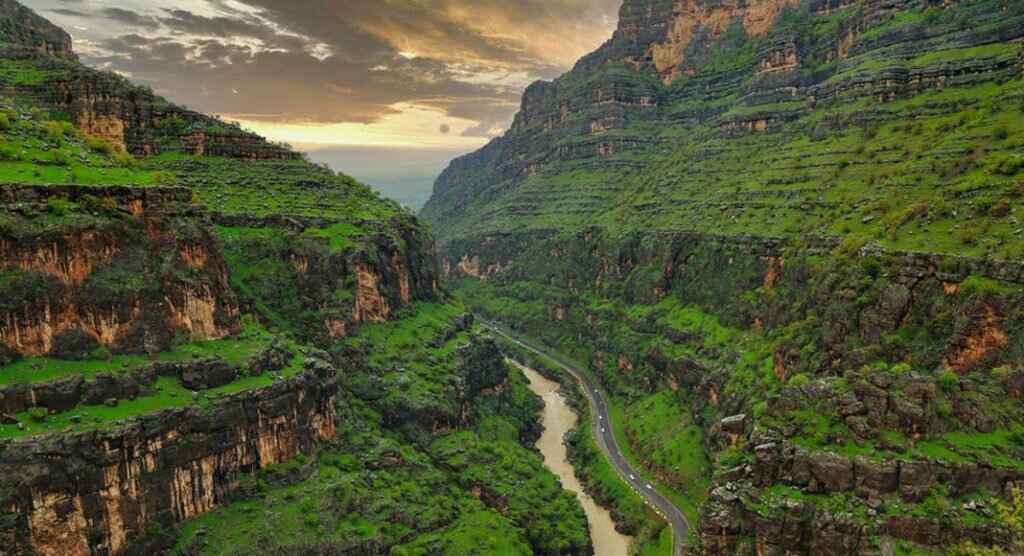
Tehran – Kordestan is a region with ancient history and culture, breathtaking nature and kind people. It is a state that boasts rising mountains, terraced villages, authentic Cordi music and enduring handicrafts. It has an unparalleled ability to attract domestic and international tourists.
With its diverse national and historic charm, the province is considered one of the important tourist destinations to the west of Iran, Isna writes.
The experience shows that whenever conditions are preferred, the state accommodation is full of visitors eager to explore its cultural and natural locations.
Conversely, the crisis and shortages in transport and welfare services have resulted in a significant decline in tourism.
On the one hand, statistics provided by officials in the Cultural Heritage and Tourism sector in Kordestan show a significant increase in travel this year. Meanwhile, issues such as limited accommodation capacity and flight restrictions remain obstacles to tourism development in the region.
These figures clearly indicate that Kordestan needs investment in tourism and cooperation between all relevant institutions to achieve a legitimate location at both national and international stages.
Teimore Kaledi, deputy director of the Kordestan Cultural Heritage, Tourism and Handicrafts Bureau, noted that tourist arrivals had increased by 20% before the 12-day Israeli war with Iran. Currently, the state has 31 hotels, 21 guesthouses, 51 eco-lodges, 5 traditional accommodations, 1 boutique hotel and 4 hotel apartments, offering over 7,000 inventory stays.
He said that from the beginning of the year until the 12-day conflict began, Kordestan saw a growth of over 20% in tourism, occupying the accommodations entirely. Unfortunately, the onset of conflict has sometimes reduced the number of tourists to a large extent, as it remains the most important factor in choosing a destination.
Khaledi added that recovery has begun in recent weeks and that several accommodations have been fully booked. He pointed out that it includes creating more than 40 promotional clips and teasers, publishing content on social media, and distributing over 150,000 promotional items such as maps, brochures and CDs.
He highlighted the role of local residents in promoting attractions, noting that many villagers, eco-lodge owners and hoteliers promote independently on social media and contribute significantly to the state’s visibility.
Khaledi reiterated its current accommodation capabilities and urged tourists to use only licensed agencies and official centres to ensure safety and quality service.
He emphasized that tourism development is not just a responsibility of the cultural heritage sector, but a cross-sectional effort. He said all agencies must participate as poor roads, inadequate emergency services or any incident can have a wide range of negative consequences on tourism. He expressed his hopes for sustainable growth through collective efforts.
Golan Falzami, a local cultural heritage official, also said the state has 1,260 registered history, culture and tourism sites. Over 3,400 domestic and international tourists visited the attractions in Kordestan in the last 15 days of Iran’s month, he added.
Fazami emphasized that Kordestan, with its rich collection of registered sites, is an important tourist hub in western Iran. Since the beginning of this year, 27,699 cultural tourists have visited the state, visiting 195,342 general attractions and 18,049 people to historic buildings and museums.
During the last 15 days of Sharibal, 3,441 visits were recorded, including 2,829 domestic tourists and 612 international tourists.
He highlighted the global perception of some of the historic sites of Kordestan, noting that Uramanat is listed as a UNESCO World Heritage Site. The province also holds a special place for music and crafts, and Sanandazi is recognized as Iran’s creative music city.
Farzami says 122 accommodation centres, including hotels and eco-lodges, are currently active in the state, but this capacity is insufficient for large numbers of travelers. It is essential to expand the infrastructure of accommodations, he added.
KD