
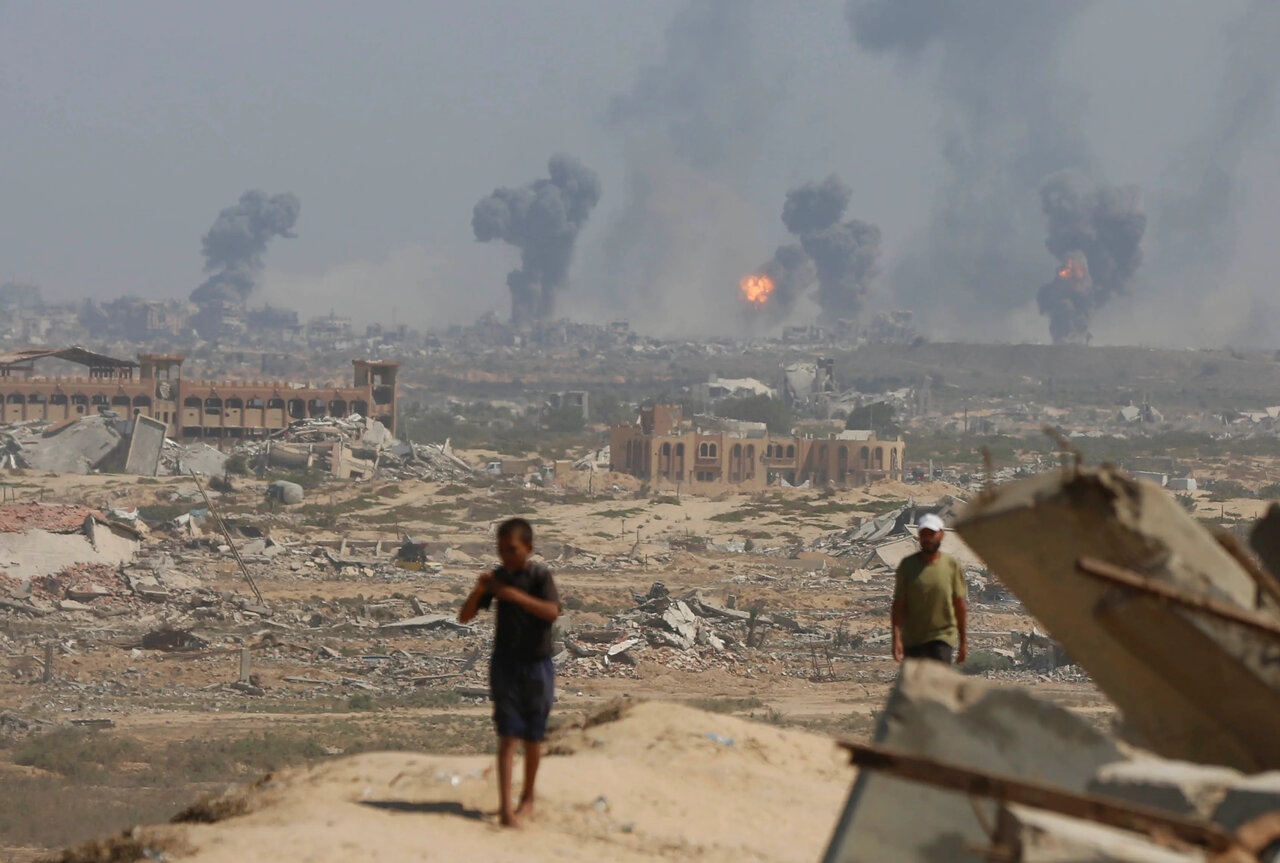
Tehran – Israeli forces have stepped up their attacks in Gaza city and unleashed a combination of airstrikes, drone attacks and ground attacks.
Witnesses explain Friday’s “apocalyptic” destruction as civilians flee south in a desperate search for safety, and many are forced to walk for hours to carry only what they have. Telecommunications blackouts have crippled rescue operations and obscure the true scale of the victims.
Olga Celevko, a spokesman for the UN’s Humanitarian Office, told the BBC that she personally witnessed the devastation during her 14-hour 29-kilometer trip to Gaza city. “What’s there, and the scene on the way to Gaza city, is nothing but a cataclysm,” she recalls.
Cherevko explains the constant flow of people heading south on foot, leaving hundreds of thousands trapped in the city. Her UN convoy became a nearby mistake from an Israeli strike, highlighting the dangers to both civilians and aid workers.
Israeli forces argue that the operation is intended to dismantle Hamas battalions, release prisoners of war, and eliminate what it calls “terror infrastructure.”
But humanitarian agencies say that tactics that go from multiple directions and force families towards the coast are equivalent to a systematic compression of civilians into reduced and dangerous areas. As many in Gaza have declared evacuation zones, aid groups claim there is no true “safe zones” remaining.
The hospital is collapsed under double weight of gunfire injuries and hunger. The World Health Organization warns that critical facilities have run their intended capabilities several times, with life-saving supplies being blocked at intersections.
Gaza’s Health Ministry announced Friday that the hospital has recorded at least four new deaths from hunger and malnutrition in the last 24 hours, bringing the overall casualties of hunger-related deaths to 440, including one child, since the start of the war in October 2023.
The ministry added that since March 18, more than 12,600 people have been killed, more than 54,000 have been injured, at least 2,514 Palestinians have been killed and more than 18,400 have been injured while trying to access food and aid.
The displacement has increased sharply. Since mid-August, more than 200,000 people have fled North Gaza, and Israeli forces estimate that nearly 480,000 have left Gaza city, including 55,000 in the past week.
Many of those arriving south find no shelter and sleep on the streets, as aid workers describe families carrying mattresses on their backs or pushing older relatives in wheelbarrows.
As Gaza city withstands the relentless fire, the United States once again blocked its ceasefire plan at the UN Security Council on September 18th.
The resolution, supported by 14 members, called for an immediate and unconditional halt to hostilities and unlimited humanitarian access. Washington refused to do such a sixth since the war began, claiming that the texts denounced Hamas or did not grant Israel’s right to self-defense.
Outside the United Nations headquarters in New York, the demonstrator booed and cried out, “I won’t shame you!” In the US, Morgan Ortags represented Washington in the session.
The Palestinian group responded to anger. Hamas denounced the veto as “blatant accomplice” and “green light” for the continued massacre. Islamic jihad accused the United States of acting as a “real partner” in the war. Palestinian ambassador Riyadh Mansour called the move “deeply regretful and painful.”
Human rights groups warned that veto protection Israel from accountability and entrench humanitarian disasters.
Southern shelters are overwhelmed, hospitals collapse, starvation deaths climb, international calls grow as Washington continues to block. For civilians trapped in Gaza, the cost of delays is measured by the lives lost every hour.