
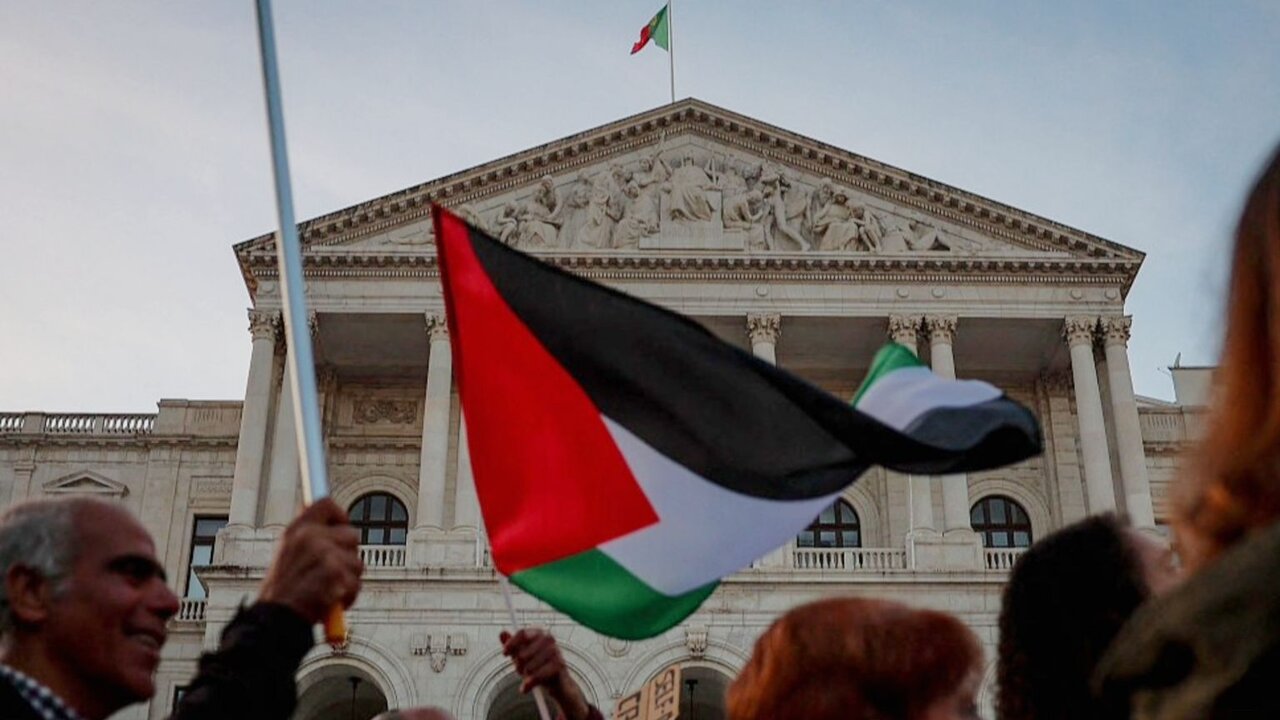
Lisbon announced on Sunday that it would officially recognize Palestine, ahead of a high-level meeting at the United Nations General Assembly (UNGA) in New York.
The decision positions Portugal amid the rise in Western countries that are changing foreign policy to support the Palestinian state.
Portugal’s Foreign Ministry confirmed the move in a statement released on Friday. This recognition is set to occur one day before the UNGA meeting.
Prime Minister Luis Montenegro, along with President Marcelo Rebello de Souza, consulted with Parliament before completing the decision, marking the pinnacle of nearly 15 years of debate in the country’s parliament.
The proposal for approval was first introduced in 2011 by the left-block political party, reflecting a long-standing commitment to supporting Palestinian rights.
The Portuguese decision is on top of international criticism of Israel’s military action in Gaza, bringing a worsening humanitarian crisis with over 65,000 dead Palestinians.
The United Nations Committee on Independent International Search recently concluded that Israel’s actions in Gaza amount to genocide.
Pro-Palestine demonstrations occur regularly in Lisbon, with thousands of protesters taking them to the streets to end ongoing violence and occupation.
These demonstrations have played an important role in influencing public opinion and political leaders, contributing to Portugal’s decision to recognize Palestine.
The decision is in line with a wider international trend as several other countries announced plans to recognize Palestinian states in the coming days.
France, the UK, Canada and Australia are among the countries expected to make similar announcements during the UNGA conference. These countries join a coalition of over 140 UN member states that already recognize Palestine as a sovereign state.
The US and Israel have strongly criticised the moves, and Israeli officials argue that such perceptions reward terrorism and undermine efforts for peace.
However, many observers emphasize that awareness alone is not enough. Without concrete measures such as ending the siege of Gaza, halting the expansion of settlements, and enforcing accountability under international law, they warn that symbolic gestures will leave behind the reality of their profession and not change the reality of daily suffering.