
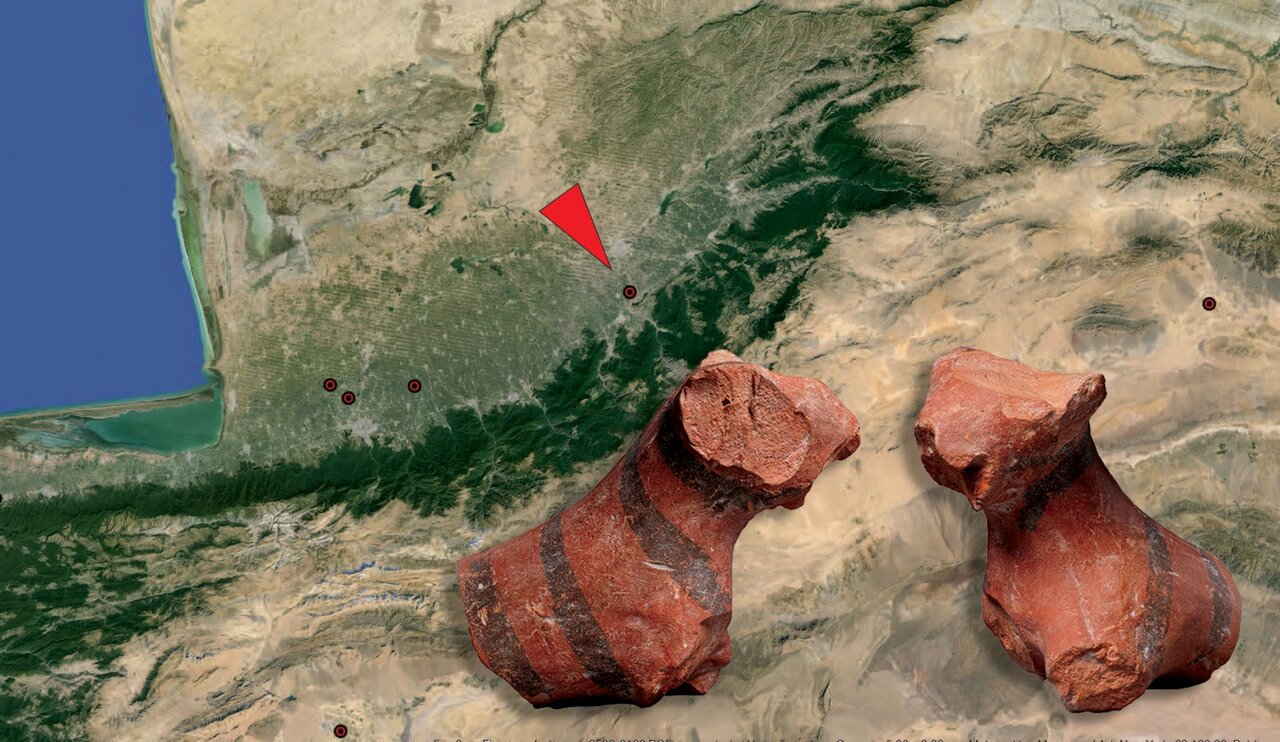
Tehran – A seemingly inconspicuous fragment of clay, raised for decades in the Metropolitan Museum of Art collection, has been identified as a groundbreaking archaeological discovery. New research confirms that artifacts are one of the oldest known depictions of tigers, and one of the depictions that shape the history of the role of animals in Iranian art and culture.
This study, published by Henry P. Colburn in Journal Anthropozoologica, focuses on the Calcolithic period figurines (from 3500 to 3100 BC) excavated in Yarimtepe, Iran in 1960. Made from the distinctive “Caspian Black on Redwear” ceramic, the object depicts a striped cat that Colburn identifies as a Tiger.
“For the Romans, the ‘Hikane Tiger’ symbolized exotic eastern ferociousness, but there was no evidence that the community within Haikanaia itself (Modern Golestan) expressed this early,” Colburn said. “This figurine reveals the deep local origins of the tiger’s iconic power.”
The figurine obtained by Met in 1963 measures slightly 8 cm and preserves the animal’s chest, neck, and partial head. The striped curves carefully painted along the body are the central and intentional features of its identification.
Previously, it was believed that the Tigers had entered the Iranian iconography through foreign influences. They appear much later during the Sasanian Empire (c. 224–651 ce) to ornament the royal silverware in a hunting scene that shows the king’s rule over nature. Scholars have long believed that these images were imported from Central Asia, where the depiction of Tiger has ancient roots.

“The Lions ruled Iranian art because they lived in Plateau. Tigers weren’t,” explained Kolburn. “In this way, Sasanian tigers were seen as artistic borrowing rather than native motifs.”
Yarim Tepe reverses this view. The Caspia Tiger (Pantera Tigris Virgata) once roamed the Hikane forest, where Yarim Tepe is located. The people there lived with these apex predators.
Object dating was achieved by ceramic analysis. The “Caspian Black on Redwear” style is well documented on northeastern Iranian sites like Turentepe and Teps Hissar, offering solid dates around the 4th millennium BC.
Although initial use remains unknown, Colburn suggests that it may have served as a marker of local identity. Its handheld size may have enabled safe and intimate engagement with predator images, perhaps for guidance and storytelling. Even that medium-sized ceramic clay may have evoked wonders by turning everyday materials into powerful symbols.
“This object stands on the head of a long, artistic lineage,” concluded Colburn. “It shows that cultural relations with the tigers existed in Iran’s millennium earlier than previously believed.”

The discovery has gained further support from archaeological discoveries in nearby areas. Fereidoun Biglari, an archaeologist at the Iranian National Museum, called the figurine “an important indirect evidence of the existence of late prehistoric tigers.” He said recent excavations at Ilginry Depe in southeastern Turkmenistan discovered tiger bones from the same era.
“Together,” Big Lari said, “The Iranian clay tiger and the physical relics of Turkmenistan show that humans and Caspian tigers share a complex history in this part of the world for at least five,000 years.”
morning