
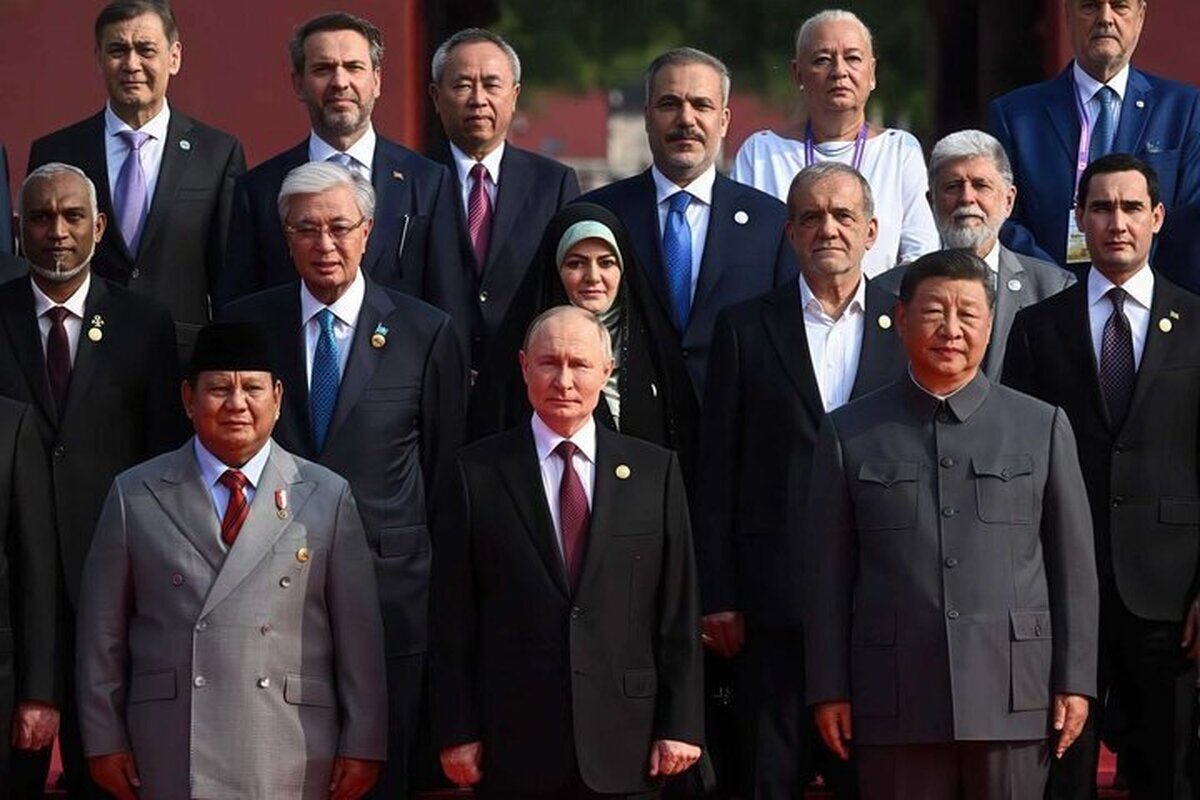
Shanghai – The first week of September witnessed the Milestone SCO Summit and the epic gathering to commemorate the 80th anniversary of the resistance to Japan’s aggression and the war against the world’s anti-fascist war. Iranian President Masuud Pezeshkian was present with the provincial chief, government and representatives from over 20 countries.
The two events certainly mean a major shift in global power as China has demonstrated its political leadership in shaping the agenda of global governance and protecting the postwar international order and its hard military forces.
There are always questions and questions, and even challenges about what kind of actor China will become. Will China grow into another hegemonic force, like the United States and other hegemony, in the history of humanity that puts pressure on others? Will China bully other countries with the military?
These questions were raised and raised 20 years ago, and are raised by people all over the world, including Iranian friends. However, modern Chinese history and practices show that China can always be a reliable partner for Iran and other countries struggling with peace and justice.
First, China is a peaceful country and will not become a hegemonic force. Unlike most other ancient forces, China has continued to respond defensively and responsively in its strategic stance over its long history. For thousands of years, China has built a wall to prevent it from being plundered and taken away, and has continued to practice this kind of practice in its ancient history. The Great Wall drove over 20km across the territory of the northwest, northeast and northeast.
China has built powerful military forces and strategic theories like the art of war by Sun Tzu, but these forces were not the cause of threats, but the result of responses to external invasions by nature. Put another way, despite military accumulation, China’s strategic culture has long been defensive and responsive. For thousands of years, the spirit of the Great Wall, among other things, has become part of the DNA of Chinese culture.
Despite its strong army, China has never attacked its neighbors. This is very easy to check in history books. Unfortunately, it was Japan that gained military advantage for a very short period of time from the 1890s to 1945 to 1945.
In modern times, China has built a very powerful army, especially in the last 20 years. However, China refrains from using military measures to address issues related to the integrity and sovereignty of its territory, while others have been able to legally traverse military solutions. The tensions behind these issues are much more critical in defining future international orders than issues other regions. Although it is doubtful whether this kind of restraint will be infinite in the face of provocation, China is expected to exercise its maximum restraint in its strategic competition with the United States.
China and Iran’s relations are peaceful and harmonious in history and in modern times. The two are connected and learn from each other through the ancient Silk Road. Many of the Chinese cultural elements are actually from Iran, and many Chinese artworks, vegetables, fruits and pet animals were born in Iran. In modern and modern times, China is the only major country that has never attacked Iran and has never exercised economic pressure on Iran.
Secondly, China is a country that respects sovereignty and follows a policy of non-intervention. The history of modern international relations is a beautiful name for interventions, originally referring to positive treatments for treatment, and there are far too many cases of Western intervention in domestic politics in non-Western countries. And interference in the name of intervention is even considered a great power and a superpower privilege.
Confucius insists that we should never do anything to others that you dislike yourself. China defends five principles of peaceful coexistence, clearly states its policy of respecting sovereignty and mutual non-interference in each other’s internal affairs, and has adhered to these principles dealing with relations with other countries since the establishment of China’s Republic.
Interference is essentially a manifestation of political arrogance. Western countries, if not all, do not actually recognize political systems in non-Western countries, including that of Iran, one of the deep reasons behind tensions between the US and Iran. They call all non-Western political systems authoritarianism or dictatorship.
However, China is a sharp contrast in this respect. China wants to view Iran’s development and prosperity as a key regional and international actor, as it recognizes and never challenges the political legitimacy of Iran’s Islamic Republic. In this regard, while meeting Iranian President Pezeshkian in October 2024, President Xi Jinping’s speech is very clear and sincere. At the meeting, he said that China supports Iran in protecting the sovereignty of the nation, security and the dignity of its people, and is steadily moving forward with its own economic and social development.
Simply put, China does not interfere with Iran’s internal harm and hopes that Iran will become politically stable and strong.
Third, China is a country that supports a favorable approach to both sides in economic relations. It is taken for granted that a country seeks its greatest interest in trade and other economic involvement, and bargains are the way to achieve that goal. This kind of mentality exists in Western business culture and other cultural contexts.
However, traditional Chinese culture represents a reasonable profit instead of a unilateral maximum profit, with the Chinese believe that only balanced business relationships make their business sustainable.
Many official Chinese documents have officially written that China calls for cooperation in favor of both sides. This means that China will pay the profits of the other side, and both businesses should bring about reasonable profits. Some partners were trying out BRI. This is because they are worried that profits are not balanced, even though they are certainly not necessary. However, it should be noted that trade issues such as deficits and surplus can always be the result of a variety of different reasons.
China is one of Iran’s major economic partners and reflects well the complementary nature of the two economies. However, there is no evidence that China intends to exploit Iran’s economic resources. Because of sustainable economic relations, China needs to address the issue in a timely manner, but there is no reason to maximize its profits.
Lastly, China is a country ready to support the legitimate cause of the nation to fight for justice. President XI has repeatedly mentioned China’s support for the cause of justice in the international community. He said on September 3, 2025 that “hurves that history must remain unshakable in the belief in justice,” “may rule the moment, but the righteous may win forever,” and “justice, light, progress inevitably win evil, darkness, and regression.”
The history of China-Iran relations has seen mutual support for justice. Iran has demonstrated political support for China to fight for justice on several territorial issues. China was a strong supporter of Iran’s struggle for justice on the nuclear issue.
The recent 12-day war saw a brave battle for Iranian justice, and China has fully demonstrated its support for Iran in this respect. President XI made a four-point proposal to call for an immediate ceasefire. China’s Foreign Minister has arrived twice with Iran’s Foreign Minister with a message of support. China also proposed a resolution by the UN Security Council on June 23, calling for an immediate ceasefire along with Russia and Pakistan.
Mutual support for the fight for justice is one of the prominent features of China-Iran relations. The world can see a one-sided revival, and mutual support for the cause of justice becomes a critical feature of China-Iran’s relations.
In summary, China is certainly not a potential hegemonic force, but a peaceful country worthy of trust in Iran and others. The above are just four of many aspects that make China’s credibility clear as a partner, despite the fact that more evidence can be found in ancient and modern history.
China is widely recognized as a partner in Iran and other countries around the world. However, efforts to demonize China’s image have always been in the West, which is very harmful and very harmful to China-Iran’s relations. Both China and Iran must be on constant alert against demonization and defamation.
President Pezeschkian’s recent visit will add a very strong new momentum to the relationship between the two, and the relationship between them will see new milestones. But the obstacles can always be there, mainly due to technical issues. It is reasonable to expect high expectations of a partnership, but it is also necessary to manage expectations of the relationship between the two, as overexpression can also damage the relationship.
Jin Liangxiang is a senior fellow at Shanghai International Institute (SII).