
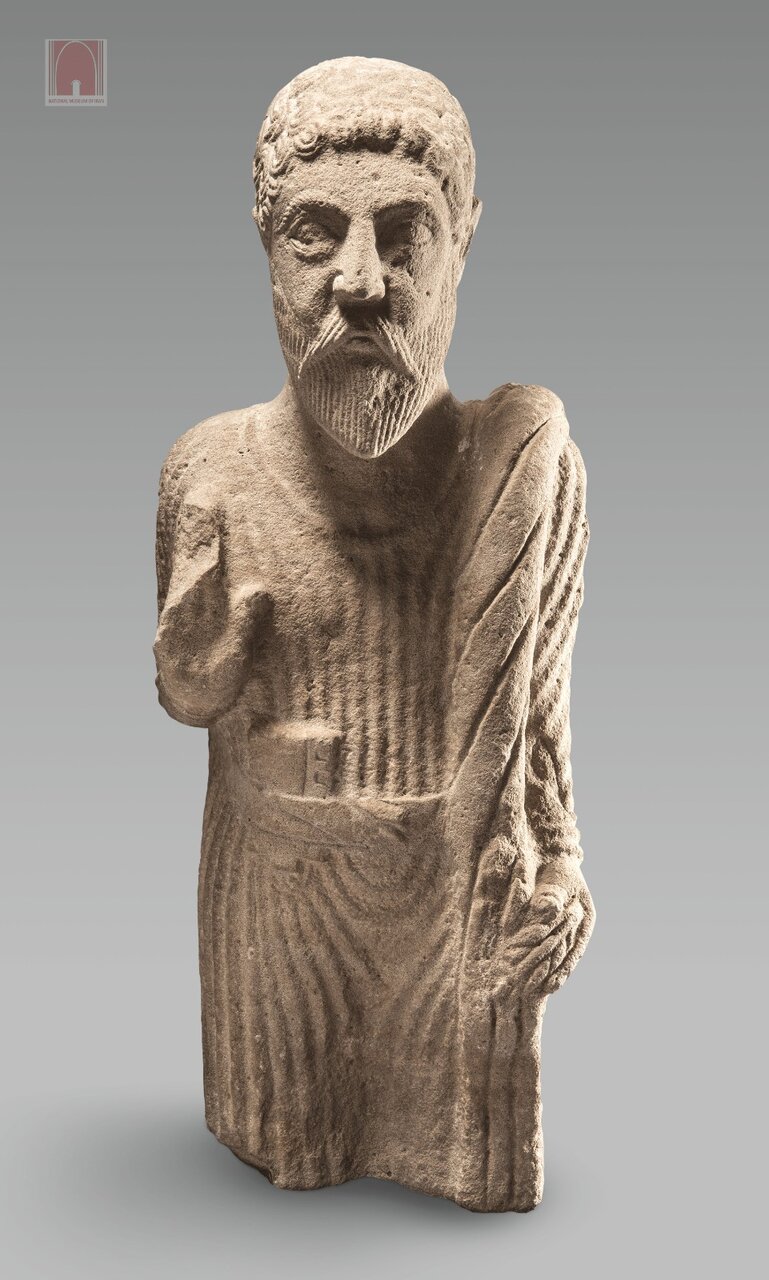
Discovered by an Iranian oil company in Karga Zarin, southwest Iran, the statue is an important discovery accompanied by a storage of Seleucos and Parthian coins.
Stylistic evidence shows its production at the Elimaian Workshop, part of the known artistic tradition that produced statues of Bird et Neschande and Masjed Soleiman. Through analysis of the techniques and forms of sculpture, scholars attribute its creation to the period from the mid-1st century BC to the late 2nd century CE.
This finely carved limestone figure, kept at the Iranian National Museum, depicts a man with distinct and stylized features. It has short, tightly curled hair placed in a semicircular ringlet, large, arrested eyes, and a long pointed nose, complemented by a full whisker and mustache. His attitude is one of respect. His right arm is bent towards his elbow, with his hands raised in the open palm of his hand in a classic gesture of worship, his left arm hanging from his side, clutching the plant element.
His outfit gives an incredible glimpse into Elimai’s culture. He wears a long sleeved, knee-length rounded tunic, and is covered in a simple belt around his waist. About this, a long, twisted sash or shawl is hung over his shoulder and falls across his chest and onto his back. The charming details are rectangular objects fastened to his belt, featuring holes and rings. This is interpreted as a ritual key designed to be inserted into a lock plate. The sculptors paid attention to parallel vertical folds that elegantly track the contours of the body’s anatomy to inscribe parallel vertical folds that penetrate the U- and V shapes beneath the belt.
The lower limbs and knees are lost in time, but evidence of the construction of the statue remains. Two small holes with traces of iron bars under the tunic indicate that the legs are made separately and attached with metal support. Based on comparable numbers, it should have been shown that he was wearing the distinctive long pants in a Parthian dress.
Ultimately, this statue is a powerful example of a wide range of artistic and religious traditions. The raised right hand and open palm are familiar motifs of Mesopotamian art from the late Parthian period, clearly identifying him as a worshiper. Through his exquisite craftsmanship and symbolic poses, this person provides a direct and concrete connection to the spiritual practices and artistic practices of the ancient Illymaians.
The Elimaics were semi-independent states that frequently depended on Parthian rule, and flourished from the 2nd century BC to the early 3rd century AD in the rugged Zagros Mountains of southwestern Iran (Quezestan). The Elimai people were probably descendants of the ancient Eramiites and worshiped the syncretic blend of the Semitic and traditional Eramitic gods. Famous for wealthy temples that even the king of Seleucus tried to plunder, they controlled important trade routes and maintained sustained autonomy despite Parthian hegemony. Their kingdom was a vibrant intersection, combining local tradition with Hellenism and Parthian influences. Known from classical sources and monetary evidence, the political history of the Elimaicans has changed alliances and is one of the repeated conflicts between the Seleucian and Parthian empires. This statue of worshippers is a direct product of its refined and unique culture. The final end of the Kingdom of Elimaian, when conquered by King Aldasir I of Sasanian, reached around 221 AD, marking the end of its distinct political identity and its absorption into the highly centralized Sasanian Empire.
morning