
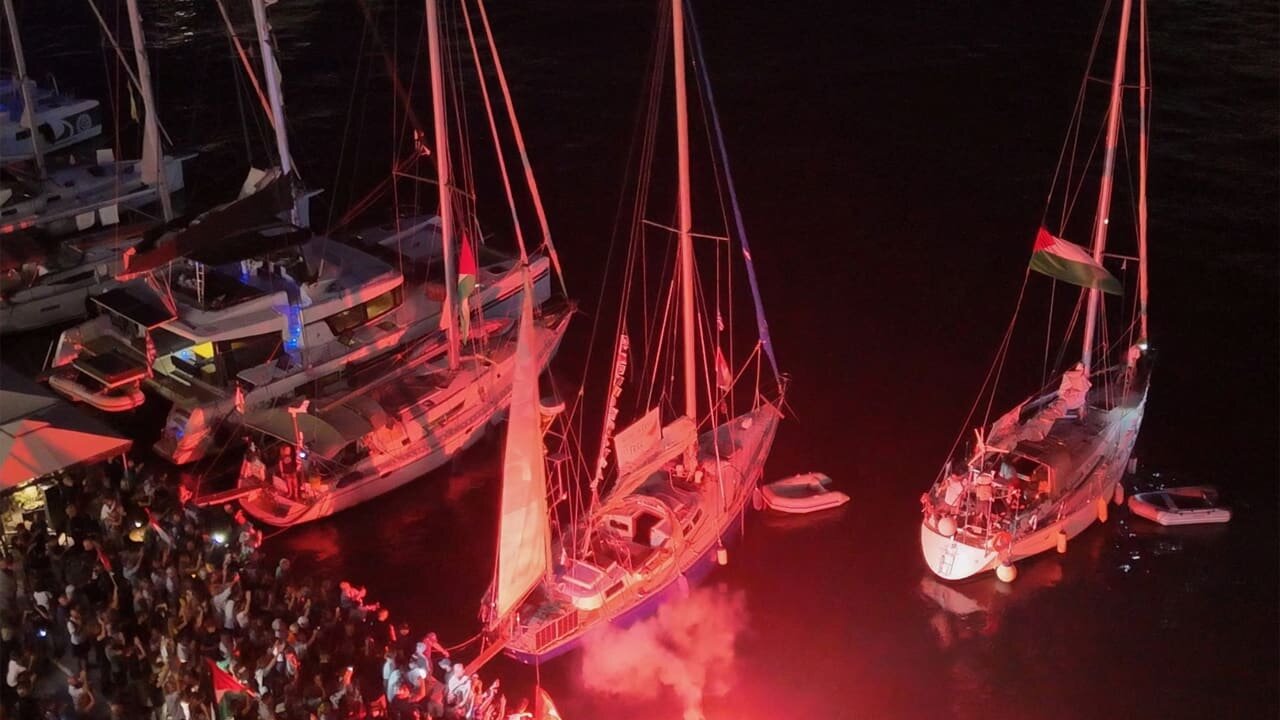
Tehran – In a few hours Wednesday, activists reported a night of sustained aerial harassment on board the global Sumud Flotilla: low-flying drones, 13 explosions around at least 13 vessels, obstruction of the ship’s radio, where objects were dropped on deck and the ship’s radio was split for cover.
All this unfolded while global attention focused on the annual meeting of the United Nations General Assembly in New York City.
Videos from several boats show drones making tight passes, bright flashes, and concussions that scramble by sailors. It’s not an accident, but a strike pattern in which multiple vessels are damaged and shaken.
Organizers and witnesses say the attack was accurate and intentionally psychological. Activists reported repeated VHF interference with flash-van-style devices that exploded near a small sailing boat, damage to sails and rigging (Zefiro was chosen), unidentified chemicals poured into Yulara, and Alma, a logistics vessel carrying legal observers and prominent passages.
The video and in-person testimony captured the sounds of drones seeking shelter, concussions, and crew panic.
Together, the campaign follows previous incidents that suggest escalation rather than accidents. In early September, the fleet said one of the ships had been struck by a drone in Tunisian waters. Tunisian authorities initially challenged the claim, but the investigation and footage remained alive. They fear that extraterritorial forces are trying to disrupt the declared humanitarian convoy.
The latest strike came as the convoy passed southwest of Crete towards Gaza. This is a journey aimed at bringing food and medical assistance to Gaza civilians.
Legal cases against these strikes are clear. The United Nations Convention on the Law of the Sea guarantees freedom of voyage on the high seas. Civil ships in international waters cannot attack without legal justification such as self-defense or declared legal blockade.
The fourth Geneva Convention requires parties to permit and protect relief contracts to civilians in need (Article 59).
The SAN Remod Manual and customary international humanitarian law require that naval enforcement be declared, proportional and directed only to legitimate military targets. Indiscriminate or punitive behavior against humanitarian ships is inconsistent with ocean and IHL laws.
At the level of serious crime, Roman law criminalizes attacks against civilians and intentionally directing the use of civilian star as a way of war.
If a non-violent civilian sumud ship is targeted or manipulated to prevent it from reaching Gaza, those actions fall straight into the kind of conduct designed to be investigated by the International Criminal Framework. Accountability is not obfuscation, but a legal and moral requirement.
The institutional response is insufficient. The United Nations Human Rights Office urged independent investigation and accountability. Francesca Albanese, the United Nations Special Rapporteur, called for “immediate international attention and protection.”
Italy claimed to have redirected the naval frigate to hide its fleet, and publicly warned that any operation must comply with international law and protect its citizens.
These moves are necessary, but patchwork naval escorts and statements do not replace any mechanisms that are legally enforced to stop nightly drone harassment or protect humanitarian passages.
Political, this episode is revealed and shameful. US envoy Tom Barrack recently recognized a significant acknowledgment of “Israel is attacking…Tunisia,” evoking the fleet’s incident in a broader pattern of coercion.
Whether interpreted as a candor or unintended admission, the actual effect is clear. When a state or its proxy treats humanitarian duties as a point of pressure, rules protecting civilians are sent, increasing the risk of immunity.
Sumud Flotilla is doing what many governments don’t. It is to hold humanitarian intentions and witnesses.
While declaring in New York, these boaters face real choices to provide assistance and effectively silence through drones, jamming and sabotage. There are legal measures to protect them. What is missing is collective political will.
The United Nations and states that advocate the fidelity of international law should move beyond the condemnation. It orders impartial investigations, establishes protected maritime corridors for humanitarian commission, and imposes real consequences on those who weaponize the ocean against civilians. Whatever is less than just a diplomatic ti disease, it is a moral abandonment.