
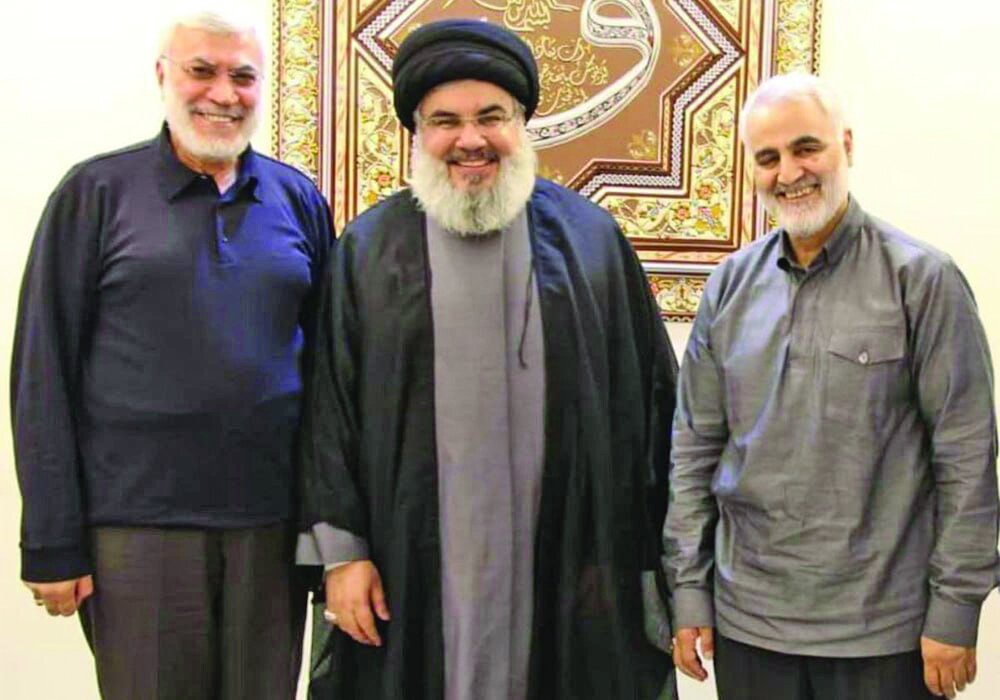
Tehran – History remembers Hassan Nasrara, who said he was General Chief of Hezbollah. For over 30 years he raised the flag of resistance with an unparalleled glow, dedicated his life, energy, and ultimately his blood to defending the oppressed Palestinians of Gaza and to confront Israeli tyranny.
He was not a normal leader. He was the embodiment of the entire movement, a symbol of resilience, and the man whose existence gave the nation courage.
From the early days of his leadership, assuming the role of the Secretary-General in Lebanon’s 33-year-old resistance, Nasrala understood that resistance was not maintained by weapons alone.
He built not only a military front against Zionist enemies, but also a vast social infrastructure that gave people the power and dignity in everyday life. He oversaw the creation of an institution that resisted its stability. Hospitals and clinics such as the Al-Qard Al-Hassan Financial Network, Al-Rasoul al-Azam, schools and universities, cultural centres, youth programs and vocational training initiatives are his legacy.
These were the centre of the vision of resistance as a complete way of life, not the peripheral effort. Under his leadership, the religious seminary flourished across Lebanon from Beirut to Bekaa Valley and from north to south. These seminaries educated a new generation of scholars, preachers and fighters who lost their lives to Israeli occupation on the Israeli occupation and military support front, which was opened in solidarity with Gaza on October 8, 2023 by Hezbollah.
It was not his strategic mind that made Nasrara unique, but his integrity, perseverance and humility. He did not rule from afar, but he lived among his people, spoke their language, and reflected their desires. His speech was not an abstract lecture, but a direct conversation filled with passion, reason and the rare ability to articulate implicit hopes of millions.
With endurance and patience, he carried a torch of resistance defiantly for 32 years. It was this credibility that opened the hearts to the entire region, not just among Muslims, but also among Christians, secularists and people far outside of Western Asia. His influence reached Europe, America, and even Latin America. There he realized that ordinary people who had never met him had been driven by their clarity and beliefs.
For 32 years he lived on the battlefield forever. Others wanted the comfort of life, but he dressed in the armor of resistance and embraced the burden of leadership with incredible courage. His presence was never separated. He was not a remote figure hidden in an ivory tower. His voice, his speech, his physical and virtual appearance all resonated with the pulsation of people.
In later years, security concerns often limited him to screens, but through those screens he was able to get closer to his people than many leaders who walked freely between them. His life embodied resistance, but deeper, it embodied the spirit of Husseny’s sacrifice. To live for justice and die when necessary.
Nasrara was Husseni’s leader in every sense. Like Imam Hussein (AS) of Karbala, he believed that silence in the face of tyranny was death, and that true life was against oppression, even when the odds seemed overwhelming. His martialism became a seal of faith, transforming him from leader to symbolism, from man to eternal school. “We will not be defeated. When we win, we will win. And in the face of the death of a martian, we will win,” he famously said.
What set him apart from many people who spoke about Palestine was his refusal to treat it as someone else’s problem. Others said their duty was first in their country. Others were worried about the consequences of facing a powerful enemy. Nasrara crushed such excuses. He boldly declared that Palestine is us and that we are Palestine. If Palestinians are crushed, then Lebanon, Syria, Iraq, Yemen and many other Arab countries follow. “If we don’t rise for them today, then no one will stand up for us tomorrow.” This vision has done more than an inspiring speech.
From Lebanon, spirits spread to Yemen, Yemen, and inspired many people in West Asia and around the world. It has become a living reality. It is a force that challenged the hegemony of global power.
Through this, Nasrara demonstrated the truth that echoed throughout history. A nation that no longer calculates survival through compromise, a nation that can never be defeated, has reverberated throughout history. His leadership has planted this seeds of courage throughout the region. It can be seen in today’s rebellion of Yemeni military forces, the unity of Iraqis resisting US occupation amidst the immorality of the Palestinians in Gaza. His words and his examples created a chain reaction of strength.
Secretary-General Hezbollah expanded resistance both horizontally and vertically. Level Struggle spread from Lebanon to Palestine, Syria, Iraq and Yemen, forming a regional network of rebellion. Vertically, it was refined, ranging from guerrilla warfare to ballistic missiles, drones and cyber capabilities.
Israeli occupation forces entered the southern part of Lebanon vertically, but they left horizontally to the co.
He was not only a military leader, but also an innovator, ensuring that resistance remained adaptive and future-oriented. For 30 years he trained fighters and leaders of resistance. He raised not only the military but also the generation. This is why he cannot say he has died because his school of thinking continues and produces martyrs and commanders, and he does so until his promise to pray in the occupied al-Kud (Jerusalem) is satisfied.
His leadership transcended Lebanon. He became a universal leader and a beacon for the oppressed people everywhere. For the Palestinians, he was a source of material and moral support. For Syria, he was a constant ally in the darkest year of terrorism. For Iraq, he was a partner in the battle against occupation and Dasterrorism. For Yemen, he was inspiration and brother. He was not trapped at the border. He was a leader in the region, the Islamic world, and humanity. His legacy is measured not only in military victory but also in intellectual and spiritual leadership. He embodied the unity of freedom and reached across denominations and borders.
Nasrara’s strength comes from the deep roots of religious learning. He studied at seminaries in Iran, Lebanon and Iraq. He absorbed not only jurisprudence but also his vision of justice that runs through sacrifice ethics and Islamic history.
He built Islamic resistance not defined by nationality or ethnicity but by the universality of Islamic appeals to defend those who were oppressed. His wisdom and foresight ensured preparation at all levels: spiritual, political, social, military.
For over 30 years, he resisted normalization and imperial rule. He rarely integrated himself with charisma, courage, vision, perseverance, intellectual depth. One or two of these qualities appear from time to time. The leader who embodies them all are first century numbers. His charisma attracted millions of people, his patience stabilized them, his vision led them, his courage urged them to endure them tightly. Even in Martkyo, his presence has not diminished. It has been strengthened. His blood is igniting the entire region and subsequent movements.
Sayyed Hassan Nasrallah is a school of thoughts that is the main link in the chain of resistance. He left his disciples who were continuing his mission with confidence. His example trained them to lead not only to fight, but to resist, to build. He embodied all aspects of leadership: organizational, military, political, spiritual. His martialism has not diminished Lebanon’s resistance. It strengthened it, turning sadness into rebellion rather than despair.
Without a doubt, his loss is felt in every heart that loved justice and humanity. But it is not the sorrow of surrender, but the sorrow of Kalbara, the sorrow that strengthens the resolution, and the sorrow that promotes the uprising. The enemy wanted his death to silence the resistance. Instead, it made him louder. His blood became a page of history, a beacon for the people, an ink of light that guided the oppressed and inspired freedom.
Every generation has a leader that rises and falls. Some are remembered for their power, others are remembered for their wealth, and others are remembered even more for their eloquence. But the rarest leaders are remembered for their truth, courage and willingness to give everything for their people and the oppressed Palestinians. Sayyed Nasrallah belongs to this rarest category. He was not the man who sought safety. He was not the man who lived for himself. He was a man who lived for others, and when the time came he was martyred for supporting the genocide against the Palestinians of Gaza.
This is why his legacy endures. It’s not even written in the street posters or in the book. It lives among the facilities he led, the fighters he led, the young people he inspired, the poor people he raised, and the millions who still have memories in their hearts. It lives in resistance that stands stronger than today, before the plot for us to disarm it. And it will live on until justice wins.
Sayyed Hassan Nasrallah was more than a man. He was an architect in a time when he changed the occupying Israeli regime and equations. He was the leader of the axis of resistance, his blood turned to hope, his life became a bridge for generations, and his martialism sealed his position among immortality.
His stories are written at the expense of deeds, not ink, not words. And as long as there are oppressed people who long for freedom, his name will be remembered, respected and obeyed.