
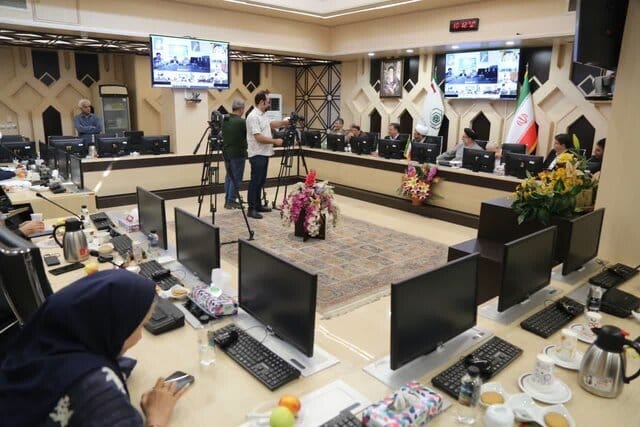
Tehran – Mehdi Khamoushi, director of state funds and charity organizations, has announced the establishment of a joint working group with the Ministry of Cultural Heritage. He described the collaboration as an important step in preserving and restoring sacred sites and historical monuments in Iran.
Tackling the gathering of two entities on Sunday, Kamoushi said the interaction between the two institutions could pave the way for maintaining Iranian-Islamic identities and revitalizing Iran’s spiritual and cultural heritage.
“One of the most important issues is sacred sites scattered across the country, with over 8,000. Many of these sites are architecturally and historically valuable, and their recovery and reconstruction must be coordinated with the Ministry of Cultural Heritage,” he explained.
He awarded buildings such as caravan sera and graves of historical value, adding that it requires restoration and enhanced maintenance according to cultural heritage standards. The purpose of this conference is to establish a joint secretariat to investigate challenges in this area and follow up with previous approvals and contracts. ”
He said that while some of the resources are provided by the government, the income from the sacred sites must be preserved and managed. “Operation volumes are very high and interagency cooperation needs to be prioritized and strengthened.”
Referring to the high potential of sacred sites in ecotourism and religious tourism, he also called for the use of donors to promote the project and hold knowledge-based exhibitions near the sacred sites.
Deputy Minister of Cultural Heritage Ali Dharabi also praised the cooperation of the National Fund and Charitable Agency, saying, “The national charity organization plays a pivotal role in the management and organisation of sacred sites.
Pointing to the large capacity of Iranian cultural heritage, he said there are more than one million identified monuments across the country, of which 43,000 have been registered.
He said that 63,000 years of prehistoric locations have been discovered in Khoramabad, Lorestan province, as Iran is a land of historic and ancient monuments. “Our country is, of course, a paradise for archaeologists.”
Darabi continues. “Currently there are over 8,000 certified clergy and 14,000 registered historic monuments, of which approximately 2,000 are owned by the Ministry of Cultural Heritage. Given the limited financial resources, it is expected that prioritization of restoration projects will be implemented to best utilize the joint capacity.
He added: “There are around 50 eligible for global registration, most of which are donations. These abilities should be revitalized in the field of religious tourism. Also, 800 museums are currently active, our goal is to reach a thousand museums in the near future.”
Another speaker at the event, Hojatoleslam Gholamreza Adel, deputy director of the donation agency, published a report on the two-year performance of the Joint Working Group, saying that in line with the implementation of the Joint Memorandum of Understanding, about 50 administrative issues have been resolved so far, and new programs with specific priorities have been resolved so far.
In the video conferencing section, general directors of state contributions and cultural heritage presented a report on the progress of cooperation.
“We are pleased to announce that we are pleased to announce that we are pleased to announce that we are pleased to announce that we are pleased to announce that we are pleased to announce that we are pleased to announce that we are pleased to announce that we are pleased to announce that we are pleased to announce that we are pleased to announce that we are pleased to announce that we are pleased to announce that we are pleased to announce that we are pleased to announce that we are pleased to announce that we are pleased to announce that we are pleased to announce that “Yazd is a heritage city and changes to the site and use around donations should be a way to create added value for donations.
Mohammad Rastegali, head of Yazd Cultural Heritage, also added that in most states, a joint memorandum of understanding has been signed to protect the fund’s buildings, and that the handicraft market is being operated in cooperation with donations.
Hojatoleslam Mostafa Majidi, head of Qazvin Endowments, announced the implementation of a large tourism town project in the 500 hectares region, saying the project is one of the largest tourism projects in the country.
Hojatoleslam Mehdi Hosseini, head of Kazbin Cultural Heritage, also said that the joint memorandum was drafted in 13 clauses and that good cooperation was achieved in the restoration of the sacred sites and joint projects.
The Isfahan Fund Director also announced that despite government funding cuts, the restoration process for the monument is being facilitated by pursuit efforts and announced the signing of a joint agreement on the recovery of the Caravan Sera and the historic mosque.
Amir Kalamza, head of Isfahan Cultural Heritage, stressed the need to fund the restoration of Isfahan Bazaar and donations, saying many donations have no income and government assistance is needed.
At the end of the meeting, attendees emphasized the need for continued cooperation between the donation agency and the Ministry of Cultural Heritage, the establishment of a joint national office and prioritization of restoration projects. The goal of this cooperation was to maintain the country’s historic and religious identity, develop religious and cultural tourism, and benefit from the potential for donations in the economic and social prosperity of the state.
KD