
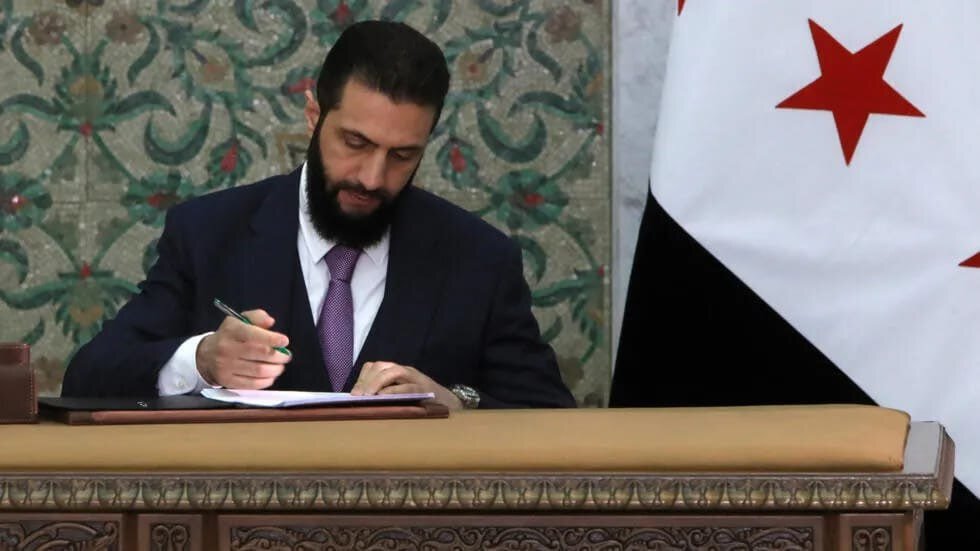
BEIRUT – Syria has witnessed an election to elect two-thirds of the new People’s Assembly members in a celebratory media spectacle.
The so-called interim authorities, led effectively by President Ahmed al-Sharaa (formerly known as Abu Muhammad al-Julani), sought to promote the supposed democratic illusions when the most fundamental elements of legitimacy and general participation were present.
The elections held in 50 constituencies within hours were nothing more than a closed door political show, limited to pre-appointed “election groups” without the real participation of Syrians living in the geographical and political sectors.
This political glorification of superiority coincided with a deep change in the symbolic structure of the nation and an undeclared rush of normalization with the Zionist enemy in the absence of a unified national value.
The final third of the members of the new council will not be elected, but will be directly appointed by the Sharia Act. This is a practice that reinforces the notion of authoritarianism shaming as a “national balance” that transitional governments seek to establish during the post-Bashar al-Assad era.
What is clear, however, is that these “balances” are not reflective of the will of the state or the new social contract, but merely reflect the new centre of new influences established by de facto arrangements.
Transitional regimes effectively control less than two-thirds of the country, but regions such as Kurdish autonomous regimes and Sweida are outside the scope of the political process, making elections incomplete in terms of legitimacy and geographical and political expression.
The promotion of decorative election spectacles in the media belonging to HTS did not stop at a closed “voting,” but expanded to a deliberate attempt at symbolic normalization, facilitating the candidacy of Henry Hamra, the first Jew to run for Congress since 1967.
This questionable movement appears to be part of the process of glorifying the authoritarian regime in its temporal and political context.
It reflects more realistic openness than blatant political exploitation of sectarian and minority issues in an international context that promotes reconciliation and progressive normalization with Zionist enemies.
It was not surprising that the move coincided with the cancellation of national opportunities that constituted the pillars of Syrian collective identity, such as Martyrs Day and the War Memorial Day in October, and with the cancellation of national opportunities that were replaced by Assad’s Autumn Anniversary and Revolution and Emancipation Day.
This illustrates the desire of a transitional regime to write new history tailored to political moments and current power centres.
Meanwhile, the emergence of extremist groups within the new governing structure is becoming apparent, and with the creation of the status of the Supreme Court, also known as the “Sheikh,” overseeing the judicial system without legal authority.
This will be appointed based on his loyalty to Hay’at Tahrir Al-Sham, even if he is not legally qualified.
This move is merely an attempt to give the judicial system the character of religious approvers.
Furthermore, it embodies the collapse of the concept of a law-based civic state, clearly reflecting the shift towards projects based on disguised sectarianism and manufactured legitimacy.
The elections are merely smokescreens for a comprehensive reconstruction of Syria’s national and constitutional identity, coordinated behind the scenes by regional and international influences, but cities like Sweida in southern Syria will endure a variety of crises.
While elections were taking place in Damascus, Sweida bakeries were closed due to a lack of flour, and the area was deprived of electricity and water.
The official silence suggests a planned intention to isolate and starve these areas politically excluded from the post-Assad landscape.
Meanwhile, the pace of courtship for Moscow is accelerating to find a regional balance with America and Israel.
Repeated visits to Russia of Shara and his military and diplomatic delegations, their photo shoot with the Russian S-400 air defense system, and their denial of importance after causing controversy reveals a vulnerable strategy to try to balance through form.
The de facto regime has not expressed any real objection to the ongoing attack on Israeli on Syria. Instead, it remains silent or formally condemned, reinforcing doubts about the existence of unpublished arrangements under the table to promote future political normalization projects.
What is happening in Syria today is not a democratic transition. Rather, it is a reenactment of oppressive authority with a new face, seeking to misuse revolutionary slogans to establish legitimacy based on monopoly, exclusion and sectarianism.
It is a distorted sectarian democracy, where minorities and religious pluralism are used as public relations cards.
Syrians who have been excluded from both ballot boxes and decision-making will continue to pay for their international and regional rivals.