
BEIRUT – In a move described as an attempt to save Prime Minister Nawaf Salam’s image and avoid a new political crisis, the Lebanese government has decided to “suspend” the license granted to the Lebanese Arts Association (Resalat).
Meanwhile, the suspension will remain in effect pending the outcome of an administrative and criminal investigation initiated by the Prosecutor’s Office.
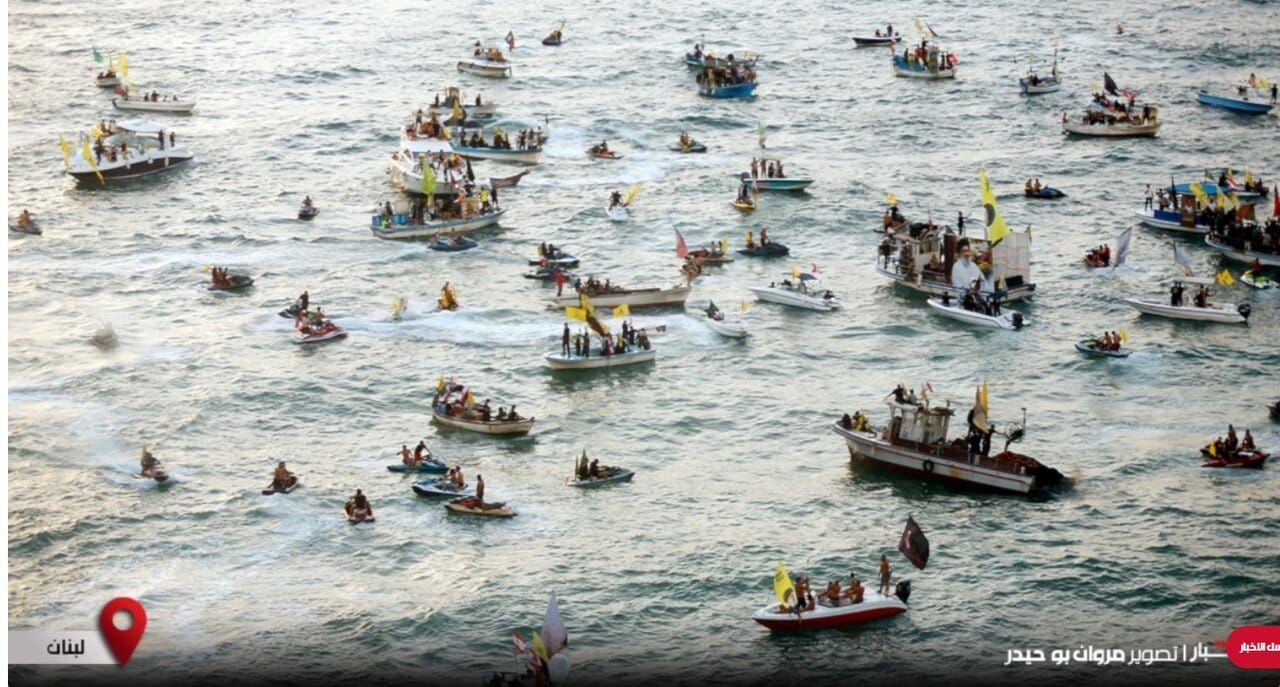
The decision, announced after a cabinet session chaired by President Joseph Ooun, came after the association illuminated Rauch Rock with images of Hezbollah’s two martyred general secretaries, Syed Hassan Nasrallah and Syed Hashem Safieddin.
Political and human rights circles considered this move to be a clear political attack not based on clear legal text.
Information Minister Paul Morkos claimed that the decision came after extensive discussions based on the Public Interest Consultative Committee (1980).
However, Lebanese law does not specifically include the suspension of associations. Dissolution or complete dissolution can only occur by a final judicial ruling after an investigation that guarantees the association the right to protect itself.
This makes government actions more like malicious political interpretations than fair legal decisions.
The Ministry of Interior presented a report containing fabricated charges against Resalat. The minister accused the association of violating its bylaws and using public property for the purpose of prejudicing “public order.”
In a statement, Resalat confirmed that it was not trying to provoke or challenge anyone and did not turn the Raouche incident into a political event, adding that it would pursue legal proceedings to the end.
The association stressed that everything that is happening only strengthens its resolve to pursue its artistic and cultural mission, stating that “those of us who have a sacred cause never tire.”
MP Ali Fayyad, a member of Hezbollah’s resistance bloc in parliament, described what is happening as a “dangerous violation of constitutional rules.”
Fayyad accused it of “deliberately injecting elements of tension and provocation into the domestic arena.”
Fayyad said that some officials “act as if they are more royal than king in their dependence on foreign powers, using the law as a tool to settle scores and appease Western capitals.”
He said this approach, if continued, would turn the majority of Lebanese into “an exiled sect with no rights or future.”
This rapprochement occurred because intensive meetings between AOUN and SALAM took place before this session.
Ministerial sources revealed that the decision was faced with direct intervention from President Aoun, who warned not to permanently revoke the license, but in a mild manner that would endure the association’s work, especially after Hezbollah’s company’s warning against infringements on the association’s rights, which could result in a lawsuit for malicious political measures that could trigger a major political crisis.
The government session also included a presentation by army chief Rodolphe Heikal on plans to confiscate the South’s weapons, confirming that it is Israeli occupation forces that are interfering with the Lebanese army’s mission, not Hezbollah, as some falsely claim.
In parallel, the government did not comment on the atrocities committed by Israel’s enemies. Israel’s enemies targeted a civilian vehicle in Nabatieh with two guided missiles, killing the civilian and his wife. His wife, Zainab Raslan, quit her teaching job to care for him and their three children.
Clearly, the proposed suspension of Resalat is the result of narrow political calculations. The government leaves Israel’s attacks unanswered, distances itself from confronting the economic crisis and corruption, yet chooses to restrict an artistic association simply because it is affiliated with Hezbollah!