
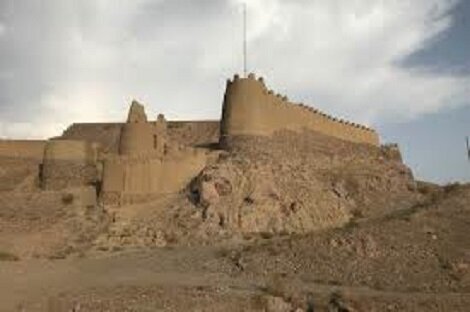
TEHRAN—Kerman’s Ministry of Cultural Heritage, Tourism and Handicrafts Secretary General Morteza Nikrou has announced that more than 7 billion rials ($7,000) have been allocated to begin the restoration of a centuries-old fortress in Qanouj province.
Underscoring the importance of protecting, restoring, reviving and organizing the state’s ancient monuments in line with the sustainable development of the tourism sector, he said that the restoration and reconstruction of historic castles in Qanuj County had begun with the appointment of contractors and the signing of contracts with state funds, ISNA reported.
He explained that restoration work using bricks, traditional insulation, plastering, strapping, reinforcement and organization are currently envisaged as restoration measures for the historic Castle of Carnousi.
Mr. Niclou further said, “The restoration and rejuvenation of historical buildings is not only a conservation measure, but also a fundamental step towards sustainable tourism development in the province. Within the framework of the ‘Kerman, the World’s Smiles 1405’ program, a series of restoration projects are being carried out in the province’s cities and villages, with the aim of showcasing the dynamic and lively face of historic Kerman.”
He said, “With the contributions of the private sector, local institutions, and the potential of Iran’s specialized forces, we intend to transform valuable historical buildings from non-operational status into tourist, cultural and residential spaces, preserving the authenticity of Iranian architecture and providing employment opportunities and the presence of domestic and foreign tourists.”
He added that the “Kerman 1405 – Smiles for the World” program is an opportunity for Kerman Province to shine in the world tourism sector, relying on its ancient heritage, and for the historical monuments of the province to be brought back into cultural and economic life.
The ancient Qanuj Castle is one of the few historical buildings in southern Kerman province. This historic site is located high up on a hill in the north-eastern to eastern part of the city of Carnuj.
According to archaeological documents, the castle’s history dates back to the 4th century BC, contemporaneous with Manujan Castle and the ancient city of Jiroft. Additions and modifications were made in later periods as well, such as the castle’s flourishing from the Qajar period to the early Pahlavi period.
From ancient times to modern times, defensive walls have been considered essential for cities to endure in an ever-evolving landscape marked by invasion and conquest.
Kerman province is a cultural melting pot where different regional cultures have merged over time. It is also home to a wealth of tourist attractions and historical sites, including bazaars, mosques, caravanserais, and ancient urban ruins. Kerman is surrounded by Fars province to the west, Yazd province to the north, South Khorasan province to the northeast, Sistan-Baluchestan province to the east, and Hormozgan province to the south. This includes the Dashteh Route, the southern part of Iran’s central desert.
KD