
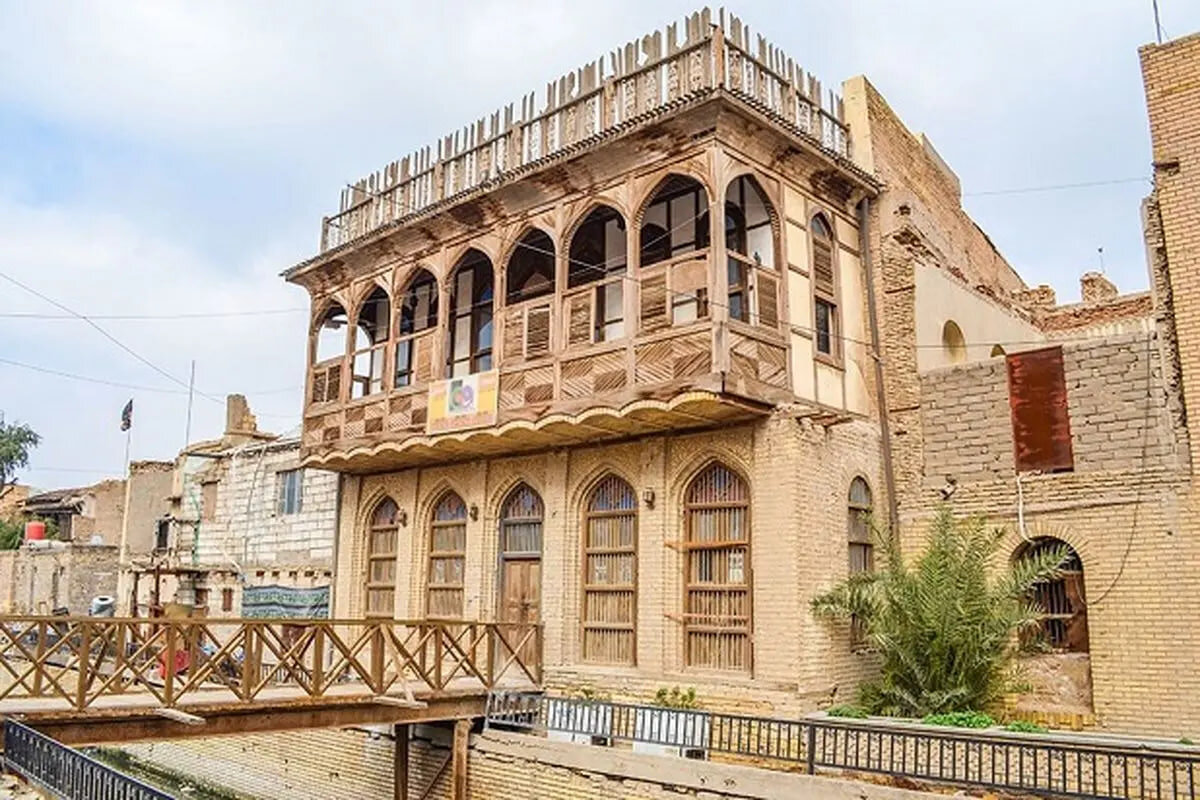
TEHRAN — The wooden balconies of historic houses (known as shanasir) have attracted the attention of the Bushehr Cultural Heritage Authority.
Their counterpart in the Iraqi city of Basra is known as Shanasher. According to Irnar news agency, research has begun in Iran to incorporate these practical elements into the traditional architecture of historical houses in Bushehr and Basra.
Bushehr Shanasir is an indigenous architectural element of the Persian Gulf and is known as an introverted and extroverted architectural element of traditional houses in the region. A wooden panel with letters and words cut out.
Shanasir in Iran and Shanasir in Iraq are wooden balconies with shutters that are installed in front of the windows on the upper floors of traditional houses, allowing light and wind to enter the building and protecting the landscape of the house. The outside space can be seen clearly from the back of the tree, but the inside of the house cannot be seen from outside.
Bushehr Cultural Heritage Officer Ali Mahini described Shanasil as the most remarkable piece of indigenous architecture in the region’s hot and humid climate and of great importance in terms of the beauty and functionality of the historic monument.
He said that according to the latest survey by the Bushehr Cultural Heritage Department, about 30 per cent of the houses located in historical buildings in Bushehr are equipped with shana seals.
He announced that among these houses, Tabib House, Dehadashti House, Golshan-e-Irani House and Bebahani House have been inscribed on the country’s National Heritage List, and documentation of other notable buildings is also in progress so that other historical houses in Bushehr with wooden balconies can also be inscribed on the country’s National Heritage List gradually.
Regarding the situation of historic houses in Bushehr, he said: “In general, within the framework of the Bushehr Historical Texture Restoration Plan, protective measures have been taken to reduce environmental damage to historical buildings. Also, some houses also require urgent restoration due to dilapidation and climatic conditions, and their restoration is on the agenda of the Bushehr Cultural Heritage Department.”
Mahini noted the similarities between shuttered houses in the two port areas of Bushehr and Basra, adding: Historical and cultural roots exist between Bushehr and Basra in Iran and Iraq, and many similarities have formed in the traditional architecture of these two ports.
He said: “The formation of shuttered structures in traditional housing is actually the result of cultural and commercial exchanges between peoples on both sides of the Persian Gulf over the past centuries.”
He mentioned the possibility of the wooden balcony with shutters being registered globally as the common architectural heritage of Iran and Iraq, and said that from a technical and legal point of view, there is a possibility that this type of architecture could be registered as the common heritage of Iran and Iraq across borders.
Mahini stressed that a preliminary study to prepare a file for the inscription of Bushehr Shanasir on the UNESCO World Heritage List is on the agenda of the Bushehr Cultural Heritage Department, and in coordination with the Iraqi side, the traditional wooden shuttered balcony could be presented in the form of a joint file between the two countries.
Regarding the restoration and revival of historical houses and the installation of Shanashir in the historical texture of Bushehr, several important programs are being implemented in the Bushehr Cultural Heritage Department, the first of which is to encourage private investors to restore traditional houses and renovate them into ecotourism houses.
He added that another challenge is to organize educational and cultural tours focused on visiting the Shanashir family.
According to Mahini, the scientific documentation of architecture by Shanashir in collaboration with the University of the Persian Gulf is another program of the Bushehr Cultural Heritage Department to promote the use of this traditional architectural heritage.
He announced another program of the Bushehr Cultural Heritage Department to produce educational and research content that introduces Shanashir as a model for sustainable architecture in hot and humid climates.
Mahini continued that Shanashir is part of Bushehr’s historical and cultural identity and is a symbol of the region’s people’s connection to the sea and climate. The preservation, restoration and introduction of this precious element in the traditional architecture of the Persian Gulf is an important step towards preserving the cultural heritage of the Persian Gulf and moving towards its global inscription, he added.
Finally, he expressed hope that the ongoing program to restore, revive and introduce the importance of using Shanasir elements in the architecture of Bushehr Province will not only preserve this architectural heritage of the Persian Gulf coast of Iran and shared with the city of Basra in Iraq, but also promote the use of Shanasir in the modern life of the people of Bushehr Province and revive this architectural heritage. Inside a traditional building in Bushehr.
KD