
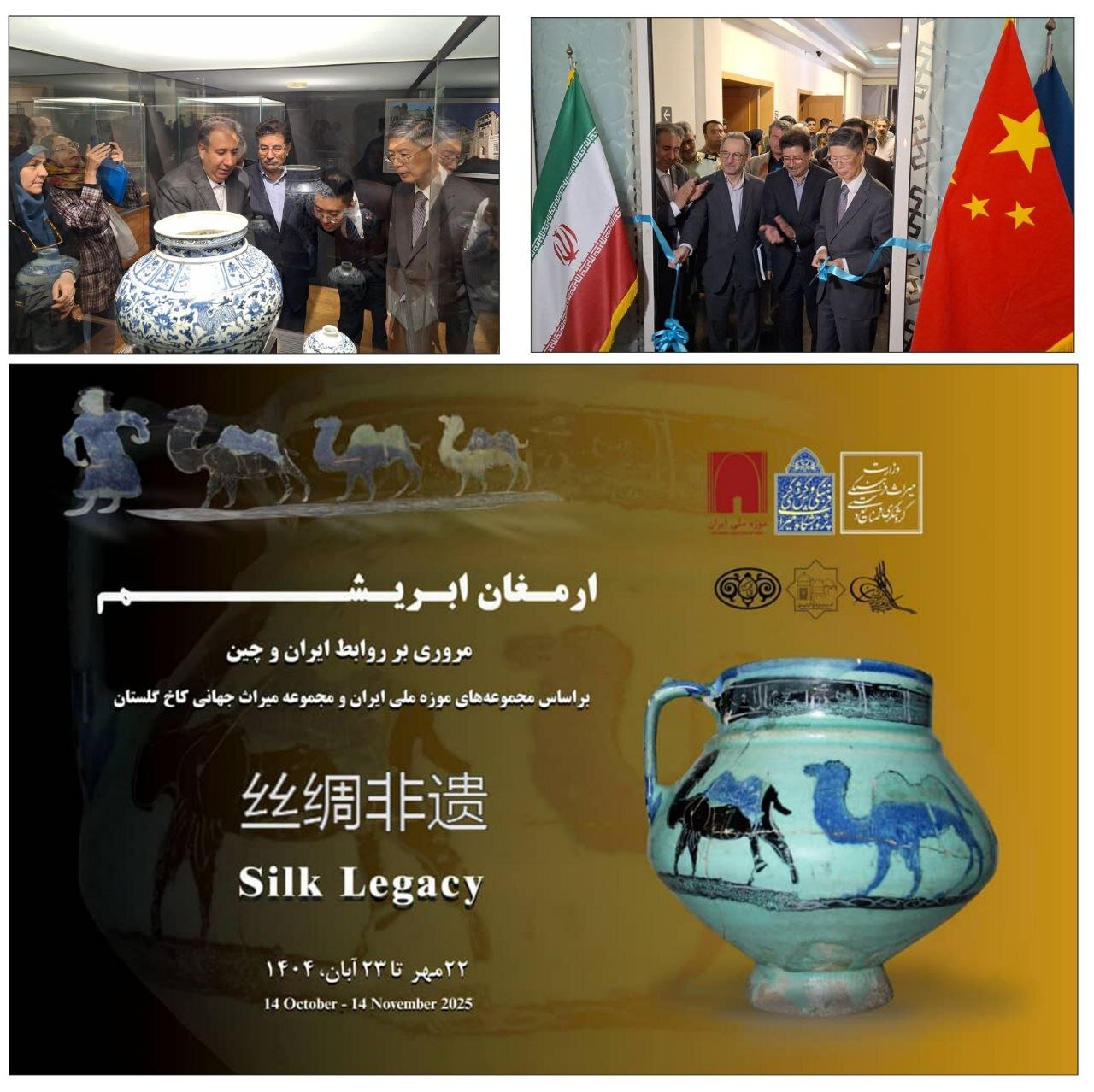
TEHRAN—The National Museum of Iran has opened “The Legacy of Silk: A Retrospective of Iran-China Relations,” an exhibition highlighting the enduring cultural and historical ties between the two ancient civilizations.
Speaking at the opening ceremony, Jebrael Nokhandeh, director of the National Museum of Iran, said that relations between Iran and China date back thousands of years and were strengthened by historic trade routes such as the Silk Road, the Lapis Lazuli Road and the Great Khorasan Road, which connected the two countries through the exchange of goods, ideas, art and technology.
“These relationships are not only historic, they continue to thrive today,” Nokande said. “In commemoration of the 100th anniversary of the Palace Museum in Beijing, I attended the 7th Taihe Forum, where representatives from more than 160 museums around the world discussed cooperation between museums. The National Museum of Iran congratulated the Chinese people on this important milestone.”
Nokande announced that a memorandum of understanding was signed between the National Museum of Iran and the National Museum of China, headed by Luo Wenli, to strengthen cultural cooperation. He added that Iran is also participating in the “Museum Collections of Shanghai Cooperation Organization Member States” exhibition currently being held in China.
Last year, the National Museum of Iran took an important step in strengthening cultural dialogue by holding the traveling exhibition “The Glory of Ancient Persia” at the Palace Museum in Beijing, the Shanghai Museum, and the Xinjiang Regional Museum in Urumqi. The museum also contributed to the exhibition “Historical Encounters of China and West Asia” to be held in Beijing in 2024, with more than 260 works from domestic and international institutions on display.
“The joint exhibition in Beijing and Tehran reflects our common commitment to cultural diplomacy and mutual understanding,” Nokande said. “Museums play an important role in showcasing the deep heritage and shared values of both countries.”
The Silk Legacy exhibition, organized by the Institute of Cultural Heritage and Tourism and the National Museum of Iran, displays approximately 90 artifacts from the Parthian period to the Qajar period, including 77 items from the National Museum of Iran and 13 from the Golestan Palace, a UNESCO World Heritage Site in Tehran.
Officials and experts involved in organizing the event include Dr. Mohammad Ebrahim Zarei, Director of the Institute of Cultural Heritage and Tourism; Dr. Mohammad Reza Mehrandish, Arts & Media Advisor. Dr. Dariush Akbarzadeh and Dr. Morteza Hesari, scientific coordinators of the exhibition. Dr. Ali Daravi, Deputy Minister and Vice-President of Cultural Heritage; and Dr. Leila Khosravi, Director of the Museum.
morning