
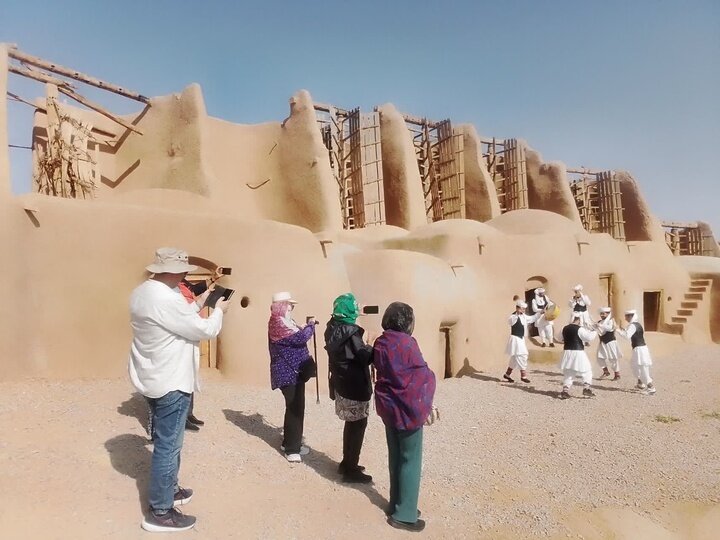
[TEHRAN]The Director of the Ministry of Cultural Heritage, Tourism and Handicrafts of Qaf announced the news that a second group of European tourists visited Qaf Governorate of Khorasan Razavi Province in Iran’s month of Mehr (from September 23).
According to IRIB news agency, Prime Minister Mahmoud Baakideh explained that 15 Greek tourists visited the most important tourist spots in Qaf Governorate.
He added that visiting workshops that make and sell handicrafts and playing local music beside an ancient windmill known as Asbad are other programs planned for the tour.
Asbarz is one of the architectural and lifestyle masterpieces of eastern Iran, especially Iranians, who use wind power to grind grain.
Baakide reported that the number of foreign tourists in Kahu County increased five times compared to last year, adding that “the situation of domestic and foreign tourists in the county has improved, taking into account the restoration of important historical buildings and the development of tourism infrastructure.”
He recalled that on October 10, 15 foreign tourists from the UK, Australia, India, Canada and Sri Lanka visited Kahu’s most important historical sites, including Nashtifan Asbad and Ghiyashie School in Halgeld village.
The lesser-known Qaf Governorate is home to many sites of historical importance. All efforts are being intensified to develop the tourism capacity of Qaf City with the aim of attracting domestic and international tourists.
Qaf Governorate, located in Khorasan Razavi Province in northeastern Iran, has more than 300 confirmed historical sites, of which 105 are registered as national heritage sites, and two, including the Qaf Windmill and the historical city of Zozan, are registered on UNESCO’s tentative list.
Out of a total of 200 asbads (vertical windmills) identified in urban and rural areas of Qaf, 130 are currently in place and 70 have been destroyed over time.
Approximately 130 asbads are still intact and some of them are still engaged in flour crushing and flour production.
In recent years, the restoration of Asbad has been on the agenda of the Qaf Cultural Heritage and Tourism Authority.
Made of clay, wood and straw, the windmill, locally known as Asbad, is proof of humanity’s adaptation to nature, turning environmental obstacles into opportunities.
The development of Asbad was caused by a 120-day period of strong winds that blow across the east and southeast of the Iranian Plateau from late May to late September each year.
KD