
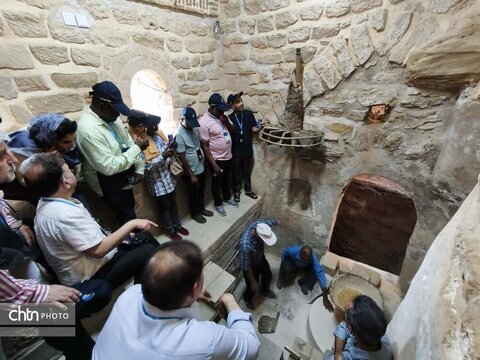
TEHRAN – A delegation consisting of representatives of UNESCO organizations from Algeria, Tanzania, Nigeria and Iraq visited the Shushtar Historical Hydraulic System in Khuzestan province.
According to Miras-e Arya (CHTN), the delegation visited the southwestern province on the sidelines of a training workshop organized by the Ministry of Energy.
They were accompanied by experts from the Shushtar Historical Hydropower System Base and representatives from the Khuzestan Water and Electricity Authority.
They visited important and integral parts of this precious complex such as the Gulgar River, Mizan Dam (Band-e-Mizan), industrial areas and waterfalls.
During this visit, the experts provided a comprehensive and professional explanation and explained to the delegates how Shushtar’s unique water system and factory work.
The factory operation was then demonstrated on-site to fully showcase the technical and cultural aspects of this outstanding global initiative.
The Shushtar Historical Hydraulic System World Heritage Site expressed its satisfaction at the presence of this international delegation, underlined its commitment to the preservation, restoration and presentation of this precious heritage, and announced its readiness to further cooperate with international organizations to protect the world heritage site of the ancient Shushtar land.
The ancient hydraulic system consists of a series of ancient water wheels powered by bridges, weirs, tunnels, canals, and man-made waterfalls. It takes its name from the ancient city of the same name, whose history dates back to the time of the Achaemenid king Darius the Great.
This land is rich in the diversity of its uses (urban water supply, factories, irrigation, river transport, defense systems) as well as the diversity of civil engineering structures and buildings. Shushtar’s historic hydraulic system testifies to the heritage and synthesis of early Elamite and Mesopotamian know-how. It was probably influenced by the Petra Dam and Tunnel and Roman civil engineering.
Hydraulic systems were considered wonders of the world not only by the Persians, but also by the Arab-Muslims at the height of their civilization.
Furthermore, one of its major canals is a genuine artificial waterway that made it possible to build new towns and irrigate vast, semi-desert plains at the time.
UNESCO states that Shushtar’s historic hydraulic system is of outstanding universal value, as in its current form it dates back to the 3rd century AD and is probably based on older foundations from the 5th century BC. It is exceptional because it is highly complete, has many functions, and is large in scale.
KD