
TEHRAN – An uneasy 48-hour ceasefire between Pakistan and Afghanistan expired on Friday night, with both countries deciding to extend it until the end of talks in Qatar’s capital Doha.
Talks between the two neighboring countries began on Saturday.
Pakistan’s Ministry of Foreign Affairs issued a statement on Wednesday announcing that it has agreed to a temporary ceasefire with Afghanistan for the next 48 hours amid recent border hostilities between the two neighbours.
Both sides claimed the other had called for a ceasefire, which Pakistan announced came into effect from 13:00 Greenwich Mean Time (GMT) on Wednesday.
Hours after the ceasefire ended on Friday, Pakistan carried out airstrikes across the border in Paktika province, targeting militant hideouts in the Urgun and Barmal districts, security officials confirmed to The Associated Press.
Initially, explosions were heard across Kabul in the early morning hours of October 9. At the time, Taliban government spokesperson Zabihullah Mujahid downplayed the seriousness of the incident and did not accept any responsibility. But the next day, Afghanistan’s Ministry of Defense accused Pakistan of bombing the capital, Kabul. Islamabad denied the accusations.
So far, neither side has claimed responsibility for the October 9 Kabul bombing. Both sides have accused the other of provoking the deadly clashes.
Landlocked Afghanistan has a 2,600-kilometer border with Pakistan known as the Durand Line, drawn in 1893 under British rule. The movement of extremists and smugglers across porous borders is a problem. The situation was further exacerbated by Pakistan’s forced repatriation of illegal Afghan refugees.
There are five main border crossings: Torkham, Chaman, Karlachi, Angor Adda, and Ghulam Khan. Although the border has not been completely closed, trade and civilian movement has faced frequent disruptions and sudden closures, particularly in Torkham and Chaman.
Pakistan has accused the Taliban government, which has been in power since August 2021, of harboring insurgents, particularly Tehreek Taliban Pakistan (TTP), and Islamabad has blamed the Taliban government for a sharp increase in attacks on security forces. Kabul denies harboring militants targeting Pakistan.
However, a UN Security Council report in July estimated that up to 6,500 TTP fighters are based in Afghanistan. He added: “The Taliban does not consider the TTP to be a terrorist group.”
The TTP, also known as the Pakistani Taliban, is an umbrella organization of extremist groups based in eastern Afghanistan and the tribal belt of Pakistan. It is fighting for its own Islamic rule in Pakistan, replacing the government with a strict Islamic-led system of governance.
TTP has been listed as a terrorist organization by the United Nations since 2011. Afghanistan’s Taliban government has not officially designated the TTP as a terrorist organization. There are two main reasons for this. First, the Afghan Taliban and TTP both draw heavily from Pashtun tribes and share the same ideological kinship.
Second, both reject the Durand Line.
Meanwhile, United Nations agencies specializing in refugees and migrants on Wednesday jointly expressed concern over Pakistan’s plan to begin a new round of mass deportations targeting three million Afghans living in Pakistan. UNHCR has warned that Afghan refugees forced to return face an uncertain future amid conflict.
indian connection
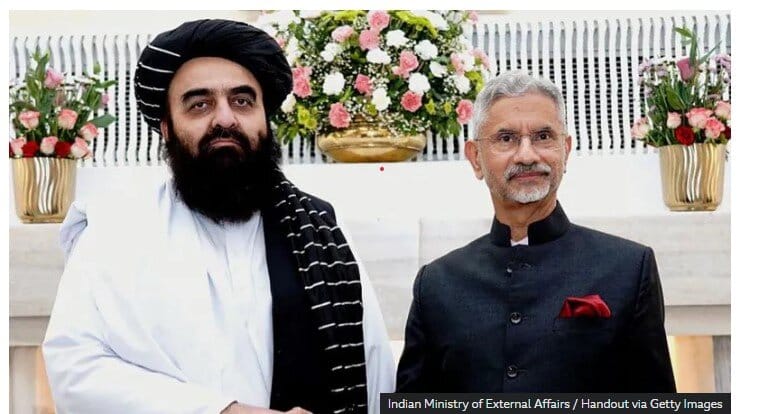
The explosion in Kabul on October 9 coincided with the arrival of Taliban Foreign Minister Amir Khan al-Muttaqi in India on the same day for a six-day visit, the Taliban’s first since returning to power.
Mr. Muttaqi was granted temporary travel exemption by a United Nations Security Council committee. He concluded his visit to India on Wednesday.
During his visit, Mr. Muttaki met his Indian counterpart Dr. S. Jaishankar in New Delhi.
After the Taliban returned to power in August 2021, India was forced to close its embassy and withdraw its diplomats and citizens. A year later, India began re-establishing its diplomatic presence in Afghanistan, tasked with overseeing the distribution of humanitarian aid.
More than four years later, India rolled out the red carpet for the Afghan delegation led by Mutaki.
Analysts believe India’s reset is because New Delhi wants to counter Pakistan’s influence in Afghanistan and create opportunities for Indian investment in Afghanistan’s vast mineral wealth.
At a press conference with Indian External Affairs Minister S. Jaishankar on Friday, Muttaqi said both Pakistan and Afghanistan want positive relations. He also said, “There are certain groups in Pakistan who are trying to stir up unrest.”
Jaishankar said this would contribute to “regional stability and resilience” and called for closer bilateral cooperation. He thanked Muttaqi for “inviting Indian companies to explore mining opportunities in Afghanistan.”
Prime Minister Muttaqi announced on Monday that direct flights between Kabul and Indian cities will soon begin.
Mineral resources of Afghanistan
When most people think of Afghanistan, they think of a poor third world country. As a matter of fact, Afghanistan is endowed with vast untapped natural resources.
Afghanistan’s rich mineral resources have huge untapped potential. The mountainous country is home to an estimated $1 trillion worth of materials, most of which have been restricted by decades of war.
Satellite images show many small-scale mines that are currently active. The Financial Times reports that 88 of the 128 contracted sites are showing signs of development and expansion.
Mine auctions boosted Afghanistan’s revenue by 22% year-on-year in April and May from a year earlier, with a number of mines and resources including oil, emeralds and nephrite, a type of jade prized in China, the World Bank said.
Afghanistan’s new ruler has announced more than 200 mining deals worth billions of dollars. Afghanistan, located in the Tethian belt, is rich in gold, copper, gemstones and lithium.
Afghanistan’s vast mineral wealth includes important reserves of copper, lithium, iron ore, rare earth elements, coal, and precious stones, as well as gold and marble. These minerals are essential to global industries such as electronics, electric vehicle battery manufacturing, construction, and energy.
The mining sector could help the Taliban make new friends as foreign powers such as China, Russia, India and Iran step in to fill the void left by the defecting Western coalition.
Taliban and the world
Many countries, including China, Russia, Iran, Pakistan and Turkey, have reopened their embassies in Kabul, but only Moscow has officially recognized the Taliban regime.
On July 3, 2025, Russia became the first country to formally recognize the Taliban regime, nearly four years after its return to power. The Taliban flag was hoisted for the first time at the Islamic Emirate of Afghanistan (IEA) embassy in Moscow.
Since June 2025, Gul Hassan has been the Taliban’s first permanent ambassador recognized by Russia.
After the Taliban returned, the Chinese government severed diplomatic relations, but China is now the largest foreign investor in Afghanistan. According to the Chinese Ministry of Foreign Affairs website, the two countries announced the establishment of a strategic cooperation partnership in 2012. The site estimates that bilateral trade between the two countries in 2024 will be $1.59 billion, an increase of 19% from the previous year. The two countries share a 92 km border.
Following Muttaqi’s visit to India, New Delhi announced that it would upgrade its technical mission to a full-fledged embassy.
Iran maintains friendly relations with both countries. Foreign Minister Abbas Araghchi called for “restraint” on both sides as the clashes continued.
At a press conference in Tehran on October 13, Iranian Foreign Ministry spokesman Esmail Baghai warned of the dangerous “spillover” effects of the conflict. “The most important issue for Iran is the security and stability of its neighbors,” he said.
He added: “Afghanistan and Pakistan are both Muslim neighbours, and the rift in their relationship could have repercussions beyond their borders.”
As border skirmishes intensified, the parties persuaded both sides of the conflict to come to the negotiating table, sort out their differences through dialogue, and end their rivalry.
Just this summer, the foreign ministers of Afghanistan and Pakistan met on the sidelines of the 51st Foreign Ministers’ Council of the Organization of Islamic Cooperation (OIC) in Istanbul.
The two sides discussed a wide range of issues, including trade, transportation, regional infrastructure, etc., and both ministers expressed support for expanded cooperation on strategic projects.
Controlling hostilities would encourage investment and development of Afghanistan’s natural resources. With peace and stability in Afghanistan, the mining sector will be able to contribute to revitalizing the Afghan economy. After decades of instability, Afghanistan’s natural resources could provide a lifeline to a country where a quarter of its 40 million people are at risk of starvation.