
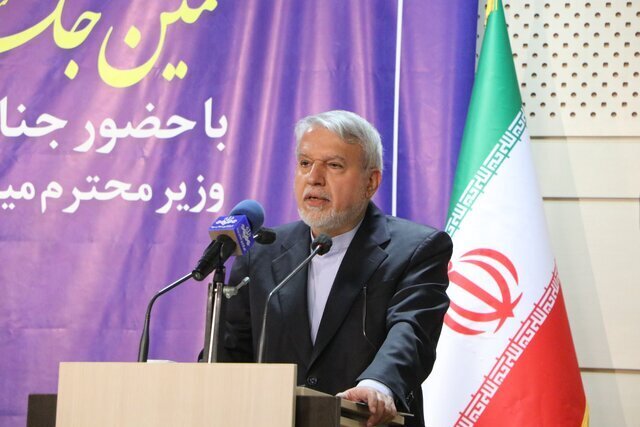
TEHRAN — Iran’s Minister of Cultural Heritage, Tourism and Handicrafts Seyyed Reza Salehi Amiri said Sunday that Iran is currently focused on attracting tourists mainly from neighboring countries.
He highlighted 13 countries that celebrate Nowruz as key target markets, including Tajikistan, Turkmenistan, Uzbekistan, Azerbaijan and Türkiye. Additionally, Iran has prioritized aid to the Persian Gulf states, with a particular focus on Iraq, Kuwait, and Bahrain.
“Before the 12-day war between Israel and Iran began, our goal was to attract 15 million tourists by the end of the Seventh National Development Plan,” he said at a meeting with the heads of the Islamic Cultural Communication Organization and cultural consultants.
He also said that the most important need for Iran’s current society is to create hope. “After the recent 12-day war, our most important task is to generate national pride and social vitality and strengthen attachment to Iran, the regime, the revolution, and Iranian society.”
Salehi Amiri said, “Currently, Central Asia, the Caucasus and the Nowruz region are our country’s main tourism basket.”
Pointing to regional cooperation, he said Uzbekistan welcomes cooperation and the way is open.
He also said that Georgia is also cooperating three times more than before, adding: “The Nowruz region, which includes countries such as Turkey, Pakistan and Afghanistan, is of particular importance. Afghanistan has huge potential that cannot be ignored.”
He said, “Pakistan has deep cultural similarities with Iran and there is a need to review and strengthen cultural cooperation with this country. Also, the restoration of political ties with Egypt has provided a suitable basis for expanding cultural and tourism cooperation. Moreover, Indonesia and Malaysia are also interested in developing religious tourism with Iran, and it is expected that tourism exchanges with these countries will increase in the near future.”
Regarding the importance of the tourism market in East Asia and northern Eurasia, he said that Iran’s share of Chinese tourists is small compared to neighboring countries. “We should increase this share by setting precise targets and focusing on China. Plans to establish a travel services office in this country are also on the agenda. Russia is also an important target destination in the Iranian tourism sector and given the country’s natural capabilities, including desert tourism, tourism cooperation with this country can be expanded.”
He further said, “Social assets are our essential need today, because the driving forces of society are social trust, satisfaction, and people’s participation.”
Pointing to the role of social assets in the era of sacred defense, he said, “During the war, our social assets increased. Today, it is more important to preserve them than to produce them.”
Satisfaction is linked to the concept of efficiency, which is the most basic and urgent need of society that provides hope for the future. ”
Recalling the government’s historical experience during the 12-day war, he said that during wartime, the government distributed more than 1 million tons of essential goods across the country, 1.5 times more than under normal conditions, so that people did not worry about the supply of supplies, but this was the same efficiency approach.
The minister considered the next important point to be national unity, stating that unity does not mean apparent unity, but rather that all capabilities of the country, including cultural capabilities, should be united towards the common goal of Iran’s survival.
Salehi Amiri further stated, “During the past year, we have focused on strengthening the attachment and dependence of the younger generation on Iran and the concept of cultural Iran. We also have an obligation to connect Iran with Iranian communities abroad. The population of Iranians abroad is between 7 million and 9 million people, and for this purpose the Supreme Council of Iranians was established with the mandate of various institutions.”
Emphasizing that unity is an element of political life, he said: “Today we are facing a series of enemies in the political, media and military fields. Therefore, we must focus on strengthening the attachment of Iranians abroad to their homeland.”
It added: “The more Iranian communities abroad can breathe in Iran’s cultural atmosphere and stay connected with Iran, the more capital and expertise will be drawn to the country. The government has decided not to hinder this connection.”
The minister announced the establishment of four specialized working groups in the fields of tourism, education and technology, legal affairs and consular affairs, economy and attracting Iranians to the capital, adding: “If Iranians feel safe, the attraction and return of the capital will be unparalleled.”
Noting that the number of tourists increased by 30% in April and May this year, he said if this trend continues, the number of tourists is expected to exceed 8 million by the end of the year.
“Three scenarios were developed for the current situation, stability and crisis situation, and concrete plans were considered for each. Also, the country’s five-year tourism plan was developed in a 2,000-page format with a national, state and county approach and submitted to the head of the Islamic Cultural Communication Organization.”
He considered attracting the capital a key priority, saying, “We received five major unprecedented incentives from the government: an 80% exemption on municipal fees, zero change of use fees, licensing for mixed-use facilities, and importing 200 items needed by hotels with zero duties and fees.”
In another part of his speech, Salehi-Amiri emphasized the need to rebuild Iran’s image, saying, “The three main factors for attracting tourists are attractiveness, safety and infrastructure. 85% of tourists who visit Iran return with a positive image of Iran.”
Noting the importance of advertising, he said: “A large-scale production of trilingual content has begun and will be made available to cultural consultants. We must use all our abilities and cross common lines so that we can all work as one for Iran.”
Salehi Amiri concluded: “The Ministry of Cultural Heritage supports all programs carried out in the targeted countries in the field of tourism and interaction with Iranians living there. If some of the capacities of the Islamic Cultural Communication Organization are strengthened in this direction, we will witness a positive development of Iranian tourism.”
KD