
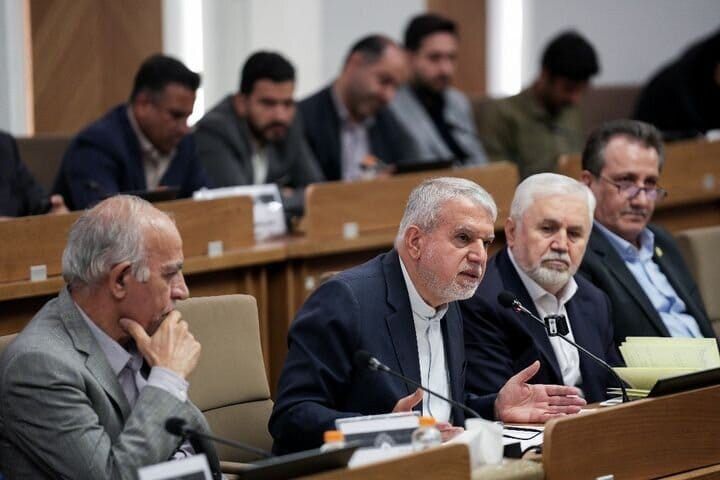
TEHRAN — Iran’s future development will be through the maritime economy, said Minister of Culture and Heritage Reza Salehi Amiri.
The Iranian president spoke on Monday at a joint meeting to coordinate the implementation of the general policy of maritime development, attended by representatives of the Iranian president and governors of the country’s coastal provinces, and stressed the strategic importance of the coast in the future of Iran’s economy, IRNA reported.
He said that from a strategic perspective, the government has made the transformation of coastal states one of the mainstays of its national development plan.
“The development of a nation is impossible without paying attention to the sea. Currently, all branches of the government believe that Iran’s future depends on the development of the country’s northern and southern coasts.”
He said the government’s plan is based on balanced development, focusing on local capacity and creating sustainable jobs in the coastal provinces. He added that the sea is not only an opportunity for Iran, but also a civilizational advantage that must be exploited with careful planning and national perspective.
Noting the low share of marine tourism in the country’s economy, he said that while in many developed countries around 30% of tourism revenue comes from the sea, Iran’s share remains less than 2%. “This indicator needs to improve and we have developed a comprehensive plan that includes both the country’s coastal areas and islands.”
Pointing out the need to form mixed tourism in the country, Salehi Amiri said, “Iran is an exceptional country that encompasses everything from the sea to the forest to the desert. Plans for mixed tourism development are based on nature and culture.”
He highlighted the government’s development-oriented approach to tourism, adding that the government is deliberately increasing financial resources for the tourism sector, including allocating $340 million to complete more than 2,700 outstanding projects across the country.
He said these resources are provided by the Central Bank of Iran, the National Development Fund and the banking network and can be used for priority projects in each province.
He said tourism is one of the main pillars of the country’s non-oil economy, noting that $25 million of facilities were provided in this sector last year and this year the amount has increased. This trend shows that the government’s view of tourism is strategic and forward-looking, he added.
Referring to support plans for handicraft and ecotourism activists, the minister said that in the memorandum of understanding with the Mosta Zafan Foundation, 17,500 handicraft units and special facilities at ecotourism resorts are planned, which will provide employment to more than 26,000 people.
He emphasized the need to form a coherent structure in the development of coastal tourism, saying: “To achieve the goal of marine-oriented development, three principles need to be taken into account: firstly, special consideration to environmental requirements, secondly, the provision of long-term facilities to attract investors, and thirdly, inter-agency cooperation. Inter-ministerial coordination will ensure the realization of this path.”
Referring to the unique potential of the coastal provinces, Prime Minister Salehi-Amiri said: “The regions of Makran, Chabahar, Hormozgan, Bushehr and Khuzestan have the potential to become the country’s major tourism and economic centers. From the Chogha Zambir civilization in Khuzestan to the pristine beaches of Makran, from the beautiful islands of the Persian Gulf to the forests of the Caspian Sea.” — All these are possibilities that must be turned into national opportunities within the framework of a coherent program. ”
Ali Abdulalizadeh, Presidential Representative for the Coordination of the Implementation of General Policy on Marine Development, also emphasized that development is the basis of effective governance, adding that countries facing challenges in progress are lagging behind not because of lack of capital, but because of weak institutional building. “In the past year that I have been in charge of maritime development, I have realized more than anything the importance of system building. This is because the value of system building is greater than any concrete investment.”
He revealed that “the first regulation we developed at the Maritime Development Secretariat was on the separation of ships and ships to systematically resolve existing differences between enforcement agencies. This measure was an important step towards establishing administrative and technical discipline in the maritime field.”
Emphasizing the need for inter-institutional coordination in the development process, he said: “More than 30 institutions are active in the field of transport and marine tourism. Our goal is to create institutional links between these institutions.”
Abdulalizadeh further added: “To prevent the dispersion and duplication of activities on the Makran coast, we have initiated two fundamental measures: the first is the drafting of regulations on the construction and operation of marinas, and the second is the design of marine tourism corridors in line with special logistics regulations. These measures will lay the foundation for a new order in marine-based tourism management.”
Referring to the unique natural resources of the country’s southern coast, he continued: “There are unique areas on the Makran coast, such as ‘Ger Feshan’, which have not yet been officially registered and documented. These areas are Iran’s natural heritage and should be recognized and protected as part of the national assets.”
He further added that the natural beauty of the Makran coast and the islands of the Persian Gulf is part of Iran’s cultural and natural identity. “When planning, the concept of the coast must be scientifically redefined to prevent non-expert intervention. All development actions on the coast must be carried out in accordance with environmental requirements and respect for nature.”
He emphasized the need to focus on the natural and cultural beauty of Makran, saying that Makran is a symbol of Iran’s natural beauty and unspoiled tourism capabilities.
“These opportunities should not be ignored. Any action that helps strengthen Makran’s position in national development should be seriously pursued.”
KD