
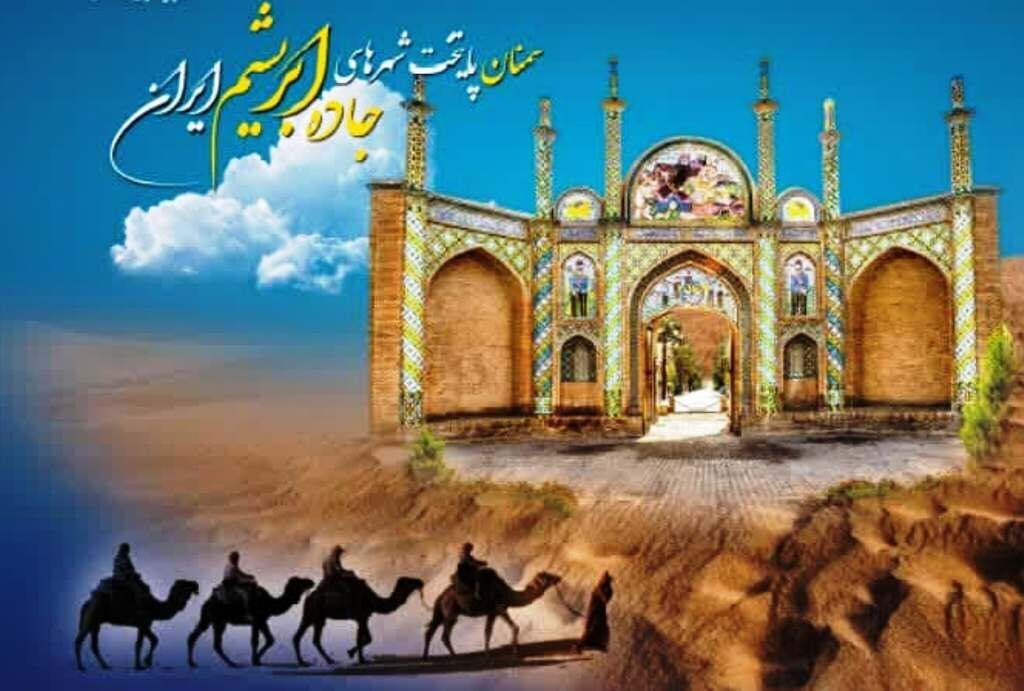
TEHRAN – The heritage of the ancient Silk Road is a living cultural ecosystem that has received special attention from UNESCO, said the Director-General of the UNESCO Tehran Cluster for the Protection of the Intangible Cultural Heritage of West and Central Asia.
Speaking at the first Semnan International Tourism Conference titled “Silk Road: Opportunities and Prospects” held at Semnan University on Wednesday, Atousa Momeni added that actions born from the heart of local communities will contribute to the sustainability of living heritage, IRNA reported.
He continued that the UNESCO Regional Center in Tehran focuses on networking between living heritage holders, researchers, universities, local governments and the UNESCO family so that the exchange of experiences leads to joint policy decisions.
Emphasizing that the Silk Road is the path to a common future, she said, “The world, currently suffering from the disconnect between humans and nature, science and life, politics and culture, needs to return to the wisdom of living along the Silk Road.”
Momeni said the Silk Road is not just a route to trade goods, but a route to exchange meanings, a living bridge between nations and cultures where the spirit of humanity’s living heritage still flows.
She added that the Silk Road cannot be defined by a silent geographical map, but should be seen within a living cultural ecosystem that still flows through people’s lives.
Momeni added that the Silk Road is a caravan of knowledge, faith and art that never stops moving and remains a bridge between past and present, nations and cultures. She revealed that culture is rooted in subsistence wisdom, neighborhood ethics, and peace.
She said the Silk Road was a historic route from Xi’an in China to Samarkand and Bukhara, from Herat and Neyshabur to Tabriz, Isfahan and Konya, creating living connections between peoples, religions and cultures.
The United Nations Association of Tourism Cities along the Silk Road has 40 member cities, half of them in China and the other half from other countries along the Silk Road, including Semnan as the association’s sole Iranian representative. According to the report, 39 cities in Iran are located on the Silk Road, with Semnan occupying the longest stretch of the road, approximately 600 kilometers. In addition to the prefecture’s unique ancient heritage, which is expected to be on the global list, the numerous monuments listed on the national list are another criterion for selecting the city as a member of the International Union of Tourist Cities along the Silk Road.
Semnan province, located in north-central Iran, is characterized by a combination of desert and forest landscapes and has historical significance as part of the ancient Silk Road.
The region’s cultural heritage and diverse geography make it a focus of Iran’s tourism development efforts.
The ancient Silk Road has existed for thousands of years and has passed through empires, kingdoms, reigns, and societies throughout history. At certain times throughout history, merchants were free to travel along these routes, while at other times travel was difficult or dangerous.
According to UNESCO, the Silk Road enriched the countries it passed through, carrying cultures, religions, languages, and, of course, goods to societies in Europe, Asia, and Africa, connecting them all with a common thread of cultural heritage and multiple identities. Today, more than 40 countries exist along the historic land and sea Silk Roads, all of which still bear witness to the influence these routes have had on their cultures, traditions and customs.
Travelers along the Silk Road were attracted not only to trade but also to the intellectual and cultural exchanges that took place in the cities along the route, many of which developed into centers of culture and learning. In this way, science, art, literature, crafts, and technology have been shared and disseminated in society along these routes, and languages, religions, and cultures have developed and influenced each other.
KD