
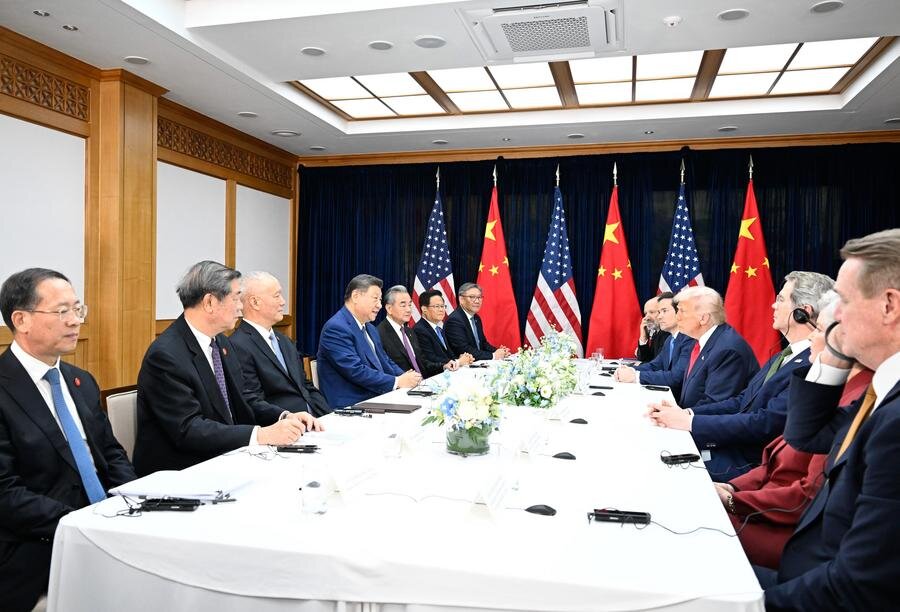
BEIJING – On the morning of October 30, the world’s attention focused on Busan, South Korea, where Chinese President Xi Jinping held a long-awaited meeting with US President Donald Trump. This high-level dialogue was quickly recognized by the world as a monumental event, at a critical juncture for both bilateral relations and the global economic outlook.
The Busan dialogue was more than just a political photo opportunity. It was a necessary readjustment. In his remarks, President Xi Jinping provided a clear assessment of the current situation and provided a template for future stability.
He acknowledged that since President Trump’s inauguration, the two countries have maintained important contacts through “three phone calls and numerous exchanges of letters,” and that this is an ongoing channel of communication that is essential to “jointly guiding China-US relations to maintain overall stability.”
This frequent, direct contact, often away from the glare of daily media skirmishes, is the essence of head-of-state diplomacy and provides the strategic stabilizer needed to weather the inevitable storms.
The “compass and anchor” of strategic guidance
The fundamental value of this top-level engagement lies in its ability to provide top-level design and strategic guidance. It provides the “compass and anchor” of the relationship.
Importantly, progress had been made on the economic front prior to this meeting. Bilateral economic and trade teams had reached “agreement in principle” in Kuala Lumpur days earlier to resolve key concerns. This seemingly technical detail is actually the clearest evidence of the effectiveness of leadership summits.
When economic tensions threaten to overwhelm a relationship, only a direct political mandate from the top can give negotiators the momentum they need to break through. President Xi acknowledged as much, saying the agreement “provided the necessary conditions” for the Busan talks themselves.
President Xi’s frank assessment of the inherent friction between the world’s two largest economies was particularly illuminating. He said that because of the different national circumstances, “some differences are inevitable, and it is normal for friction to arise from time to time.”
Normalizing this conflict is not about accepting decline, but rather a mature recognition of reality. However, the important point was his call to action that both presidents must act as “helmsmen” who “grasp the direction and steer the overall situation in order to ensure the stable navigation of the great ship of China-US relations.” This powerful maritime metaphor emphasizes the paramount importance of crisis management and strategic foresight over tactical posture.
From conflict to “mutual success and common prosperity”
The most positive aspect of the Busan Dialogue was President Xi’s attempt to redefine the competitive nature of the relationship. In a strong strategic shift, he stressed that President Trump’s goals of China’s development and rejuvenation and “Make America Great Again” are not mutually exclusive. Instead, he asserted that the two countries “are fully capable of achieving mutual success and common prosperity.”
This is a fundamental negation of zero-sum thinking. By urging the United States and China to be “partners and friends,” Xi emphasized their long-term historical obligation and the need for today’s cooperation. This vision goes beyond the transactional nature of trade disputes and frames the relationship not as a struggle for control, but as a joint project for global benefit.
This kind of leadership is desperately needed, as the response from the global business community confirms. As APEC National Center Director Monica Hardy Whaley rightly pointed out in an interview with CGTN, “The fact of the meeting and open communication is very positive…It’s a big step forward in some ways for me.” Businesses are subject to a roller coaster of uncertainty caused by tariffs, export controls, and the constant threat of trade wars. A recent World Trade Organization estimate that dividing global trade into competing blocs could shrink global GDP by nearly 7 percent in the long run is a stark warning that this uncertainty is exhausting at best and devastating at worst.
The reality on the ground suggests that tariffs were a bad strategy, even for the United States. The rebound in year-over-year CPI inflation and surveys showing American households paying significant additional costs highlight the self-inflicted nature of the tariff debacle. The logic is clear. The current path is unsustainable.
A call for global responsibility
For the ceasefire to last and for the economic structures of the world’s two largest economies to transition without conflict, what is needed is not short-term tactics but a coherent long-term vision. China’s recently released public recommendations for its next five-year social and economic development plan, which emphasizes high-quality development and a high level of opening-up, demonstrate this long-term commitment. This vision seeks mutually beneficial prospects and aims to make the pie larger and more inclusive.
This brings us to the last important element of the Busan conference: the call for shared global responsibility. President Xi acknowledged President Trump’s efforts on regional hotspot issues and emphasized China’s sustained efforts in “promoting peace negotiations.” His final appeal was that while the world remains fraught with complex challenges, the United States and China must “jointly demonstrate great power responsibility” and work together on more “big, real, and beneficial things for both countries and the world.”
This mission to unite and act on a commitment to common prosperity is where real change will occur. It’s about building a healthy ecosystem where cooperation and friendly competition can coexist, fostering more winners along the supply chain, from bean farmers in the United States to international students around the world.
The Busan talks, led by the “helmsmen” of both countries, not only temporarily eased tensions, but also provided strategic confirmation that the two countries must and can work together. With clear policy direction, head of state diplomacy has once again given the world a more hopeful outlook and a healthier heartbeat.
Jianlu Bi is an award-winning journalist and current affairs commentator based in Beijing. His research interests include international politics and communication. He holds a PhD in Communication Studies and a Master’s degree in International Studies. He has also contributed to SCMP, Foreign Policy In Focus, TRT World, Eurasia Review, International Policy Digest, Modern Diplomacy, IOL, The Citizen, and others.
This article reflects the author’s opinion and does not necessarily reflect the views of Tehran Times.