
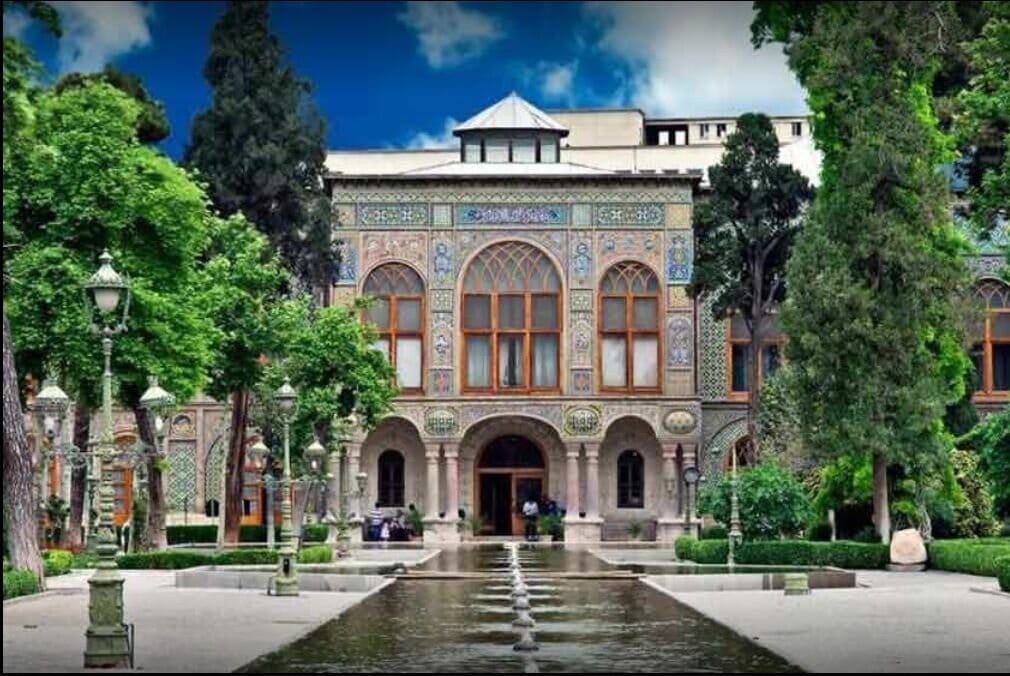
TEHRAN – Restoration work on the historic aqueduct at Tehran’s UNESCO World Heritage Site Golestan Palace is set to begin for the first time in 13 years, as part of efforts to revive the traditional geometric patterns of Persian gardens.
The north-south flow, also known as the Naseri Canal, named after the Qajar ruler Nasser al-Din Shah, was last repaired in 2012 using non-standard methods and then abandoned, IRNA reported on Monday.
Officials said the new restoration aims to conceptually recreate the flow of water and restore the original spatial design of the palace gardens.
Ali Omidari, an expert on the world heritage site Golestan Palace, said the restoration plan was drafted in 2024 and approved by the site’s management committee and technical council.
“The original qanat that fed the canal has dried up, so the restoration will be symbolic, using circulating water to recreate the sense of flow and preserving the central geometry of the garden,” Omidari told IRNA.
He said the canal will contain about 50,000 liters of water at a shallow depth of about 10 centimeters. To conserve resources, fountains within the palace have also been restored, including the Palazzo de Armas fountain, which was restored using the latest sealing techniques earlier this year.
“The Nasserie Canal forms the core of the layout of the Persian Gardens,” Omidari said. “Restoring the geometric order, planting climate-adapted species and restoring the garden axis are key elements of this project.”
Golestan Palace Director Afarin Emami said the complex still uses historical wells to irrigate green areas. After the canal is repaired, some of the well water will be returned to the canal for aesthetic purposes, she said.
Emami added that during the summer, when the water level in the wells drops, the city of Tehran will provide additional water in tankers. She said the site has stopped using chlorine for water purification and smart irrigation research is underway in collaboration with the Ministry of Culture and Heritage, to allow water to be recycled naturally within the garden.
According to Emami, the project will allow Golestan Palace to restore some of its historical buildings and symbolically revive the concept of a Persian garden in the center of Tehran.
Located in the heart of Tehran’s historic center, this palace complex is one of the oldest palaces in the city and was originally built during the Safavid period within the historic walled city. Over time, it underwent several expansions, giving it its most distinctive features in the 19th century. In the 19th century, it was designated as a royal palace and seat of power by the Qajar ruling family. Today, the Golestan palace complex consists of eight main palace buildings, primarily used as museums, the eponymous garden, and a central green area surrounded by a gated exterior wall.
The complex embodies the architectural and artistic achievements of the Qajar period, including the integration of European motifs and styles into Persian art. As well as being the seat of government for the Qajar kings, it also served as a residential and recreational facility and a center of artistic production in the 19th century. Through these activities, it became a major source and center for art and architecture in Qajar province.
Golestan Palace provides unique and rich evidence of the architectural language and decorative arts of the Qajar period, particularly reflecting the legacy of Nasser al-Din Shah. The palace displays European-inspired artistic motifs along with Persian traditions, representing some of the earliest examples of a combined European-Persian style. This fusion became a hallmark of Iranian art and architecture in the late 19th and 20th centuries, and parts of the palace complex were considered the foundation of the modern Iranian art movement.
morning