
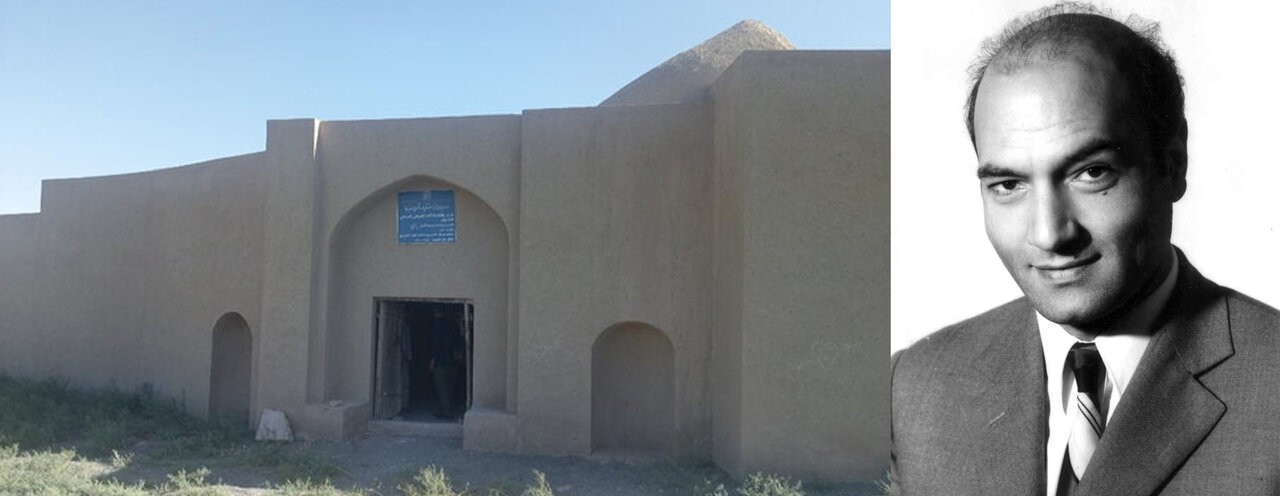
TEHRAN – The house of the late Dr. Ali Shariati, a 20th century Iranian revolutionary and sociologist famous for his research in the sociology of religion, has more than just a historical monument, Governor Davarzan said.
Hassan Qorbani pointed out that the building has the potential to serve as a cultural hub to introduce tourists and researchers to the rich history and traditions of Davarzan, Khorasan Razavi province.
ISNA reported on Monday that while visiting Dr. Shariati’s historical residence in Kahak village, Qorbani stressed the need to preserve the site as a cultural and identity landmark of the city.
Dr. Ali Shariati, one of Iran’s most prominent contemporary thinkers, said that he has had a profound influence on people’s social and cultural thought throughout his life.
He pointed out that Dr. Shariati’s House, known as a symbol of the thoughts and life of this great thinker, is not only considered a historical monument, but also provides a gathering space for people interested in Dr. Shariati’s works and thoughts.
Mr. Qurbani considered the preservation of this house very important, adding that he considered the preservation and restoration of Dr. Shariati’s house to be a national and cultural obligation.
Commenting on the current condition of the building, the governor said that the worn texture and collapse of some of the walls and ceilings create an alarming situation and that the problem requires immediate and professional attention.
He said the building must be seriously preserved, adding that restoration of this priceless work must be prioritized to prevent further destruction.
Mr. Qurbani pointed out that Dr. Shariati’s house could serve as a cultural and educational center, providing a suitable space to hold workshops and exhibitions related to Shariati’s works and ideas. “Reviving this space will allow new generations to benefit from his ideas and participate in cultural and social discussions.”
He also pointed out the importance of producing a comprehensive report on the current situation and estimating the cost of restoring the monument. “This report will be sent to the relevant state and national administrations in order to provide funding and start restoration work as soon as possible. This measure will be an effective step in the protection and restoration of this historical monument and will be a good opportunity to attract the attention and support of various institutions.”
Mr. Davarzan continued that attracting tourists to this place can help the economic and social development of the region, as well as raise public awareness of Dr. Shariati’s ideas and their importance.
He stressed that focusing on Dr. Shariati’s house will not only help preserve the historical monument, but also strengthen the cultural and social identity of Davarsan district.
“Given the various threats endangering cultural heritage, it is imperative that we all pay special attention to this issue and strive to protect these historical and cultural monuments.”
“Dr. Shariati’s House, as a symbol of Iranian thought, should be prioritized in the cultural and social programs of Davarzan County so that we can properly protect it and pass it on to future generations,” Qurbani said.
The historical monument of Dr. Ali Shariati’s home and birthplace in Kahak village, Davarzan District, was inscribed in the National Heritage List of Iran with number 9591 in 2003.
Dr. Shariati is known as a cultural and social figure whose ideas have had a profound impact on the modern history of the country.
Dr. Shariati’s origins can be traced to the village of Majinan, 80 kilometers west of Sabzevar, but he was born in the village of Kahak. The village is not only known as the birthplace of this great thinker, but also has special significance due to Dr. Shariati’s family and cultural ties to the region. His birthplace is now a historical and cultural monument that requires attention and protection.
KD