
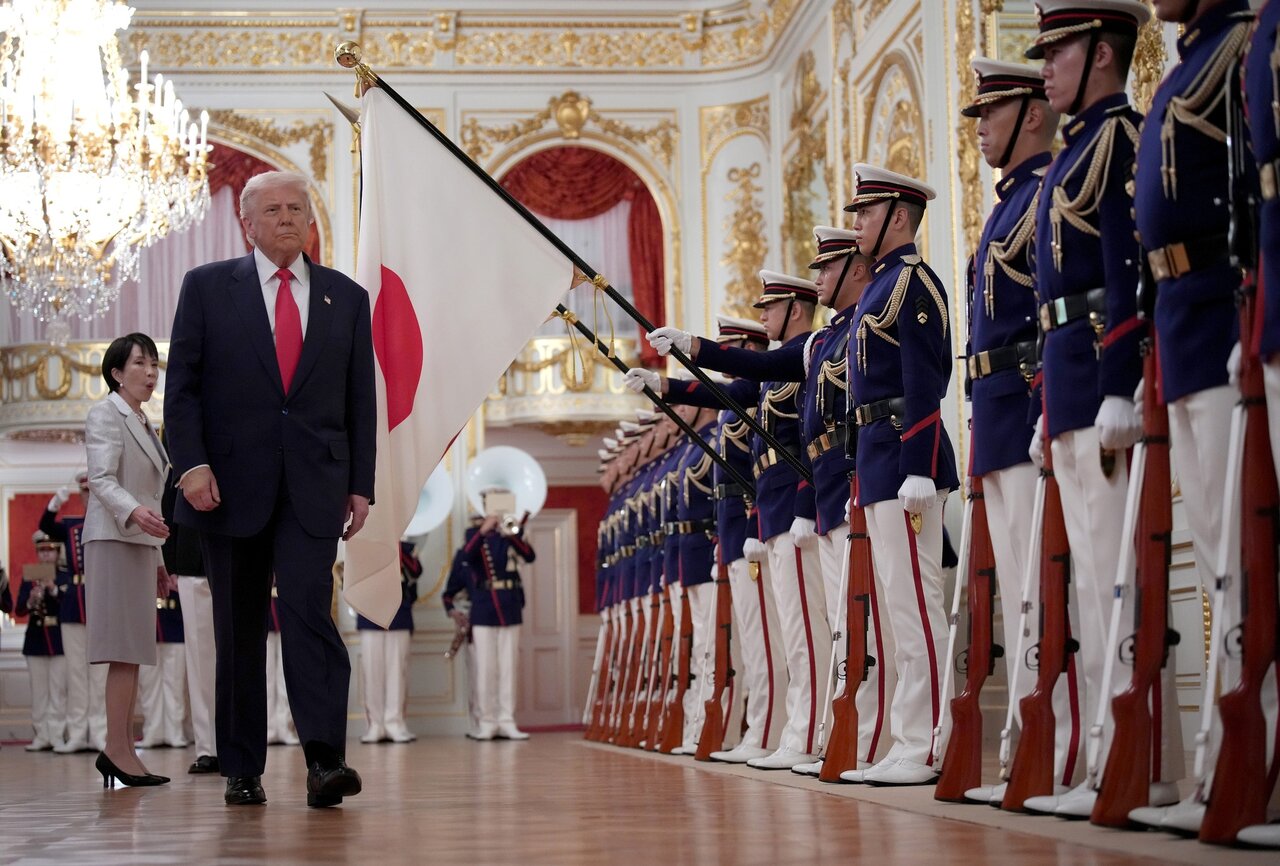
Tehran – The spectacle is on point. Fighter jets escort Air Force One. Prime ministers arrive with golf specialties and gold leaf baubles. Foreign leaders are orchestrating airport contests to protect Donald Trump from protesters, not to honor the partnership but to appease a disposition that values praise over advice.
The Journal has dubbed this a “hospitality arms race,” and the term captures an alarming truth. Today, in diplomacy with the United States, the prize is not who can create lasting policy, but who can make the most gilded display.
Shinzo Abe’s old strategies – sumo shows, custom trophies, glamorous attacks – have metastasized into a global formula.
Japan’s new Prime Minister Sanae Takaichi, though clearly nervous, followed the script, presenting Trump with a putter and gold-foil golf ball once used by Prime Minister Abe, and tying the visit to generous investment and defense pledges, an optical exercise designed to flatter and pave the way for substantive concessions.
At the White House signing ceremony for the Armenia-Azerbaijan peace agreement, Ilham Aliyev and Nikol Pashinyan competed for praise, praising President Trump as “the only architect of peace.”
Israel’s Benjamin Netanyahu has long refined his skills at exploiting Washington’s vanity. At a White House dinner in July, he theatrically presented Trump with a framed “Peace Prize Nominee” and declared him a man who would “build peace in one nation after another.”
This farce was repeated at the Sharm el-Sheikh summit in October. Pakistan’s Shehbaz Sharif passionately said that Trump was “the most sincere candidate for the Nobel Peace Prize” and a “true man of peace.”
President Trump then glowingly repeated Sharif’s remarks at rallies as proof of his “world respect”, unaware that his remarks had provoked ridicule in local newspapers.
“The prime minister said to me, ‘Mr President, you saved millions of lives. You prevented the Indian war from turning into a nuclear war.'”
The pattern continues at home. At a White House tech dinner, Meta’s Mark Zuckerberg announced $600 billion in AI investment “inspired by President Trump’s leadership,” but was caught getting heated on the microphone and tweeting, “I didn’t know what number I wanted.”
This slip revealed what this new era of flattery demands. The inflated numbers and empty praise were offered not to shape policy but to placate a presidency that confuses flattery with success.
Such gestures are not some strange ritualism. They are leverage, soft auctions where accolades are entry fees to commercial and strategic benefits.
That choreography does three things. Conceal, redirect, and destroy.
It remains hidden as the tightly staged visit keeps protesters, watchdogs and tough questions at bay. Headlines about “historic” handshakes are distracting because they often precede procurement and investment commitments that benefit narrow contractors. And it is corrupting, as the access secured through personal flattery increasingly funds private enterprises tied to Mr. Trump’s circle.
The recent surge in World Liberty Financial’s token sales (largely owned by Trump’s family) and large investments in Abu Dhabi illustrate the point: What appears to be a private innovation can also serve as a geopolitical influence vector that overlaps with the president’s support.
The domestic consequences are clear. When the tone of the White House’s foreign policy matches deals that enrich allies or families, the guardrails come undone.
High-profile crypto trades, chip export relief, and President Trump’s sudden pardon of Binance’s Zhao Changpeng are reportedly linked in a pattern where policy shifts and capital flows appear more rewarding than coincidental.
It’s not the usual give and take in diplomacy. It is a market where individual loyalties and private interests shape the behavior of states.
This stance will be on display at the C5+1 summit on November 6, when the presidents of Kazakhstan, Kyrgyzstan, Tajikistan, Turkmenistan and Uzbekistan will visit Washington.
It is expected that the summit will first be constructed as a play. Photo ops, symbolic gifts and promises may read well in press releases, but the terms of implementation and procurement remain vague.
This gap is where leverage turns into exploitation, where local dictators can trade rights and income for headline-worthy commitments.
Even more serious damage is reputational and institutional damage. So-called superpowers that allow their diplomacy to be shaped by vanity and private wealth lose moral authority and suffer humiliation.
This deterioration is not only embarrassing, but also dangerous. National strategy is being hollowed out into a market of gilded favors, where flattery buys access and access buys policy.